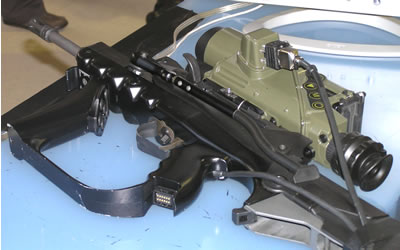
Surefire’s Rebuttal to Force Science News Claim that Grip Activated Lights are Unsafe.

As a courtesy to Surefire LLC, I’d like to publish their rebuttal to statements made by Force Science News regarding the safety of grip activated lights. These claims are typical of organizations that lack the experience and advance conference room arguments.

Surefire’s Response in its entirety.

Recently an article appeared in an email newsletter distributed by the Force Science News of the Force Science Institute, quoting its own Dr. Lewinski. The article and Dr. Lewinski make several troubling assertions that must be rebutted in the (long-term) interest of officer safety. The gist of the article and Lewinski is that grip-activated pistol-light switches are unsafe. I paraphrase (to clarify), quote, and respond to some of the more disturbing assertions below.

1) You cannot train officers to keep their finger off the trigger under stress. According to the article, “…despite training to the contrary, officers in high-stress situations tend to move the finger onto the trigger…”

Response: If true, this has nothing to do with grip-switches, but it would support a ban on the use of firearms in general. But obviously, it is not true; officers can be trained to keep their fingers off the trigger in high-stress situations. If the fact were otherwise there would be thousands of unintended discharges each day.

2) The device is unsafe. The article states, “At least twice in recent months the device has been associated with shootings in which officers reportedly said they thought they were turning on the flashlight…”

Response: In 1986 SureFire introduced the first light designed specifically for mounting on handguns. This light (equipped with remote switching) was quickly adopted by SWAT teams, including LAPD’s D-Platoon. In 2004 SureFire introduced the current X-Series WeaponLights, intended primarily for attachment to handguns. There are well over 100,000 SureFire X-Series lights and tens of thousands of optional grip-activated “DG” and “SL” switches in use today, and our competitors have sold hundreds of thousands of other pistol-mountable lights themselves. During this 24-year period the only reported safety-related incidents involving such lights are the two incidents mentioned above. These figures alone prove that SureFire WeaponLights, and weapon-mounted lights in general, are safe.

3) According to the article, Lewinski asserts that, “…an officer pressing his middle finger against the flashlight switch pad will produce a sympathetic reaction in the index finger. If that finger happens to be inside the trigger guard and on the pistol’s trigger, the reaction may be forceful enough to cause an unintentional discharge.”

Response: Sympathetic Response is a real phenomenon, but it’s not the boogeyman and it can be addressed with training. Think about it: our trigger finger doesn’t magically pull the trigger when we use our thumb to manipulate the safety or the magazine release. Nor does the trigger finger unconsciously jump into action when we use our opposite hand to activate our radio, handheld flashlight, or pepper spray. The answer to Sympathetic Response is training and adherence to Rule #2 of The Four Basic Rules of Firearms Safety: Keep your finger off the trigger until your sights are on target and you are ready to fire.

And please note, if an officer experiences Sympathetic Response while his or her finger is on the trigger when it shouldn’t be there, it would not matter which light switch the officer is using, or whether the officer has a weaponmounted light at all. The point is, the officer’s finger is on the trigger when it shouldn’t be there.

4) The article quotes Lewinski as saying, “When you think you’re doing one thing but are actually doing another, the result often is directly opposite of what you intended.”

Response: I believe he is referring to the phenomenon of reverting (under stress) from an intended action (activating the grip switch) to another action (pulling the trigger).

Let’s borrow Lewinski’s own analogy of drivers stepping on the gas pedal when they meant to step on the brake pedal. Can this happen? Of course, it’s called a mistake. Does every driver do it? No, in fact, most do not. Do trained drivers-such as highway patrolmen, or professional racecar drivers-make this mistake? No, not in any number that is statistically significant. Again, the issue here is training. You cannot make officers safer by taking away their equipment-you must provide them with adequate training.

Dr. Lewinski lists research as one of the services he provides. Yet-with the newsletter in question-he has published what most would assume to be a professional opinion-based on just two isolated incidents (out of 24 years of safe use) that he read about in news reports, incidents that are still under investigation and that he is not privy to at this time. While he may have conducted legitimate research regarding human dynamics during deadly force encounters, he does not appear to have done any research particular to SureFire products or the use of weapon-mounted lights. For that reason alone I find the article to be unprofessional and certainly not qualified to stand as an expert opinion.

I assume Lewinski is acting out of a real concern for officer safety-and not to generate future engagements as an expert witness. But I fear the article may actually have the opposite effect by frightening some administrations into depriving their officers of crucial safety tools. Regardless, Lewinski’s opinion is just that.

The greater issue is whether officers are provided adequate training to ensure they can safely use the tools they have. To address that issue I have attached a separate document, unconcerned with Dr. Lewinski’s opinions, entitled, Officer Training for Low-Light Conditions: A Matter of Life and Death.

It should be noted that Force Science News is a communications vehicle for the Force Science Research Center, of which Lewinski is the executive director. Quoting yourself in your own publication and referencing your own studies is questionable at best. And finally, the article ends with this statement: “Lawsuits have been filed in both shootings.” For clarification, SureFire has not been named in those lawsuits.

Respectfully,

Derek McDonald
Vice President of Marketing, SureFire

Relevant experience includes but is not limited to:

U.S. Navy Gunners Mate “A” and “C” schools
U.S. Navy Small Arms Instructor / Range Master
P.O.S.T. certified instructor of Officer Survival in Low-Light Conditions
SureFire Institute founding instructor cadre member
NRA Law Enforcement Tactical Handgun Instructor
Simunition Scenario & Safety Instructor
Hundreds of hours providing training to, and conducting informal interviews of, law enforcement officers with regard to lethal-force encounters, specifically as it relates to the use of low-light tactics and lighting tools
Posted in Uncategorized | Comments Off on Surefire’s Rebuttal to Force Science News Claim that Grip Activated Lights are Unsafe.

Hohenstein Institute – Comments on the Thermophysiological Properties of Sleeping Bags

The Hohenstein Institute is located a few kilometers north of Stuttgart. The Institute is a well-recognized interdisciplinary research facility. They’re also actively involved in the testing of textiles – testing and measuring the efficacy of these materials for specific applications.

In a press release dated March 15, 2011 titled ” Even Soldiers Have To Sleep: Thermophysiological Properties of Sleeping Bags” they address the European standard EN 13537; commenting on its applicability and potential adaptability to military applications.

The authors make a number of statements to the effect that users of sleeping systems should know the operating temperature range, which seems fairly obvious.

They also comment on the anthopometric differences between the average camper and a soldier operating in the field.

I think the point being made is that current standards, EN 13537 and EN 15537, do not fairly represent military requirements. However, in their view, the standard can be expanded or modified to take into consideration the physical and physiological differences between commercial and military use.

Posted in Sleeping Systems | Tagged , | Comments Off on Hohenstein Institute – Comments on the Thermophysiological Properties of Sleeping Bags

FN Black Box – How does it work and is it up and running?

Part of the alleged reliability issues with the M4 carbine seem to stem from the absence of a systematic preventative maintenance program. Individuals change oil in their vehicles at 3 months or 15K miles, take the vehicle back to the servicing dealer for a periodic maintenance based on elapsed miles. We do that to ensure that catastrophic failures are prevented.

Weapon systems, require the same systematic approach and judicious field maintenance if they are to function reliably, so when FN announced the “Black Box”  I felt it would provide the same functionality as an odometer; opening the door to a more systematic approach to weapon maintenance.

I recently reached out to FN for some details on the Black Box. I specifically requested that they not disclose proprietary information. Below, I’ve listed my questions with FN’s response.

FOG HORN: With regards to the Black Box’s operation. Is it acoustic or impulse (meaning that it detects the operation of the rifles action)?

FN: The FN Black Box uses a proprietary process that makes it independent of the recoil level; it is based on the analysis of the dynamic signature of the rifle.  It has a bidirectional communication interface and can store maintenance operation data. Except for recording maintenance operations, it requires no operator input or action.

FOG HORN:  I assume that it can be programmed for the weapon’s serial number.

FN: Yes

FOG HORN: How much data can it collect and is it stored in a circular file. If memory is full what happens?

FN: The FN Black Box is a molded module that features a non-replaceable battery with a recording capacity of 100,000 rounds. When the FN Black Box needs to be replaced, all data recorded on the FN Black Box can be saved so no data gets lost.

FOG HORN: Who is using them and in what quantities?

FN: Product currently under development.

FOG HORN: Is there a PC based application that collects the data., correlates it and provides analysis or diagnostic reports?

FN: A Data Collection Device (DCD) has been developed. It can reactivate the FN Black Box (in standby mode when not firing), read and/or download the data stored on the FN Black Box. An armorer software, currently under development, will allow analyses to be carried out for maintenance purposes, etc.

FOG HORN: Do you have a sample of the software and a shot counter that I could take a look at?

FN: Not currently.

I’d like to see the Black Box implemented and operational system wide because it’s the only way to ensure that critical system components are serviced or replaced using a systematic approach based on manufacturer’s RCBF (round count between failure) for all system components. Without a system in place that makes a proactive maintenance schedule feasible reliability issues will continue to be issues regardless of the weapon system.

I want to thank the folks at FN for helping us out with our query.

Posted in Black Box, Weapon systems | Comments Off on FN Black Box – How does it work and is it up and running?

Suppressors – Current State of Technology Part 4

In Part 3 of Suppressors – Current State of Technology, I talked about the importance of the mount. Single point mounts v. two point mounts and quick attach / detach.  The take-away is the overshadowing requirement that whatever mounting arrangement you choose it secure the suppressor to the weapon and maintain suppressor to weapon concentricity under all operating conditions.

In Part 4, I’ll take you through the unique characteristics of pistol caliber suppressors and dispel some ridiculous notions.

Nothing conjures up images of sinister spies and hitmen running about the country side whacking people than a suppressed pistol, and Hollywood has, once again, convinced us that these devices are the tools of clandestine operators and assassins. Take for example agent Jack Bauer, in 24, played by Kiefer Sutherland, operative extraordinaire at the Counter Terrorist Unit based in L.A., of all places. Agent Jack’s favorite interrogation technique is to use a suppressed SIG to shoot the suspect in the kneecap. Well, I suppose if he weren’t doing that he’d be running around Atlanta’s Caribou Coffee Houses with, dad, Donald Sutherland.

Even more interesting than agent Jack is the concept of a suppressed revolver. How many times have you seen films where good and bad guys used suppressed revolvers? Suppressing a revolver has the same tactical advantage as installing a pay-toilet in a diarrhea ward.

Although manufacturers have gone to the extreme in making available tons of information dealing with suppressor technology, I still get 3 or 4 question a quarter from people asking what suppressor they should use with their S&W .38 special. That’s the power of misinformation.

The reality is that suppressors are not evil nor sinister, and many countries in the EU require sport shooters and hunters to use suppressed weapons.

Alright, so why can’t revolvers be suppressed? The reason a revolver cannot be effectively suppressed is that there’s a huge gap between the cylinder and the barrel, which allows hot gases to escape. The Russian made Nagant, M1895, is the only revolver that can be effectively suppressed. It uses a Belgian design that forms a gas seal between the cylinder and the barrel. When the hammer is cocked the cylinder moves forward creating a seal with the barrel, hence it can be suppressed. This made it popular with KGB operators and it was used throughout the Cold War era. Unless you own a Nagant M1895, please get over your desire to suppress your revolver.

I’d like to deal for just a moment with the sneaky clandestine reputation, and a picture is worth 1000 words.

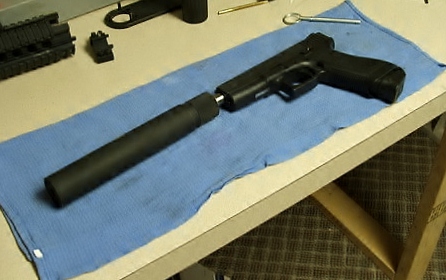
Suppressed Glock 17

 Allow me to call your attention to the bench’s leg, which is 1 inch stock. Using that as a reference we see that the suppressor has effectively added, approximately, 10 inches to the pistol’s 7.6 inch overall length; unless you’re planning to stick it down your left pant leg, and change your name to Disco-Duck, it’s not a real stealthy weapon. In fact, the system is so long that if you were using an isometric hold you probably wouldn’t be able to turn around in a narrow corridor.

Alright, let’s talk about the unique characteristics of pistol mounted suppressors.

The vast majority of pistols sold today are blow-back operated fixed barrel or Browning style actions where the barrel is unlocked and allowed to tip up. For example, SIG, Glock and 1911 pistols all use the Browning action. The barrel unlocks and the muzzle is allowed to tip up. The Walther PPK, some HK models (e.g. P7) and the Beretta 92/M9 (not exactly true but for our purposes let’s go along with it)  use a fixed barrel. The barrel does not unlock and it stays in place with no tilting at the muzzle or breech.

This excellent animation of a 1911’s operation clearly shows the Browning style action. Note how the barrel unlocks and the breech drops to accept a new round.

Your pistol’s operating system drives your suppressor requirements.

Broadly speaking, a pistol’s suppressor can be made lighter using less robust materials because the pressures it deals with are much lower than a rifle. Manufacturer’s also build pistol caliber suppressors that can be interchangeably used on a submachine gun (SMG) and that will take the abuse of fully automatic fire. These designs will generally be heavier with fully welded cores making them more robust. Before you use a pistol caliber suppressor on an SMG or for fully automatic fire it is critically important that you speak with the manufacturer to ensure the design you plan to use will support fully automatic fire.

The vast majority of pistol suppressors thread directly on to the pistol’s muzzle and most pistols, that you plan to suppress, require that you order the weapon with a threaded and extended barrel. The thread patterns are caliber dependent and generally specific to that caliber, but assume nothing and make sure that your barrel is threaded to the suppressor manufacturer’s specifications. The barrel also needs to be extended so there is no contact between the suppressor and the pistol’s frame. Any contact between the two is dangerous and will impede the system’s operation. European thread patterns will generally be metric and left-hand.

Your pistol’s operating system, or action, will drive the type of mount used. Fixed barrel designs only need a mounting piston threaded to match the muzzle thread pattern. I favor the European metric , for example 13.5mm LH, patterns because they are very effective at resisting loosening of the suppressor while firing. The right hand twist, used in the barrel’s rifling, applies a left-handed torquing vector that keeps the suppressor tight on the muzzle.

Pistols that employ a Browning style action require a mount known as a Nielsen Device, recoil booster; there are a number of industry names for it, for example LID. None actually boost recoil.

SWR's LID

The LID’s function is to decouple the suppressor’s mass from the muzzle so that the tipping action of the barrel is not inhibited.

Let’s talk about the individual components illustrated in the picture above. The two cylindrical parts are called pistons. They are threaded on the long side to match the muzzle thread pattern. The piston fits into and is keyed to the housing – this is the large knurled component at the top. The piston slides into the housing short end first. The spring then slides over the piston and into the housing. Finally the threaded bushing slides over the piston and threads to the housing holding the entire assembly captive. When the pistol fires, gas pressure pushes against the blast baffle. This is the name for the first baffle it encounters in the suppressor tube. The initial impulse, compresses the spring in the LID and when the spring returns under its own pressure it lifts or decouple the suppressor’s mass from the muzzle so that it does not interfere with the action. With out a LID or recoil booster, the pistol would have to be cycled manually.

This video clip will help you visualize its operation.

You are now armed with sufficient information to understand the peculiarities of pistol caliber suppressors. As always, if you have any questions, post them or e-mail me directly and I’ll answer them for you.

In my next post, I’ll introduce you to several companies that I consider industry leaders. These are companies with a significant number of patents and posses the depth and breath to be serious players in the industry.

Posted in Suppressors | Tagged , , , , , , | Comments Off on Suppressors – Current State of Technology Part 4

Top Ten Reasons Why You Should Consider Yourself a Jackass.

  • 10.    Your hot date last night was with a hooker.
  • 9.      You eat your home cooked meals at a restaurant.
  • 8.      Your children call the therapist DaDa.
  • 7.      You drive your Porsche under 2500 rpm to prolong engine life.
  • 6.      Your idea of getting in touch with nature is to put on a The North Face Boonie hat and cruise rest stops with a 3000 cc backpack.
  • 5.      You think Tiny Tim is a porn star.
  • 4.      JC was trying to be a Big Shot.
  • 3.      You sit in a meeting with 5 Indians and pretend you understood the whole thing.
  • 2.      You think the Rascal House in North Miami Beach is a health food store.
  • 1.      You think Bernard Madoff was just overzealous.
Posted in Morale Builders | Tagged | Comments Off on Top Ten Reasons Why You Should Consider Yourself a Jackass.

Xe, Formerly Blackwater International, Gets New Director.

Retired Admiral Bobby Ray Inman was tapped to lead Xe Service’s board. Admiral Inman has had an extensive naval career and is considered by many to be one of the best intelligence officers in U.S. history.

Adm. Inman served as Director of Naval Intelligence from Sept. 1974 to Jul. 1976. He was Vice Chairman at DIA until 1977 and became Director of the NSA. His tenure at the National Security Agency lasted until 1981 when he became Deputy Director of the Central Intelligence Agency.

In addition to a brilliant military career and intelligence resume, Admiral Inman was Chairman and Chief Executive Officer of the Microelectronics and Computer Technology Corporation (MCC) in Austin, Texas for four years and Chairman, President and Chief Executive Officer of Westmark Systems, Inc., a privately owned electronics industry holding company for three years. Admiral Inman also served as Chairman of the Federal Reserve Bank of Dallas from 1987 through 1990. 

Full Article

Posted in Uncategorized | 1 Comment

Insight Technologies – Update Re: LED upgrade kits.

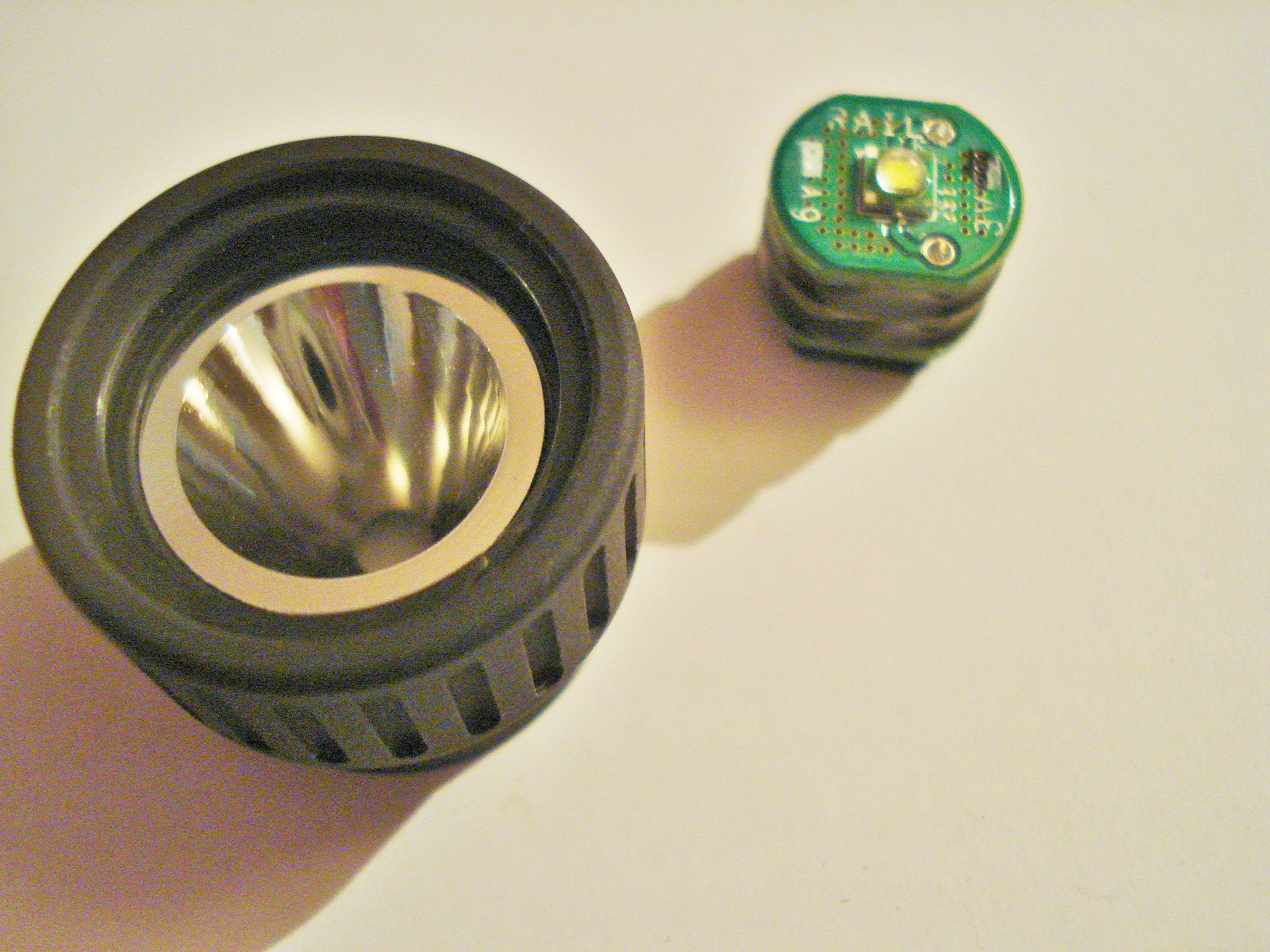
Those of you waiting for the L.E.D. upgrade kits for the M2 and M6 family of weapon mounted lights, sources inside the company expect to start shipping them in April. The kits will also be available for online orders in that time frame.

It is a great way to get your M2 or M6 up to snuff.

M2 L.E.D. Upgrade Kit - Insight Technologies

Posted in Tactical Lighting | Tagged , | Comments Off on Insight Technologies – Update Re: LED upgrade kits.

Suppressors – Current State of Technology Part 3

In Part 2 of my “Suppressors – Current State of Technology”  I covered subsonic ammunition, its common application and the requirements it places on both the operator and platform. I mentioned that due to its low-speed and weight, subsonic ammunition requires a relatively fast twist of 1:10 for a 7.62×51 caliber. Suppressors also require a precise alignment between the bore’s centerline and the suppressors centerline. Meaning that the bore and suppressor must be completely concentric. A failure to achieve concentricity will significantly degrade performance and in extreme cases can cause injury from baffle strikes. This YouTube video of a baffle strike should drive home my point. Watch the suppressor as the individual fires the rifle.

It’s the mounting system, that ensures concentricity and securely holds the suppressor in place. It is critically important to the successful implementation of a suppressor.

Threaded Barrel - Single Point Mount.

Broadly speaking, suppressor mounts fall in one of two categories, single point or two point mounts.

When we use a single point mount we screw (or quick attach) the suppressor directly to the muzzle or use a purpose-built mount – for quick attach/detach support.

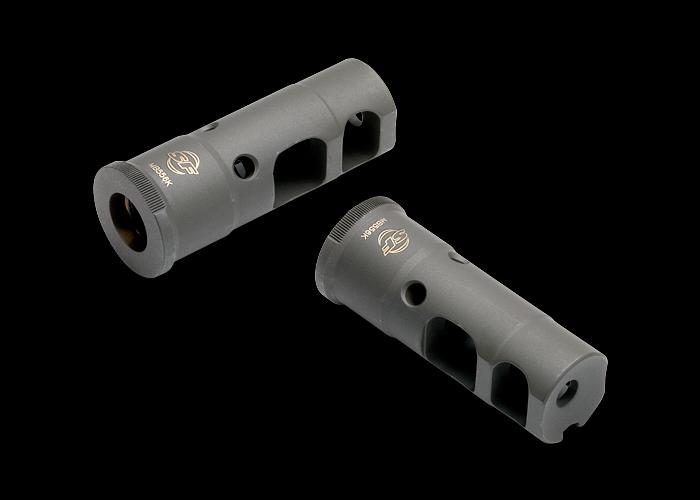
Surefire’s MB556K serves both as a muzzle brake and a suppressor quick attach/detach mount.
The defining characteristic of a single point mount is that the suppressor is held or supported at a single point.
One of the issues associated with a single point mount is that painstaking steps must be taken to ensure concentricity of the bore to the suppressor or the quick attach/detach mount.

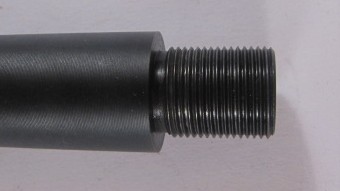
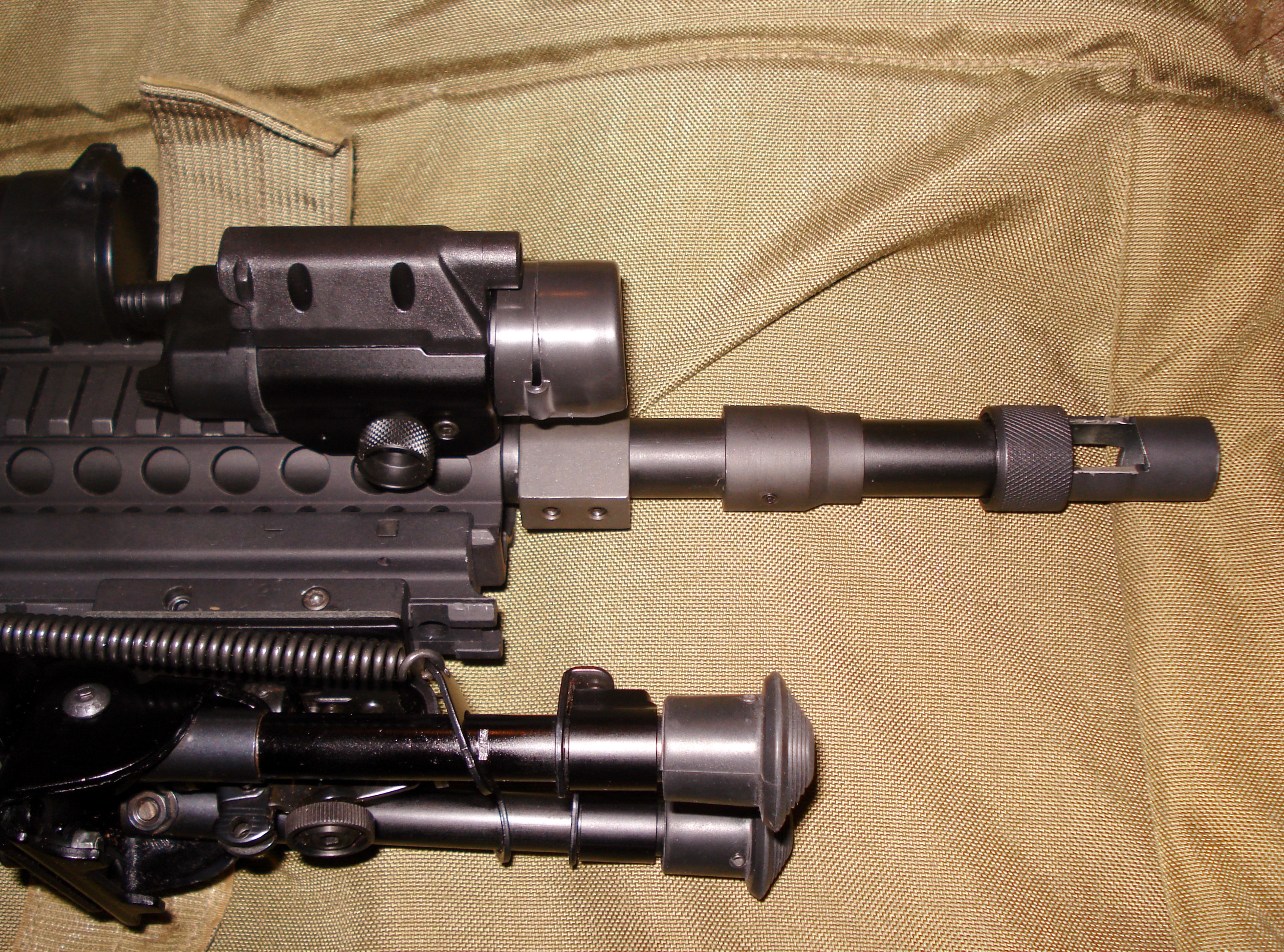
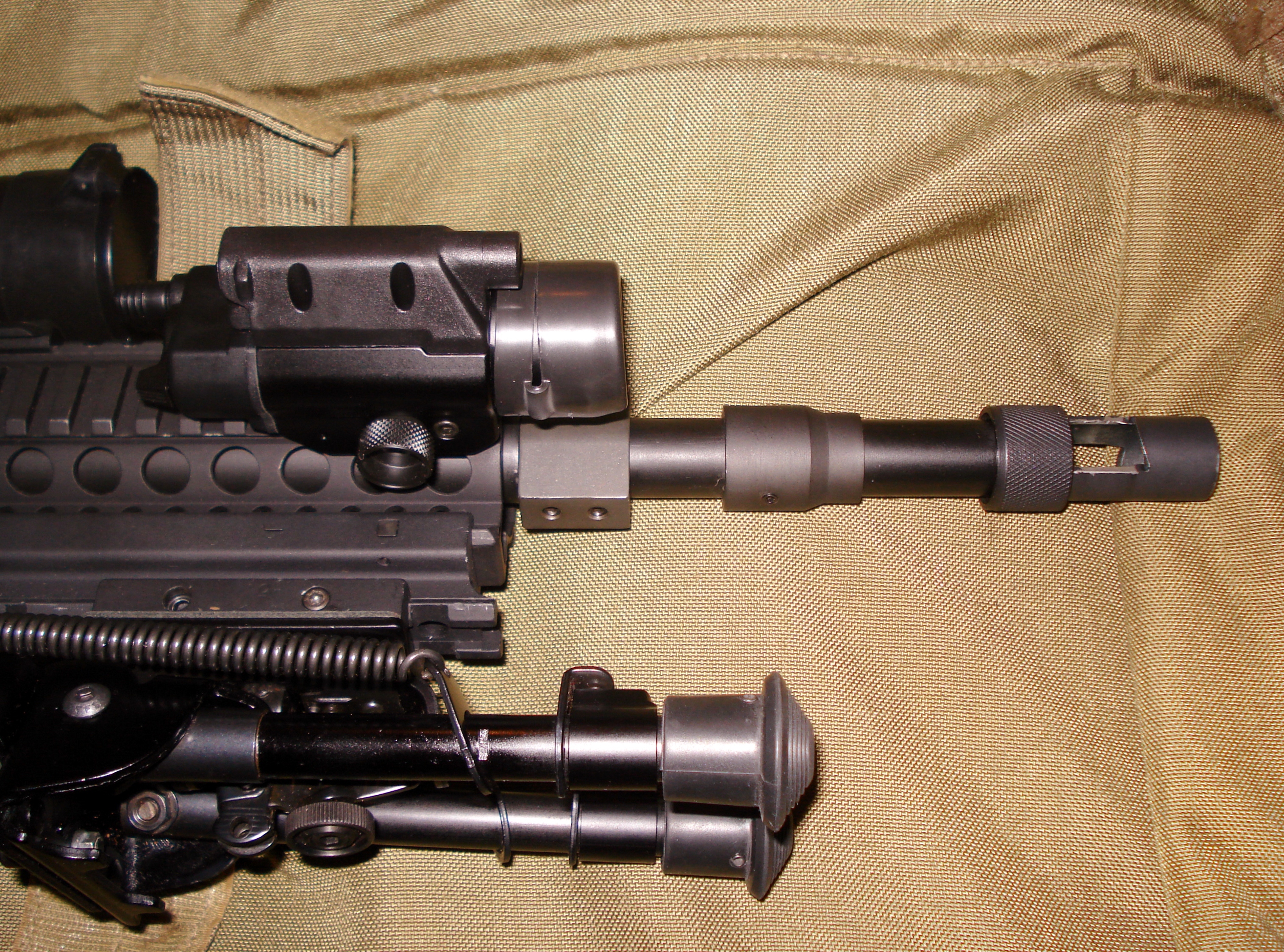
Made by Advanced Armament Company - Note the ACME thread pattern just forward of the notched spring mount. This particular mount functions as a flash hider and a suppressor quick attach/detach mount.

Single point mounts are also susceptible to jarring loose and creating a potentially hazardous situation. For example, thread on suppressors will loosen under fire and need to be periodically tightened on the muzzle. Quick attach suppressors use ratchets and other mechanical systems to keep the suppressor from working its way loose; because of their more complex nature, failures of the spring locking mechanism can occur.
Single point mounts are also more susceptible to accidental misalignment resulting from a shock or impact to the mounted suppressor; for example, a hard smack against a wall could potentially change the suppressor’s alignment with the weapon.
In the plus column, single point attachments are generally simpler to manufacture and when QA mounts are used the operator has the flexibility to easily remove the suppressor from the muzzle for compactness.

Two point mounts are considered to be self aligning.

 A two point mount aligns to the barrel using muzzle threads and a bushing that’s fitted to the barrel such that the suppressor slips over the barrel.

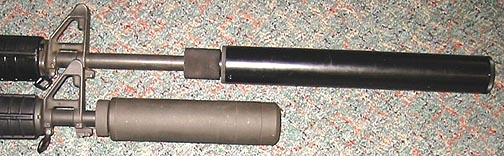
The distinct advantages of the two-point mount is that it is self aligning, it provides a massive expansion chamber and it extends only a few inches past the weapon’s muzzle. If the weapon receives a hard smack at the muzzle, the suppressor is more likely to retain its alignment to the bore.

Single Point Mount (top) v. Two Point Mount (overall weapon length comparison)

Its disadvantage is that it will form condensation more readily, due to its larger expansion chamber, and can not be quickly removed or attached because it has to be screwed on to the muzzle and/or a secondary mounting collar.

One example of a two point system currently used by the U.S. Army is the Knight’s Armament Company M110 SASS. The system uses a thin suppressor that slips over the barrel and locks against the A2 bird-cage and to a collar downstream from the muzzle.

Suppressed M110

Illustration of two point mounting arrangement. Note the collar behind the muzzle. The suppressor slips over and threads on to the muzzle device while the collar or bushing supports the suppressor at the second point. This arrangement is self-aligning and makes concentricity achievable without matching suppressor and barrel thread patterns.

Your choice on the mount type is ultimately driven by operational requirements; however, whatever mounting arrangement you select it must secure the suppressor so that it is mechanically concentric with the rifle or pistol bore.  My personal preference is the two point mount because of its self-aligning and its resistance to shocks or impacts. There are a number of excellent quick attach / detach mounts on the market; however, as part of your testing criteria be sure to expose the mount and suppressor to shock and confirm concentricity before you make your decision.

In Part 4 I’ll conclude the “background” segment with a discussion of the unique aspects of pistol caliber suppressor.

Posted in Suppressors | Tagged | 1 Comment

JTRS Project

I spent a large part of my military career conducting SIGINT and COMINT and there’s probably not much in the r.f. spectrum through Ku band that eludes me; I also have a thorough understanding of the IP stack and routing. 

A few months ago I decided to sit down and write an article, or two, on JTRS (Joint Tactical Radio System) if for no other reason than to gain an understanding of it. I am finally at the point where I “think” I can discuss it with some degree of authority; especially, reducing it to a non-technical level, so that non-technical folks get a better understanding of it than the average bear.

In the weeks to come, I’ll be discussing the concept of software definable communications equipment, waveforms, multi-protocol and ad hoc networks. I’ll also try to deal with the issue of spectrum requirements and its availability – or perhaps the better question is where will it come from.

Posted in Comms | Tagged , , | Comments Off on JTRS Project

The Importance of Flame Resistance.

Our friends at Soldier Systems Daily are the definitive internet source for gear and apparel.

This morning I read a post that is worthy of repeating if for no other reason than to amplify its impact. The subject is FR clothing and the testimonial was enlightening.

“…the Importance of Flame Resistance…”

Posted in Uncategorized | Comments Off on The Importance of Flame Resistance.

Streamlight TLR-VIR – Sneak Peek

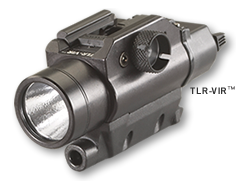
Streamlight's TLR-VIR shown rail mounted.

I am very excited about this light and I want to share that enthusiasm with you.

Look for the complete review this month on the FOG HORN Blog or download a copy from Scribd.

Posted in Uncategorized | Comments Off on Streamlight TLR-VIR – Sneak Peek

Magpul Gen 2 MBUS is Now Shipping.

MBUS Front and Rear

Magpul Industries has redesigned their highly successful polymer MBUS sights and is now shipping a Gen 2 version of the product.

The Gen 2 MBUS is fully compatible with any Milspec 1913 Picatinny rail. The new sights have a slimmer profile so they stow nicely under your primary optics.

The rear sight is adjustable for windage and utilizes small, large and  the NAWS (No aperture window sight) apertures.

The Front Gen 2 MBUS is not compatible with railed gas blocks.

I like these sights because they reduce weight and they integrate well with your primary sights. Check them out…

Posted in sights | Tagged , , | Comments Off on Magpul Gen 2 MBUS is Now Shipping.

Suppressors – Current State of Technology Part 2

Last week I began our suppressor discussion by giving the reader a high level view of what a suppressor is, what it does and does not do, and what benefits accrue from using a suppressor. I said that the two most significant components of weapon related noise is the muzzle blast and ballistic crack, which you may recall is the noise made by the bullet flight as it breaks the sound barrier. I also mentioned that subsonic ammunition is often used to mitigate the risk of producing a ballistic crack. Additionally, I spoke about the possibility of subsonic ammunition generating a ballistic crack given the suppressor’s free bore boost and prevailing atmospheric conditions.

In this segment, I’d like to discuss subsonic ammunition in greater detail to provide the reader with a deeper understanding of the subject.

Two components contribute to a bullets lethality; they are the cross-sectional area of the bullet – larger calibers produce greater tissue damage – and kinetic energy, which is the energy of the projectile on target impact. Kinetic energy provides the penetration and fragmentation necessary to enhance effectiveness. The equation for kinetic energy is k= (m*v²)/2.

A full power .308 load leaves the muzzle at 2600 fps, and as it travels through its flight path it remains above the speed of sound until it has traveled a distance of approximately 1100 yards or more. Because it travels faster than sound, it produces a loud crack that can be detected easily by the human ear or sensors.

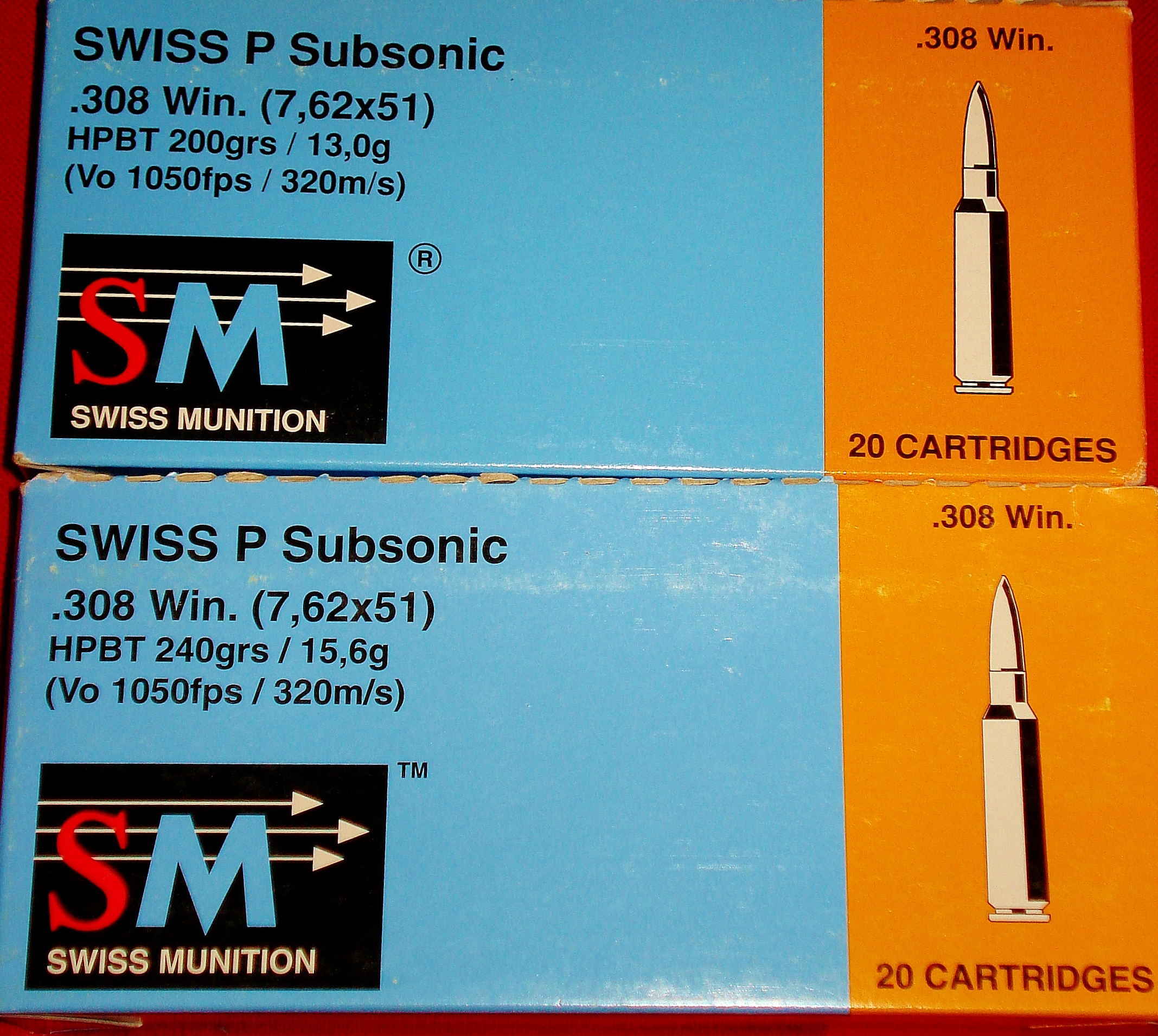
To mitigate the probability of detection, subsonic ammunition is sometimes used.  Because the velocity of the round is reduced from 2600 fps to 1050 fps manufacturers increase the mass of the projectile; doing so will preserve the rounds terminal ballistics. Referring back to the kinetic energy formula we can readily see that when velocity is reduced kinetic energy is reduced; so, to maintain an effective level of kinetic energy we increase the projectile’s mass from 175 grains to 220 grains or 240 grains.

RUAG Swiss P manufactures extremely high quality subsonic ammunition. It is, by far, the best I’ve ever tested in terms of consistency and vertical spread across a wide range of ambient temperatures.

Using subsonic ammunition places additional requirements on both the operator and platform, so it needs to be approached cautiously.

Because a heavier projectile is used, the barrel’s rifling needs to be no slower than 1:11, and preferably 1:10. Using rifling that is slower than 1:11 will fail to stabilize the round and may result in a baffle strike. Should the bullet impact against the suppressor, or its baffle stack, injury to the shooter or those in the surrounding area could result.

In addition to rifling requirements, subsonic ammunition when used in semiautomatic weapons like the M110 SASS, SCAR Mk 17, or HK 417 will generally fail to cycle the action reliably. This is true for a gas piston operating system or direct gas impingement.

 Finally, subsonic ammunition is designed for use in short-range engagements. Internet stories of 900 yard shots with subsonic ammunition are either showmanship or sea stories.  Subsonic ammunition requires that the operator take up a firing position that is 300 meters or less from the target’s position. 

RUAG Swiss P 240 grain .308 Subsonic


In next week’s post, I talk about mounting technologies and discuss some of the pro’s and con’s.

Posted in Suppressors | Tagged , | 1 Comment

Streamlight’s TLR-VIR

Streamlight's TLR-VIR

The TLR-VIR™ is the product of a continuum of Streamlight’s TLR series development. It’s also the light that won the company a $4 million order from the Defense Logistics Agency’s Special Operational Equipment Tailored Logistics Support Program. The order was placed on behalf of the U.S. Army’s Program Executive Office (PEO), the acquisition agency for the Army.
This month I’ll  complete a review of this exceptional weapon mounted light.
The 1000m/W IR illuminators was amazing.
Mounting and operation is equally impressive but I don’t want let the cat out of the bag until I’ve completed work on the full review.
However, I can’t resist…

IR illumination - Target Area

Posted in Tactical Lighting | Tagged , , | Comments Off on Streamlight’s TLR-VIR

Exploding the Missing Link Myth – Letterman vs. Primate


Posted in Morale Builders | Comments Off on Exploding the Missing Link Myth – Letterman vs. Primate

Eating Crow 101

I am a type “A” personality and with that comes taking ownership of mistakes. You’ll never hear me say “that I was missed informed”; as you’ll see, I am not perfect but I don’t give up.

Nearly two years ago, while at a SOFIC Conference, I ran across two companies whom I thought had some interesting products – Sealskinz and OTB (now a New Balance Company) boots. I was completely high – still am – on OTB’s concept, and in particular their line of SAR (Search and Rescue) sadly missing from their current catalog.

My plan was to test both products concurrently and both Sealskinz and OTB sent me a T&E sample, for the review – thank you both.

My review was to consist of wearing the Sealskinz waterproof socks and the OTB SAR boot, jumping in the pool at Piedmont Park, do a little combat swim, then exit the pool and hit the 800 meter track just outside the pool area. My objective was to validate the waterproof sock, the boot drainage system and its ability to keep out dirt and the small debris that I would encounter while running the 800 meter.

I approached the pool management about the review and asked for permission to come in 30 minutes prior to opening, with a photographer, to do the swim. The pool manager looks at me like I was crazy and asked me what I meant by a combat swim. She immediately directs me to city government who most likely had me followed around by behavioral scientists. Mind you, this is the same pool that every wino uses as a urinal after midnight so you’d think they would like to get the press. Nope, not happening!

Ok, do I stick my foot in a bucket filled with water and call it a test. Nope, not me I am a type “A” remember.

I waited for a response from the City of Atlanta for several months, Nada.

I then approached LA Fitness. I sat with the manager and asked if they’d allow me to use the pool – a nice 50 meter pool. I told him that I’d like to come in early in the a.m. or late at night with a photographer. The manager looks at me like I am nuts, until it sinks in that I was doing a review. He then says sure, but I can’t let you take pictures. Why not I said! I pleaded with the guy that this would take place when no one was in the pool – No go! It was no problem to jump in the pool with the SAR boots and swim a couple of laps but pictures were out. OK, go figure!

I followed up my meeting with the local manager with a call to LA Fitness Corporate – no pictures!

 It is now a couple of years later and I think that I’ve finally found a pool that will let me do this. Too early to say just yet but I am keeping my fingers cross.

To Sealskinz and OTB the review will be done and my sincerest apologies for the delay; the saga continues.

Posted in Uncategorized | Comments Off on Eating Crow 101

Boston Dynamics Tapped by U.S. Army to Develop a Robot and Android.

Boston Dynamics has been in the sensor based robotics business since its founding in 1992. They have worked on a number of projects for the DoD, among its development efforts is the Petman robot currently in use testing Nuclear, Biological and Chemical (NBC) protective clothing.

Petman circa 2009

Army Technology.com reported that the company has been awarded a multi-million dollar contract to develop a new robot, the Cheetah, capable of outrunning the fastest man on Earth, and a Terminator-type android, Atlas robot, that will work alongside troops…”

According to Army Technology.com, “the four-legged Cheetah will have a flexible spine, articulated head, and will be able to sprint, take sharp corners, zigzag and reach speeds of 20mph-30mph.

“The Atlas robot will have a body, two arms, two legs and no head and will be able to walk over rough terrain, fit through tight gaps and crawl on its hands and knees if needed.”

Posted in Alerts | Tagged | Comments Off on Boston Dynamics Tapped by U.S. Army to Develop a Robot and Android.

Suppressors – Current State of Technology

A couple of years ago I wrote a three-part series for Sniperworx.com on suppressors. Late in 2010, I got a couple of requests for a survey; the individuals were looking for recommendations; however, FOG HORN doesn’t endorse or make recommendations. Instead, we approach any given product or technology on its own merit and compare it to what we view as minimum requirements. If it meets that criteria then it meets it.

With that in mind I’ll get started with the task at hand, which is to provide an overview of suppressor technology – 2011, and who the players are. Look for one article per week on suppressors and the current state of technology.

In this week’s piece, I’ll provide a background of what suppressors do and how they do it, and why suppressors are used

Suppressors are not silencers and silencers are figments of Hollywood’s imagination. A suppressor is a tube that attaches to the muzzle of a firearm, made of varying lengths and diameters, housing internal components and materials broadly referred to as baffles. A suppressor traps hot high pressure gases exiting the weapon’s muzzle, reducing pressure and temperature sufficiently to reduce or eliminate muzzle blast. It accomplishes the task using a series of chambers separated by baffles; which allow hot gasses to expand and cool. The baffle also disrupts and adds resistance to the expanding gas so that it drops in energy. Fore example, a 5.56 round generates an excess of 50,000 psi in the chamber and bore, a suppressor will act on that gas to reduce its temperature and velocity so that gas pressure, at the exit point, is in the order of 30 to 20 psi; thus reducing or eliminating the muzzle blast. In order for a suppressor to be highly effective its internal volume must be 20 to 30 times larger than the weapon’s bore internal volume. Therefore, shorter suppressor will usually be larger in diameter and longer suppressor will have a smaller diameter.

A weapon’s sound signature comes from the weapon’s muzzle blast, the noise generated by the weapon’s action and ballistic noise. Ballistic noise is the loud crack made by the projectile in-flight as it travels above the speed of sound. A suppressor does nothing to eliminate the weapon’s action noise nor will it alter the projectiles ballistic crack. The only way to eliminate ballistic crack is to use subsonic ammunition, this is a load that will keep the muzzle velocity below the speed of sound.

An important point to note, when discussing ballistic crack, is that the speed at which sound propagates is not a constant of 1100 fps. It is dependent on atmospheric conditions – principally temperature, relative humidity and barometric pressure; so, it is possible that you will still experience ballistic crack when firing a subsonic round – this has happened to me on more than one occasion.

Most subsonic rifle loads are designed to deliver 1030 to 1050 fps in muzzle velocity when fired through an unsuppressed bore; however, when you install a suppressor they will pick up, on average, an additional 20 to 40 fps in velocity – this phenomenon is called freebore boost. So, a round loaded to 1050 fps will exit the suppressor at 1070 to 1090 fps, or more. If atmospheric conditions are such that sound propagates at a lower speed, you will experience ballistic crack.

Therefore, the primary function of a suppressor is to reduce or eliminate muzzle blast; however, there are secondary benefits. Suppressors, in most designs, will eliminate muzzle flash, reduce recoil and reduce dust signature. Since they reduce or eliminate muzzle blast, they remove a loud noise point source making ballistic crack and weapon action noise hard to localize.

When considering suppressors the requirements at the top of the list are muzzle blast and muzzle flash elimination or reduction, and all else is secondary.

In my next posts, I’ll expand on my closing sentence; giving it the explanation it deserves. Because mounting options, recoil reduction and other benefits deserve amplification and discussion.

Posted in Suppressors, Weapon systems | Tagged , | Comments Off on Suppressors – Current State of Technology

Colgate Wisp

Colgate Wisp (waterless toothbrush)

I run across a lot of stuff at Fog Horn but when I came across Colgate’s Wisp, I said to myself, man I wish I had a few of these in my pack.

Folks that spend a large part of their lives moving about the countryside know, all too well,  that basics like shaves and haircuts, and oral hygiene become secondary considerations. I remember times where my mouth literally felt like grunge; it’s a crappy feeling but there’s not much that can be done – Enter Colgate’s Wisp.

This tooth-brush requires no water for brushing or rinsing. It comes pre-seeded with a breath freshener, and at the opposite end of the brush, there’s a pick that actually does a decent job at removing mild calculus.

The active ingredient is Capric/caprylic triglycerid, which is a medium chain triglyceride with an indefinite shelf life.

Wisp appears to have no anti-bacterial properties but if you fill a pint-sized bottle with water and then add a cap of Clorox bleach to it, you’ll have the best mouthwash that you’ll ever come across. The solution is a broad spectrum prophylaxis that will keep your mouth free from bacteria and your gums looking great.

Wisp is not intended to substitute a normal brushing regimen but if you just can’t get it done, this little brush will help you feel like you’re alive again.

Posted in Medical | 1 Comment

A Closer Look at Glock’s Gen 4…

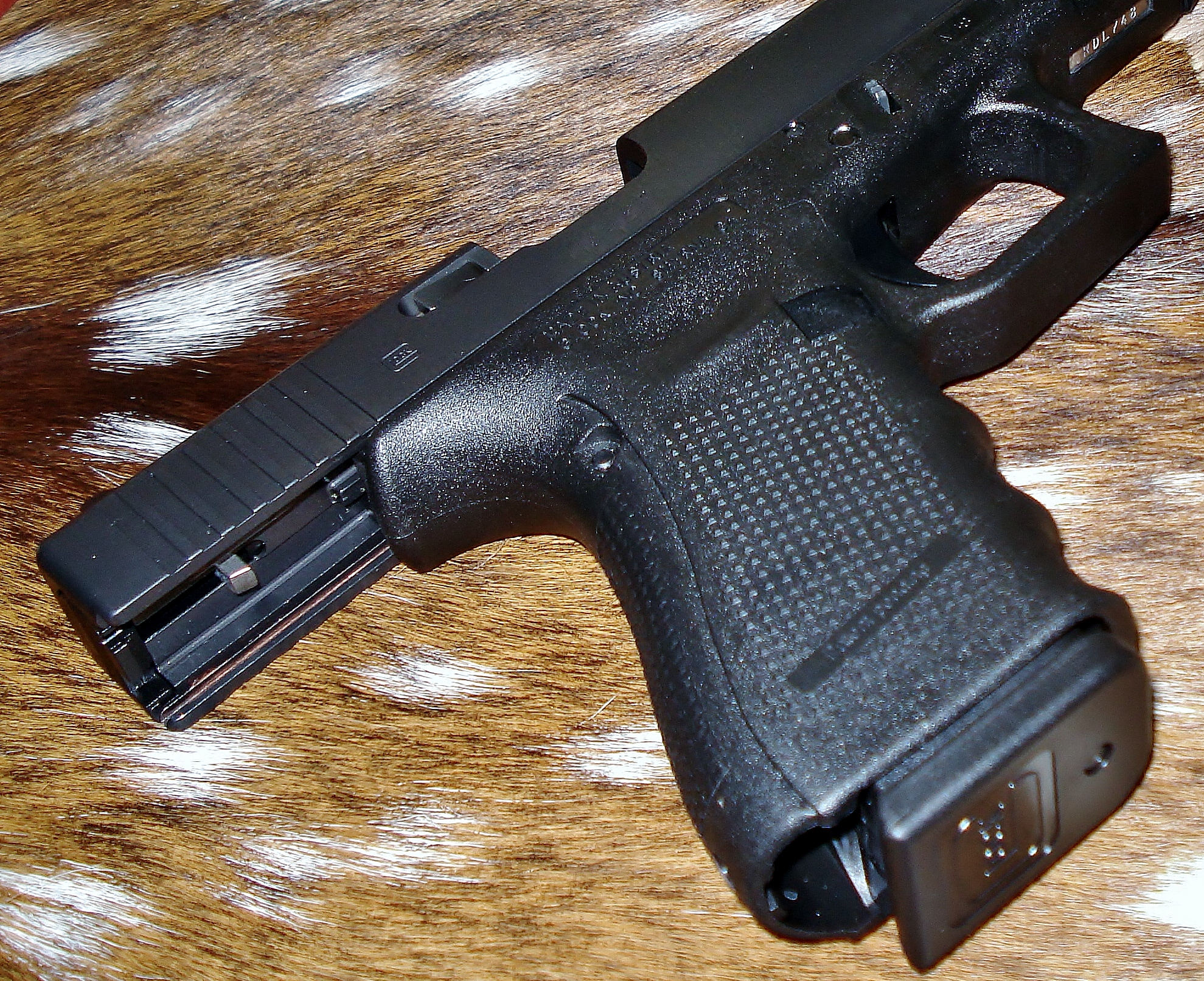
Glock's Gen 4

I often find myself searching for words when discussing Glock’s. Its utilitarian design and total absence of elegance would make it “The People’s Handgun” if we only had one choice in life. But, how does one improve on perfection.
In production since 1982, Glock has delivered a line of “Safe Action Pistols” that allowed it to capture over 60% of the law enforcement market.  Each generational upgrade didn’t involve groundbreaking technology but rather simple modifications to improve grips and texture. Gen 2, for example, consisted of adding chequering on the strap and serrations to the back strap. Gen 3 changes were a bit more substantive with the addition of an accessory rail, thumb rests (port and starboard) and finger grooves on the front strap. In 1997 or 1998, if memory serves me, Glock introduced a redesigned extractor that doubled as a loaded chamber indicator. Glock also increased the size of the locking block and added an extra pin just above the trigger.
Now, in the Gen 4 design, Glock reduced the size of the grip and wisely gave us the option to change out the back strap. The smaller grip size required a redesign of the trigger housing, which placed the trigger closer to the grip making it more comfortable for shooters with smaller hands.

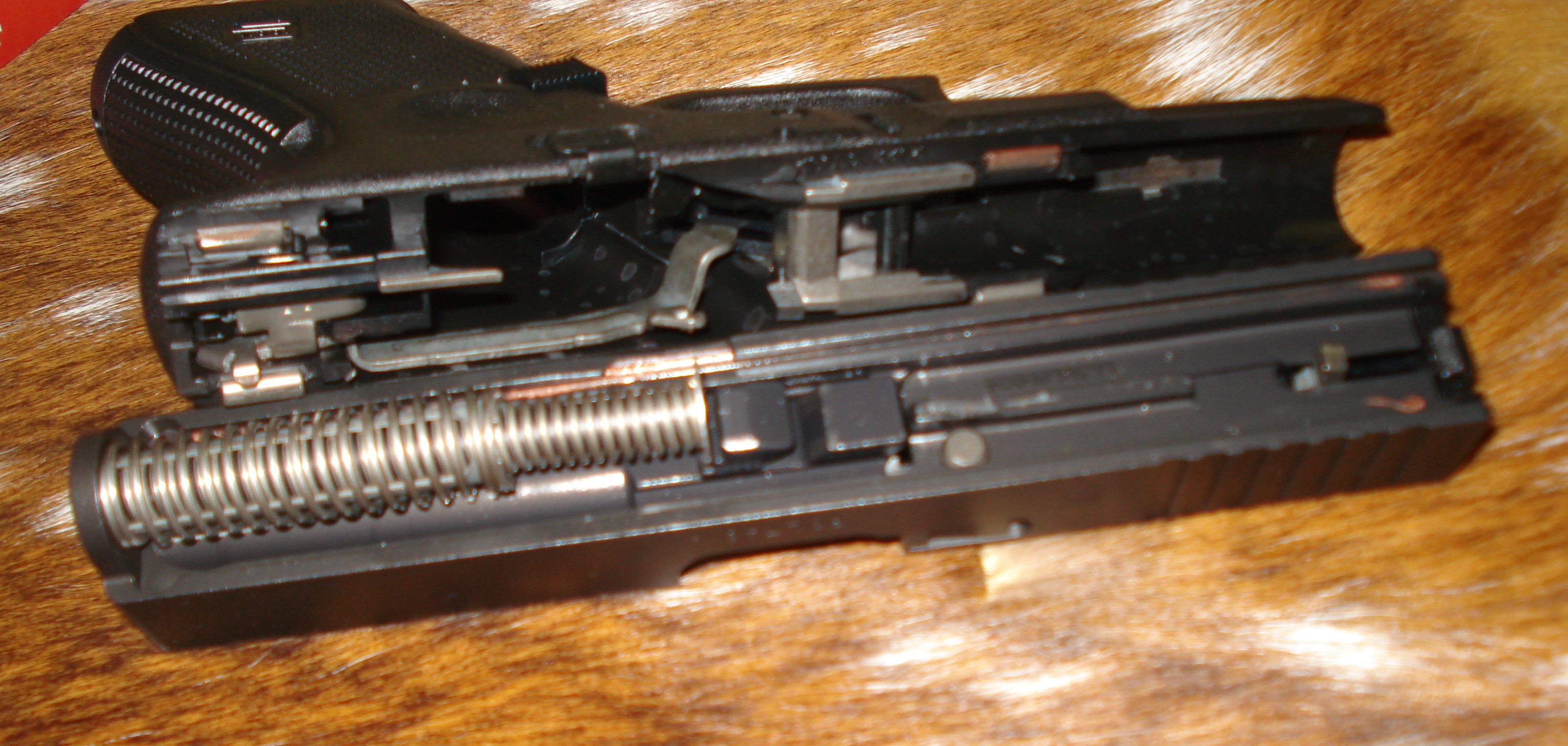
Redesigned Recoil Spring Assembly

In Gen 4 Glock also introduced a redesigned recoil spring assembly that incorporates a dual recoil spring arrangement originally found in their compact models. The company feels that it reduces felt recoil – a claim that is highly subjective. The measurable benefit of the new recoil spring assembly is the reduction of stree related frame failures; thus extending the service life of the polymer frame.
I wish there were more I could say but it’s a Glock! 
Posted in Weapon systems | Tagged , | Comments Off on A Closer Look at Glock’s Gen 4…

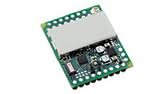
Rockwell Introduces its MicroGram GPS Receiver

MicroGram GPS Module

Rockwell Collins unveiled its MicroGRAM GPS receiver, which is 90 percent smaller than the earlier version of its Miniature Precision Lightweight GPS Receiver Engine SAASM (MPETM-S). The size reduction means that equipment such as handheld radios, ruggedized field computers, laser range finders, gun scopes and small unmanned aircraft can be equipped with secure GPS capability.

MicroGRAM’s unique security features are the result of designing a rugged product that leverages Rockwell Collins’ strong legacy in providing Selective Availability Anti-Spoofing Module (SAASM) capabilities to our warfighters. Engineered to minimize its footprint and power usage, the MicroGRAM (GPS Receiver Application Module) has also been optimized to allow rapid acquisition of the GPS satellites when the power is first supplied to it.

Even more interesting than a GPS equipped rifle scope is the possibility for smaller tagging and tracking devices.

Posted in Electronics, Nav Aids | Tagged , , | 4 Comments

FN Herstal Shows off FN Fire Control Unit at IDEX 2011

FN FCU-1.5M

FN Herstal debuted impressive new technology at IDEX 2011. Among the new offerings is the Fire Control Unit. It turns what used to be an art form into a repeatable and accurate process.

Those of you equipped with M203 40mm tube grenades know all to well that achieving repeatable accuracy is easier said that done. That changes with the availability of the FN FC-1.5M.

The sight is equipped with a laser range finder and an inclinometer. It accurately determines a range to the target and inclination or declination angle. That data is fed to an onboard ballistic calculator which determines the exact aiming solution. The aiming reticle actually shifts in the display so that the operator simply places the crosshairs over the target and fires the projectile.

As of this writing, I don’t have an assessment of how many, if any, are in service.

If you have that information or have used the FC-1.5M, chime in and share your thoughts.


Posted in Optics, Weapon systems | Tagged , , | Comments Off on FN Herstal Shows off FN Fire Control Unit at IDEX 2011

The Importance of Cultural Awareness …

We Americans traditionally, and innocently in the majority of cases, have disregarded cultural differences; as a result, we’ve been viewed as rude and insensitive or poorly educated. It’s no one’s fault, that’s just the way we’ve grown up, right, wrong or indifferent.

About a year ago, I kicked off a cultural awareness tweet (@Twobirdsflying) on Twitter. It’s intended to raise awareness of the need for becoming more culturally tuned; done in a humorous way.

The U.S. Army, specifically, USASOC sees it the same way and has made significant investments in training the SFGs to be more culturally aware. Culturally aware operators are better prepared to meet mission demands.

For example, your team has been ordered to infiltrate a small Cuban town. Your infil was brilliantly executed and no one knows you are in-country. Unexpectedly you run across a Cuban militia, do you light’em up or do you rely on your cultural awareness to overcome the obstacle?

Theoretical Cuban Militia

If you’ve been following my Cuban cultural awareness tweets, You know that you can rely on the word “conyo” to get you through quite a few situations by simply changing your inflection. However, when we combine the word “conyo” with the expression “Ave Maria” you have an incredibly powerful combination that will make your infiltration like butta.
What makes this so powerful is that “Ave Maria” is something you’ve heard at church all your life so it’s easy to remember; requiring no language schools. The key is pronunciation and inflection, if you sound like you’re from Connecticut you blew it.
To help you with that I’ve added an audio clip. By the way, this will also work on a comm channels under general chatter.
As you practice, relax and be natural; don’t try sounding like Tony Montana in Scarface.
To effectively use Ave Maria – Conyo, walk past the guard, smile, it helps if you have your shirt’s top two or three buttons open, and let the words just roll of the tip of your tongue.  This will work even if she has a male partner. Strolling is important as to maintain a casual and relaxed appearance.
Have a great day, enjoy what you’re doing and may life shower you with the best it has to offer…
Posted in Morale Builders | Comments Off on The Importance of Cultural Awareness …

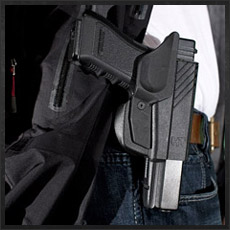
HT Holsters Ltd – Exhibits in the Finnish Pavillion.

Conceal Carry Holster

HT Holster Ltd., Finland,  displayed their line of speed draw and conceal carry holsters in the Finnish Pavillion.

The company markets what they call the most advanced and innovative holstering solution for military and police.

I have not had the opportunity to do a side by side comparison, so I am not shelving my Blackhawk SERPA yet.

If you’ve had hands on experience with the HT Holster, write in and share your opinion with us.

Posted in Holsters | Tagged , | 2 Comments

MMI Outdoor – Granite Tactical Gear at IDEX 2011

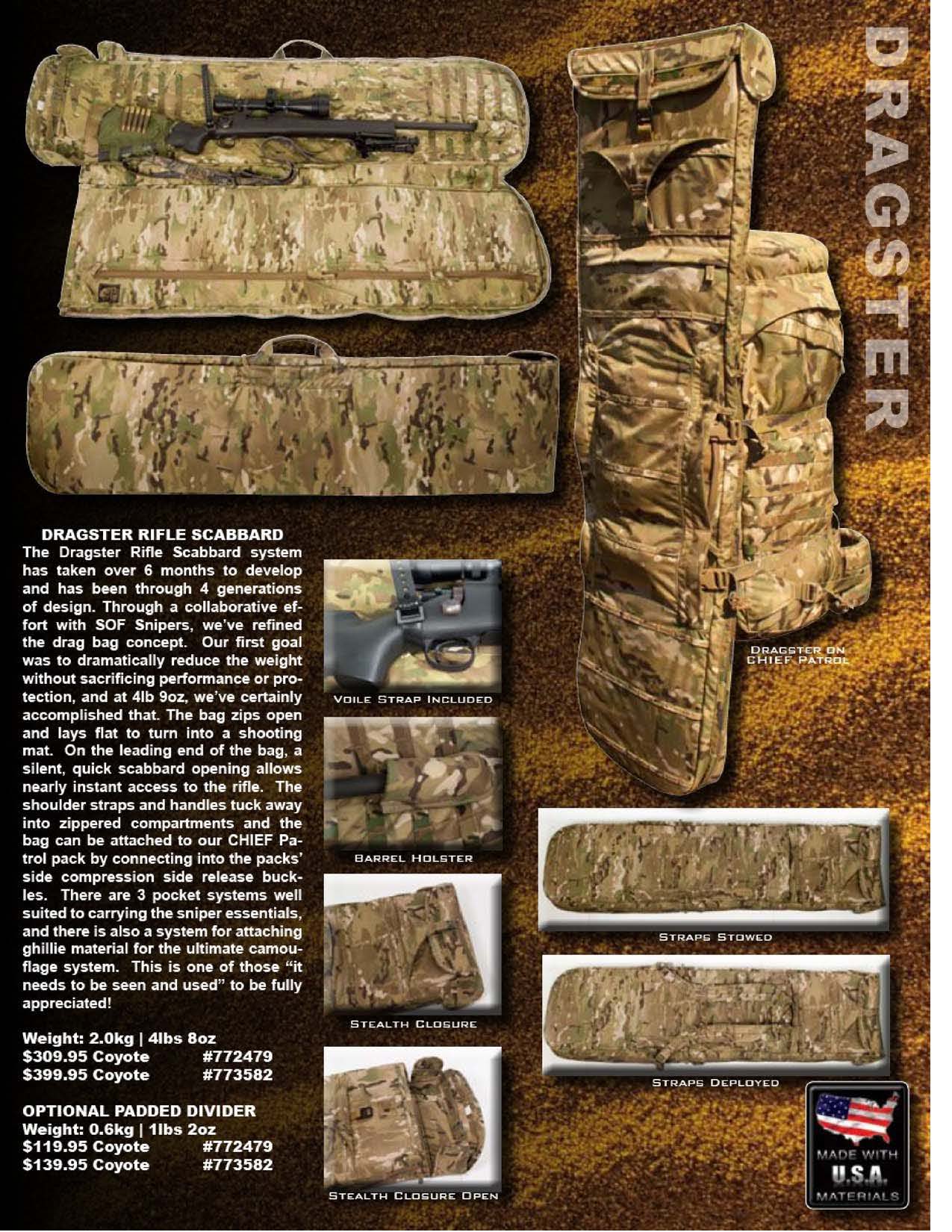
MMI/Granite Tactical's Dragster Sniper Drag Bag


IDEX 2011 offered something for everyone. This year MMI Outdoor debuted its Dragster Sniper Drag Bag System.

The Dragster offers a number of improvements over the traditional drag bag. All of the straps fold into pockets, and the system integrates well into a patrol pack. Compartments and zippers are arranged extremely well and the scabbard design makes accessing your weapon fast and easy. Unlike the LBT that I use, the Dragster opens completely and flat so it can be used as a shooting mat. Quality is consistent with Granite Tactical’s superb tactical gear. Check it out!

Posted in Gear | Tagged , , | Comments Off on MMI Outdoor – Granite Tactical Gear at IDEX 2011

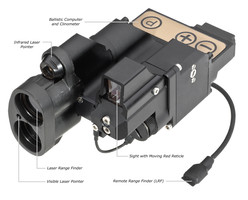
Laser Devices – DBALA3 Gen 3

DBALA3 Gen 3

At IDEX 2011, Laser Devices shows off its third generation laser pointer, illuminator, the DBALA3.

The DBALA3, Gen 3, is a dual-beam aiming laser that can be readily attached to any Picatinny 1913 rail system; on any weapon platform. The unit includes  and infrared (IR) pointer, IR pointer/illuminator and a red/green visible laser pointer. The DBALA3 can be integrated with the company’s tactical lights and is easily operated with two pressure pads.

Laser Devices is a U.S. Company located in Monterey, CA and they’ve been doing it right for over 30 years.

Posted in Laser Based Technologies, Tactical Lighting | Tagged , , | Comments Off on Laser Devices – DBALA3 Gen 3

ISR becomes more compact with Thermoteknix Systems’ SCOTI

Small Clip On Thermal Imager


Thermoteknix Systems, Ltd. was founded in 1982 launched SCOTI – Small Clip On Thermal Imager at IDEX 2011

SCOTI is fully compatible with the AN/PVS-14 and AN/PVS-15. This miniature thermal imager, is very small, very light and has a 4.5 hour run time on 1 AA-battery. SCOTI is based on the company’s shutterless MicroCAM 384×288. The imager integrates seamlessly to the NOD using interchangeable mounts.

Great performance with miserly power consumption.

Posted in Electronics | Tagged , | Comments Off on ISR becomes more compact with Thermoteknix Systems’ SCOTI

Top 10 reasons why you should read Fog Horn and not watch Letterman.

(10)                  You know that fat chicks should sail barges not J boats.

(9)                    You know that Chuck Norris can kick Chuck Schumer’s ass.

(8)                    You know that spandex should be licensed.

(7)                    You actually know the meanings of words you use.

(6)                    You don’t make fun of children to bump ratings.

(5)                    Lindsey Lohan says yes to you.

(4)                    You don’t follow people to job interviews.

(3)                    You don’t follow people at trade shows.

(2)                    You don’t think Harvey Levin’s, You Know You’re a Jew, is

                          anti-Semitic.

(1)                    This is your idea of will it float…

Posted in Morale Builders | Tagged | Comments Off on Top 10 reasons why you should read Fog Horn and not watch Letterman.

Shoulder Worn Acoustic Targeting Systems (SWATS) – QinetiQ

Snipers have earned their place in military history as one of the most effective weapon systems ever deployed. During World War II, Russian, snaiperskaya, wreaked havoc on advancing German troops. A single sniper team can successfully pin down a company, and they have a devastating effect on an opposing force’s moral. Snipers are, by far, more surgical than a Hellfire missile. For these reasons, there’s been a considerable amount of research and development done to advance and deploy shooter detection systems. One such system, the Shoulder Worn Acoustic Targeting Systems (SWATS) developed by QinetiQ is currently fielded in Iraq and Afghanistan.

SWATS functions very much like SONAR in that an array of microphones measures time differences between shock wave and muzzle blasts to ascertain the general location of a shooter or sniper. The QinetiQ video is an excellent overview of SWATS.

What remains a question in my mind is how well the system performs in urban settings where sound can be amplified or diffused by surrounding structures or how effectively the system works against suppressed weapon systems.

I’d like to give it a try and I’ve added testing it as a task, given QinetiQ’s willingness and my ability. However, if it saves just one life then it has met its objective, and that’s a great thing.

Posted in Electronics, Soldier Systems | Tagged , | Comments Off on Shoulder Worn Acoustic Targeting Systems (SWATS) – QinetiQ

Harris’ Falcon Fighter Soldier System

Soldier modernization programs seem to be alive and well.

Harris’s Falcon Fighter Soldier System made its debut at IDEX 2011 announcing a 500 unit sale to an undisclosed Asian country[1].

 The system is designed around the Harris line of secure radios and one would reasonably expect that. Harris goes one step further by using open standards, which embrace a number of “legacy” sensors allowing them to interface with the system.

One of the challenges faced by the surveillance sector is how to integrate analog devices already in place into the digital framework so that data and control can be networked efficiently. The Falcon Fighter includes an onboard computer and processor that compresses and wraps the data stream in an IP compliant protocol, which can then be readily networked.


[1] Look for a scaled down version at Toys R Us this fall.

Posted in Electronics, Soldier Systems | Tagged | 4 Comments

Caracal’s CSR – Sniper Platform

CARACAL’s CSR Sniper Platform

Caracal International is the first arms manufacturer in the UAE.  Among its already highly regarded line of pistols, notable additions, this year, include the  Caracal CSR sniper rifle.

Development of the CSR began last year and was shown still in its prototype form. The rifle is intended to be a modular design focusing on ergonomics to deliver a superior weapon-operator interface.

The CSR will be available in .308 Win or .300 WinMag as a folding stock, magazine fed, 10-round , bolt-action rifle. The chassis is fully Picatinny 1913 compliant with enough rail space to mount any combination of optics, including thermal imagining and image intensified. Two versions of the rifle will be produced. The CSR Basic with a 600mm barrel and the CSR Compact with a 510mm barrel.

Caracal anticipates that it will be in full production by the end of this year.

Posted in Uncategorized, Weapon systems | Tagged , , , | 1 Comment

IDEX 2011 – It’s a Wrap.

The 10th International Defence Exhibition and Conference is held under the patronage of His Highness Sheikh Khalifa Bin Zayed Al Nahyan, President of the UAE, at the Abu Dhabi National Exhibition Centre (ADNEC).

This year’s conference and exhibition brought together 1060 exhibitors in what is the largest defense and military exhibit in the Middle East.

Although the political climate in the region has taken some interesting turns, the major geopolitical players in the region will spend as much as 26% of GDP on defense and military. This year the UA fielded 169 exhibitors; accounting for about 12,000 square meters of display.  Like Jordan, the UAE has made impressive gains in the development of a domestic defense industry.

Posted in Alerts | Tagged , | Comments Off on IDEX 2011 – It’s a Wrap.

Homemade Implants…

Before getting on with some of the more serious topics of the day, I thought I’d share a little comedy. It’s hilarious and I hope it kicks off your day with a good laugh.

Posted in Morale Builders | Comments Off on Homemade Implants…

The Music of Dr. John P Mistretta… great music for troubled times!

Nothing creates a window to one’s soul more so than a skilled musician and vocalist; John Mistretta is just that artist.

The subtle nuances of John’s music conjures images of Simon and Garfunkel, revealing an inner peace and serenity. His instrumental agility and vocal clarity is uncommon in today’s meadiacracy, yet it remains profound with every cord his skilled hands strike.

Great music for troubled times! His work is a must have in your collection.

                                                        Dr. John P. Mistretta

Posted in Morale Builders | Tagged , | 2 Comments

Garmin’s Fortrex 401 GPS Receiver – Good things do come in small packages…

GPS technology has improved over the years by leaps and bounds; not only have there been significant improvements in system accuracy but advancements in materials and manufacturing have made it possible to house devices of impressive features and functionality in a small form factor. Such is the case with the Garmin 401 Fortrex.

The 401 Fortrex offers an impressive array of features. They include an altimeter, barometer, electronic compass, timer, and support for a cadence accessory and a heart rate monitor. The instrument is waterproof to IPX7 standards and offers wireless data transfer.

Posted in Nav Aids | Tagged , , | Comments Off on Garmin’s Fortrex 401 GPS Receiver – Good things do come in small packages…

Pee-Wee® Unisex Urine Bag Receives Clean Review…

I was thrilled to see my review quoted in this prestigious newsletter.

Folks, I can’t say enough about these Pee-Wee® urine bags, they are awesome. I have personally spent time in the back of a CH-47 Chinook as it executed two and three faints with vivid recollections of lowering Johnny into a styrofoam cup and having the cup runneth over.

They are in the supply system and they work exceedingly well. Read my review.

Lower all masts and antennas. Make your depth 200 feet, all ahead two-thirds.

Posted in Uncategorized | Comments Off on Pee-Wee® Unisex Urine Bag Receives Clean Review…

Can anything be worse than a Letterman Show?

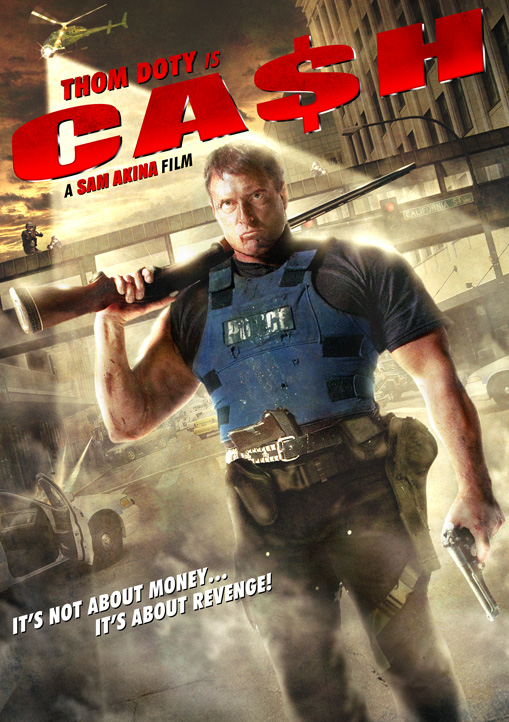
CA$H – Keep yours…

Yes it can and it’s not often that one runs across a movie where the cost of power consumption is greater than the entertainment value.

Thom Doty plays CA$H – that’s right, no first or last name, just CA$H, an ex-con shot by Pablo – Hector’s Buddy – during a bank robbery. Pablo shoots CA$H leaving him to be caught by the police and sent to prison.

After his release CA$H hunts down Pablo and Hector. The movie has a Vietnamese drug gang, Sicilian mob, Mexican drug gang, Russian gang and a Jewish middleman, who is responsible for setting off an all out gang war when he assigns Lenny, the hitman, to take care of a problem. Regrettably, Lenny has an I.Q. of  (negative 160) and messes up the delivery of body parts setting off an all out war.

There is no conceivable way to spoil this film, so it ends when CA$H breaks his own arm at the wrist and with the protruding bone stabs Hector in the neck.

The movie has a Hong Kong / Spaghetti Western style that’s not been seen since the late 50’s or early 60’s. They even steal a line from Tombston, “Tell Hector that I’m coming and hell is coming with me.”

Come on!!

The movie does offer the audience Cuchi and Motorcycles throughout.

CA$H – KEEP YOURS!

Posted in Morale Builders | Comments Off on Can anything be worse than a Letterman Show?

Deficit Reduction Mania Could Jeapordize National Security Posture.

This is about as political as I will get on this Blog but it would be a colossal error in judgement to view Egypt’s recent move for a better government as a signal to start erecting Paul Revere statues, or the assumption of a Pax Americana. However, there is reason for hope but it is a fragile situation that has to be watched. There are very influential groups at play, all of whom have differing views of this vitally important region’s future, and that has to play itself out.

Certainly Israel’s position with regards to a Palestinian State will go a long way to defining how the Middle Eastern milieu will gel as the call for meaningful reform spreads across the region.

Posted in Uncategorized | Comments Off on Deficit Reduction Mania Could Jeapordize National Security Posture.

French Ready to Deploy FELIN.

FALIN Concept

The 1st Infantry Regiment of the French Army has successfully completed soldier orientation on the FELIN Modernization Initiative.

FALIN is a concept designed by Sagem developed under a contract awarded by the DGA in March of 2004.

FALIN is a forcklift upgrade of the soldier that includes clothing, sensors, wearable computer, communications, display system, protection and weapon system. FELIN comes in at 24kg (53 lbs) fully loaded – batteries, water, ammo, etc.

The clothing has been ergonomically enhanced and is NBC ready.

 Weapon systems based on the FAMAS assault rifle will be enhanced with a number of sensors delivering interesting capabilities. The FAMAS rifle equipped with I2 and a wireless networked video camera will send video images to torso or head mounted displays. The video signal can be transmitted to C2, for enhanced situational awareness. Command weapons and sniper systems are included in the modernization initiative with enhacements that iclude thermal sights, GPS, LRF and a digital compass. All of the data collected by these sensors is available and networkable.

Posted in Alerts, Weapon systems | Tagged , , | Comments Off on French Ready to Deploy FELIN.

BAE Eclipse® T-Shirt Design Contest Jan 18 – Feb 21

Last chance for you artistic types to get in on the BAE Eclipse® T-Shirt Design Contest!


IDEX- February 20-24 in Abu Dhabi, United Arab Emirates. Booth #CP200
AUSA Winter -February 23-25 in Washington, D.C. Booth #2422
AAAA– April 17-20 in Nashville, Tennessee. Booth #140

Posted in Uncategorized | Comments Off on BAE Eclipse® T-Shirt Design Contest Jan 18 – Feb 21