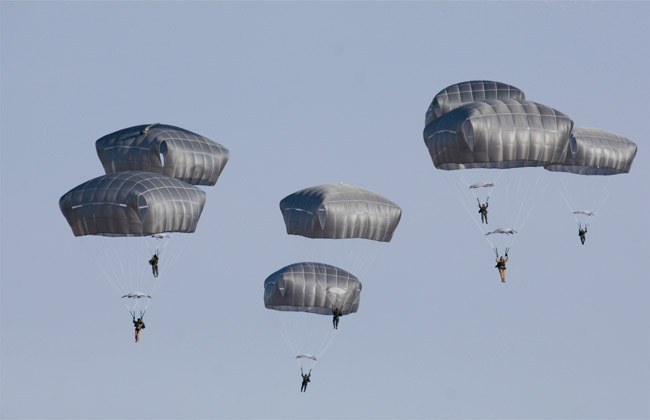
Replacing the T-10 Troop Personnel Parachute with the T-11 Delayed.

T-11

The U.S. Army has issued safety warnings that amount to a delay in the deployment of the T-11. It appears the U.S. Army lacks confidence in the published wind drift offset factors calculated by the U.S. Air Force. The restriction seems to be centered around ground marker release system or GMRS and verbally initiated release systems or VIRS. Windrift is factored in drop zone computations. Safety issues are not structural but an error in offset factors could adversely influence drop zone calculations resulting in a potentially hazardous situation.

For additional details see Army Times.

Posted in Uncategorized | Comments Off on Replacing the T-10 Troop Personnel Parachute with the T-11 Delayed.

Suppressors Current State of the Technology – Part 9 – GEMTECH

Few companies have the reputation and history in the suppressor industry than GEMTECH of Boise Indiana enjoys. The company began delivering high quality suppressors in 1993, and their suppressors can be found in use globally with military and law enforcement, at all levels of these organization. The GEMTECH name is synonymous with suppressors and sound signature reduction technologies.

The company manufactures a full line of rimfire suppressors, centerfire pistol, centerfire rifle, submachine gun and PDW suppressors.

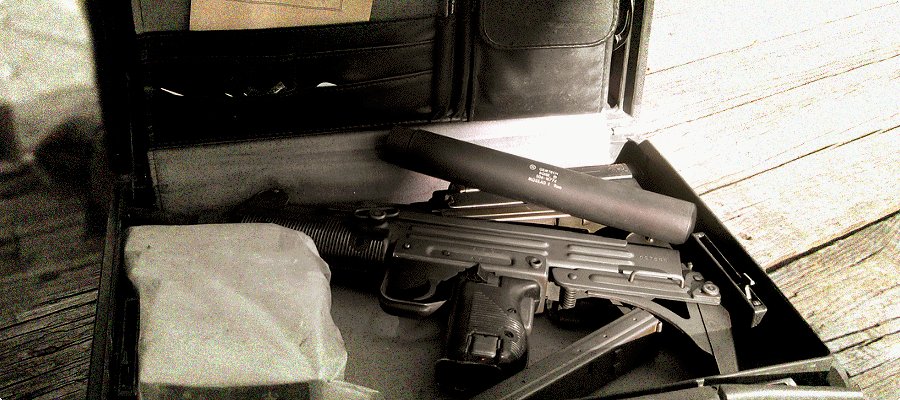
My first exposure to GEMTECH was a suppressed UZI SMG; fitted with a MOSSAD
suppressor. The MOSSAD threads directly to the UZI’s barrel nut, and today GEMTECH
manufactures an improved version of the original MOSSAD, the MOSSAD II.

Photo Courtesy GEMTECH - MOSSAD II

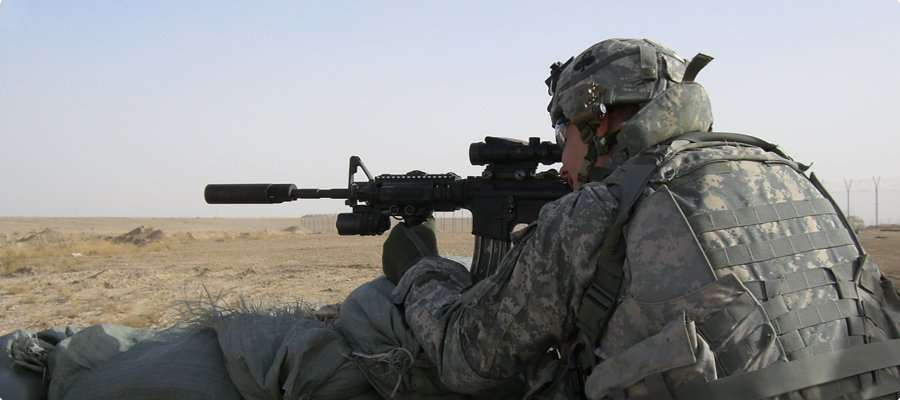
Equally notable is the GEMTECH HALO a 5.56mm rifle suppressor that mounts directly to the rifle’s existing muzzle device without modification. It has an overall length of 7.2″ and a tube diameter of 1.5″. The HALO uses 300 series stainless steel and inconel making it a robust hard use signature reduction device.

Photo Courtesy GEMTECH - HALO

The 7.62×51 caliber is the defacto standard for precision engagement rifles like the venerable M24. GEMTECH manufactures a number of suppressors specifically designed for a sniper weapon system, for example its SANDSTORM.

Photo Courtesy GEMTECH - SANDSTORM

The SANDSTORM is usable in both 7.62mm and .300 WinMag. This suppressor has an overall length of 7.8″ and a diameter of 1.5″. The SANDSTORM threads mounts to the muzzle using a 5/8-24 or 18×1.5M thread pattern.

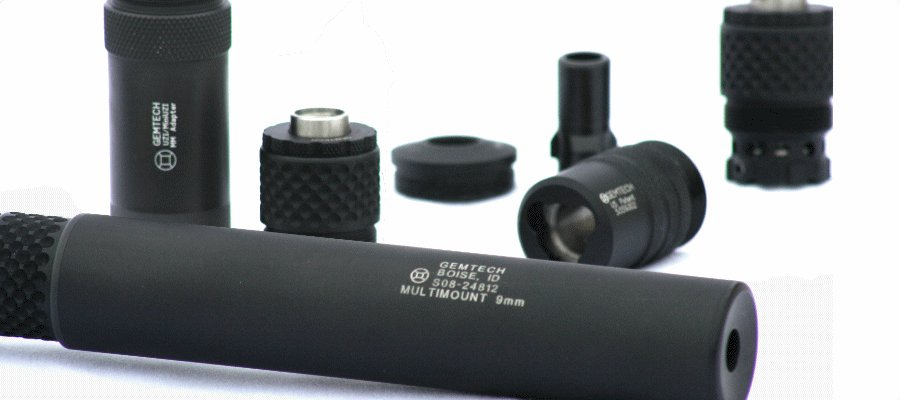
GEMTECH pistol suppressors are  among the best available. The company manufactures pistol suppressors in .45 ACP, 9 mm and 5.7×28 mm. The most versatile design in their inventory is the MULTIMOUNT. The core component is the 9 mm suppressor module, the customer can then purchase a variety of mounts to accommodate the variety of platforms in use.

Photo Courtesy GEMTECH - MULTIMOUNT

Posted in Muzzel Devices, Sniper Systems and Tools, Suppressors, Uncategorized | Tagged , , | Comments Off on Suppressors Current State of the Technology – Part 9 – GEMTECH

Why Do You Like the Dragunov Ranging Reticle… Reader Question

A reader asked me to explain why I like the Dragunov ranging reticle.
First, let me apologize for not responding in a more timely manner but I’ve been up to my eyes in work.
The explanation has to begin with the central question, and that is why we use ranging reticles.
A ranging reticle performs a number of functions. First it has to provide you with accurate range information as quickly as possible. Second, it must allow you to decisively engage your target. Third, it must allow you to correct your fire.  All three are critical to a successful operation.
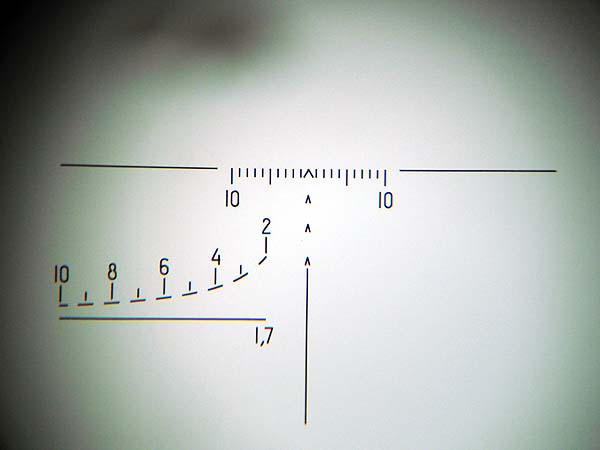
If you look at Figure 1, you’ll see a 1,7 this means that the ranging reticle is calibrated for a 1.7 meter target which translates to a 5’6″ target  or 66 inches.
If we divide Figure 1 into quadrants, the third quadrant contains the ranging element of the reticle.
To range a target place the target image so that it sits between the enumerated top line and the horizontal line below. When the target in squarely bracketed between top and bottom lines read the target range shown along the top enumerated line. Note that all ranges are in meters. The number 2 indicates 200 meters, the next tick mark to the left of the number 2 is 300 meters, etc. Now, lets assume that the target is not fully exposed. Furthermore lets assume that all you have is the upper torso. What’s the range to the target now? Simply bracket the torso and read the range. Lets say that it’s 4 0r 400 meters. Since the torso is about half of the full target size simply dive by two. The actual range is 200 meters. Making it more complex yet, let’s say that only the shoulders and head are exposed. Proceed as before by bracketing the target and reading the top number. Let’s assume that number is 8 or 800 meters. Since your target is head and shoulders, which is approximately one-fourth of a full size target we dive 8 by 4 and arrive at 2 or 200 meters. Note that you can also interpolate. For example, the exposed target is 10 inches high and when you bracket the target it falls between the 6 and 7 tick mark. You would call that 650 meters; the 10 inch target is approximately one-sixth of a full target so divide 650 by 6 to get a target range of 108 meter.
The fact that you may be engaging taller or shorter targets should not distract you as the proportions tend to be the same. This ranging reticle will provide you with extremely fast ranges that have better than combat accuracy.
The chevrons are hold points at specific ranges for a specific caliber and those will vary with the weapon system and ammunition.
The top horizontal line is calibrated in mils so I can use that for wind holds and to determine target movement, direction and speed, in other words target leed.
My own proficiency with the Dragunov ranging reticle is high enough that at a known range I can give you the target height, as well as range normally.
There are great reticles available, like the Horus reticle, but if they don’t deliver on the criteria mentioned earlier, they’re useless.
Disclaimer: All of the calculations discussed in this post are not precise nor do they need to be. The intent is to illustrate how quickly range can be determined without the use of mil calculators or other apparatus.
Posted in Optics, Weapon systems | Tagged , , | Comments Off on Why Do You Like the Dragunov Ranging Reticle… Reader Question

Is There A Vaginal Pulmonary Link?

Recently, I was at a local Starbucks enjoying a Verona French Press doing some research for a review I’m working on. A few minutes after my arrival two individuals arrive. One wearing an N.Y.C. shirt. The other, a female, was dressed in pink tights with black shorts – clearly dance apparel.

They begin to talk, but their tone was loud and their N.Y. accents conspicuous. It was annoying to everyone in the establishment. However, their rudeness was not the point of curiosity.

Most human speech occurs in half-duplex form, meaning one person speaks at a time. These two defied that MO and spoke concurrently or in full-duplex to each other. The woman was particularly obnoxious. She spoke at a rate and so voluminously that it was physiologically impossible for her to breathe. I was amazed by this but on closer inspection, I saw her wildly fanning her legs back and forth in such a prosaic manner and at the same rate that she spoke, which lead me to the conclusion there may have been a vaginal pulmonary link.

It was amazing!

Posted in True Story | Tagged | Comments Off on Is There A Vaginal Pulmonary Link?

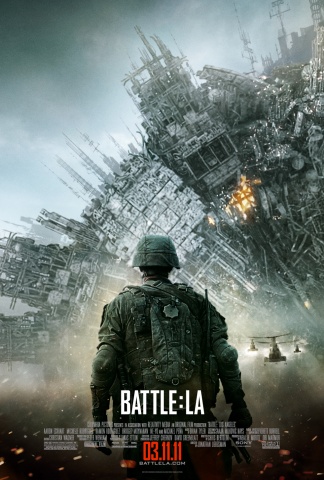
Battle: Los Angeles

It’s time for an addition to our Moral Builder section with a movie review and we’ve chosen Battle: Los Angeles. If there was ever a lack luster “combat / war” movie, this was it.

It starts with scenes from Camp Pendleton, home of the 2nd Battalion, 5th Regiment U.S.M.C. otherwise referred to as the “25.” Aaron Eckhart plays veteran Staff Sgt. Nantz who after a number of combat tours in Iraq decides to take his 20 and rotate to the world. His plans are sabotaged by persnickety aliens that decide to invade planet Earth for its water. Although the reason(s) for the invasion was never developed in the story, an egghead from some university (probably NYU) postulates that water is a form of fuel for the invaders; they’re here to take our water –  a concept so ludicrous that it’s laughable. I’ll explain why in just a minute, but it is a glaring example of how poorly researched this film was.

This is why water makes for very poor fuel. Water is H2O, that means it has two parts Hydrogen and one part Oxygen. The source of energy in water is Hydrogen because it contributes a single proton, a single electron and a single neutron. Using electrolysis (large electrical current run through water to separate O from H2) leaves and H2 or hydrogen gas atom – highly explosive I might add. Because H2 is in its most stable form, splitting it into 2H (two hydrogen atoms), to get two electrons and two protons and two neutrons, requires an enormous amount of energy. The aliens would better off vaporizing humans to extract the hydrogen (H) from the carbon chains in our bodies. Folks, I can assure you that there is not a respectable alien in the Universe that would use water as a fuel. Take my word for it okay!

Anyway, the aliens hit every major metropolitan center across the planet – sound familiar? That’s because its been used in virtually all alien invasion movies ever made. When news of the invasion broke, Staff Sgt. Nantz’s C.O. cancels his retirement and places him in a unit with a rookie LT. His problems worsen when his squad finds out he got some Marines killed in Iraq – an idea later dispelled with a moving speech, from Nantz, in which he calls out the dead’s names and serial numbers.

Nantz’s squad is ordered to move to an abandoned police station to rescue civilians. As Nantz’s LT manuevers his squad, his ineptness is revealed which climaxes as it becomes clear that he’s gotten himself into a complete cluster-fuck (military jargon for bad situation). It is at this point that he allows Nantz greater latitude, but a supportive Nantz always insists that the LT lead.

Along the way, Nantz’s squad picks up Air Force Tech Sergeant Elena Santos, played by Michelle Rodriguez. Santos was on a “secret” mission to locate “The” Command and Control alien ship. Folks, the second thing that respectable alien invaders would never do – especially one’s capable of interstellar travel – is create a single point of failure in the invasion force – joins up with Nantz’s squad. Upon her arrival Nantz hands her an M4 saying “Airman, I hope you know how to use this…” to which she says “Staff Sgt. I didn’t get my stripes on my good looks…” I couldn’t stop laughing but I can assure you that it wasn’t marksmanship that got her promoted.

With civilians (one who is a veterinarian) and Santos in tow, Nantz wounds an alien. They decide to dissect the creature to determine where to shoot it to kill it. They cut into its chest and begin to stab various parts of it with a K-Bar to see what spot would lead to its death – LOL. They find that a spot to the right of where a human heart would be is where you need to hit them to kill them. Once they find that spot Nantz orders his squad to shoot to the right of where the heart would be. Information that he never shares with his command and control.

Nantz and his squad slug their way through Los Angeles arriving at the extraction zone with the remaining members of his party. The Helo takes off  when he and Santos spot “The” Command and Control ship. Nantz orders the pilot to put him 20 feet above it. Unable to comply, Nantz decides to fastrope into the AO alone; however, his team, including Santos, inspired by Nantz courage fastrope in with him. Once in position, they use a laser designator and call in an air strike but “The” Command and Control ship uses drones to target the incoming missiles. Finally, Santos attacks one of the drones with an AT4 taking out the drone, which allows the incoming missile to hit “The” Command and Control ship.

It wasn’t a complete disaster but pretty damned close. Throughout the movie you get a sprinkling of some good fire fights but that’s all you get. If you’re a closet commando, you may like this movie because it’s full of inspirational one liners.

Regrettably, it’s consistent with the endless supply of crap coming from Hollywood lately. Where has good art gone?

Posted in Morale Builders | Tagged , | Comments Off on Battle: Los Angeles

Individual Carbine RFP (Update)

Readers following the Individual Carbine solicitation should be aware that the RFP is finally out. Please refer to my previous article for a link to the complete set of documents.

It’s important to note that the RFP does not, in any way, shape or form, cancel or modifies the PIP. The program improvement is alive and well and attempts to resolve some of the more glaring issues with the M4 like the bolt and carrier group. Manufacturer’s or designers have two paths they can take. First, supply some of the requested enhancements to the M4. You may also submit an individual weapon system, as detailed in the RFP.

One or both of those paths are available to you. Participation in any one path does not preclude you from participating in the other or both.

The process is consistent with PEO Soldier’s dual path approach articulated by Col. Tamilio’s Office.

Posted in RFP | Tagged , , | Comments Off on Individual Carbine RFP (Update)

The Long Awaited Request For Proposal – Individual Carbine

The Request For Proposal for the Army’s Individual Carbine Program is out. The Final RFP was posted today, 29-June-2011.

You can download the complete document here.

We will be following this competition closely so look for more on the subject.

Posted in RFP | Tagged , , | 1 Comment

SOFIC – Gallery

Cashing The Checks Can Be Hard On A Guy

Doin' All the Selling

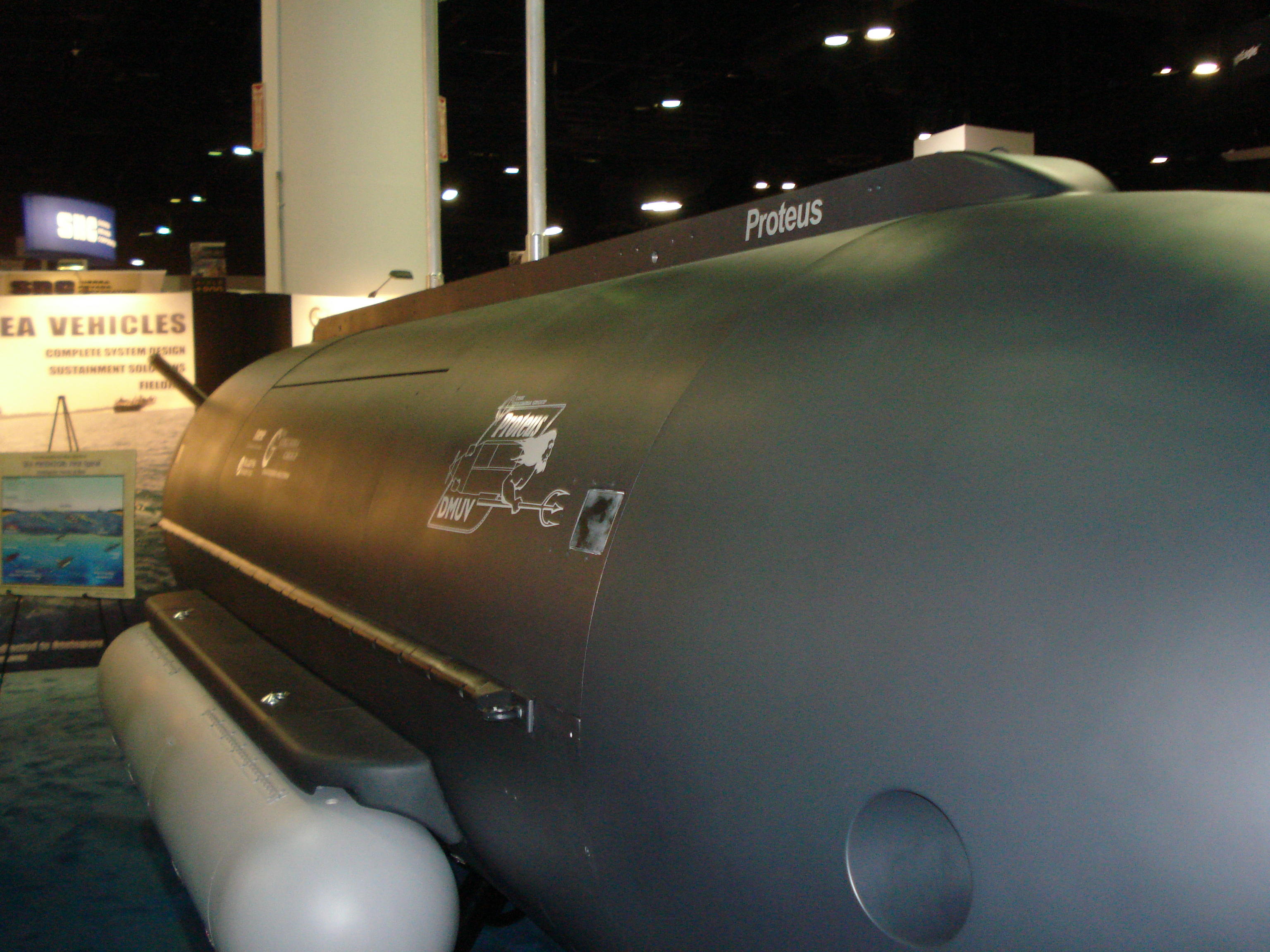
Seal Delivery Vehicle

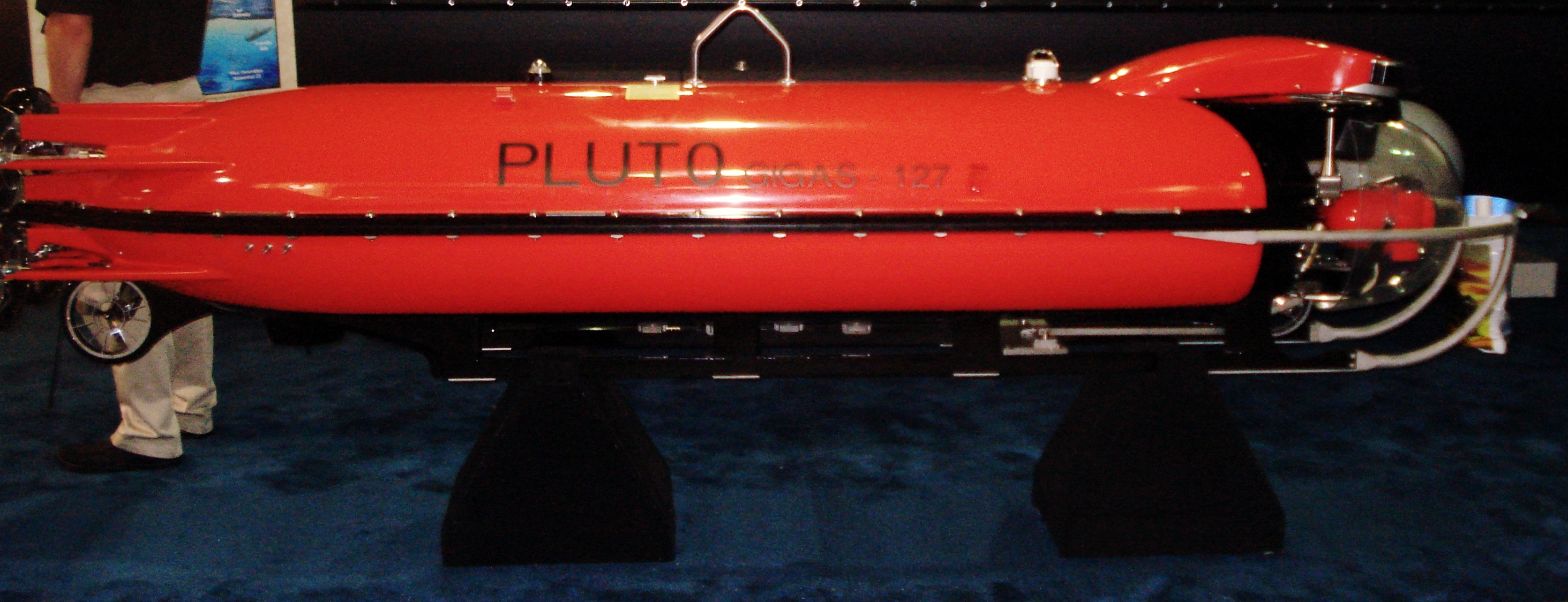
Pluto Gigas - designed and developed to meet operational requirements. Remotely operated mine disposal vehicle capable of operating in sea currents up to 5 kt, at depths down to 1,000 m and at long ranges.

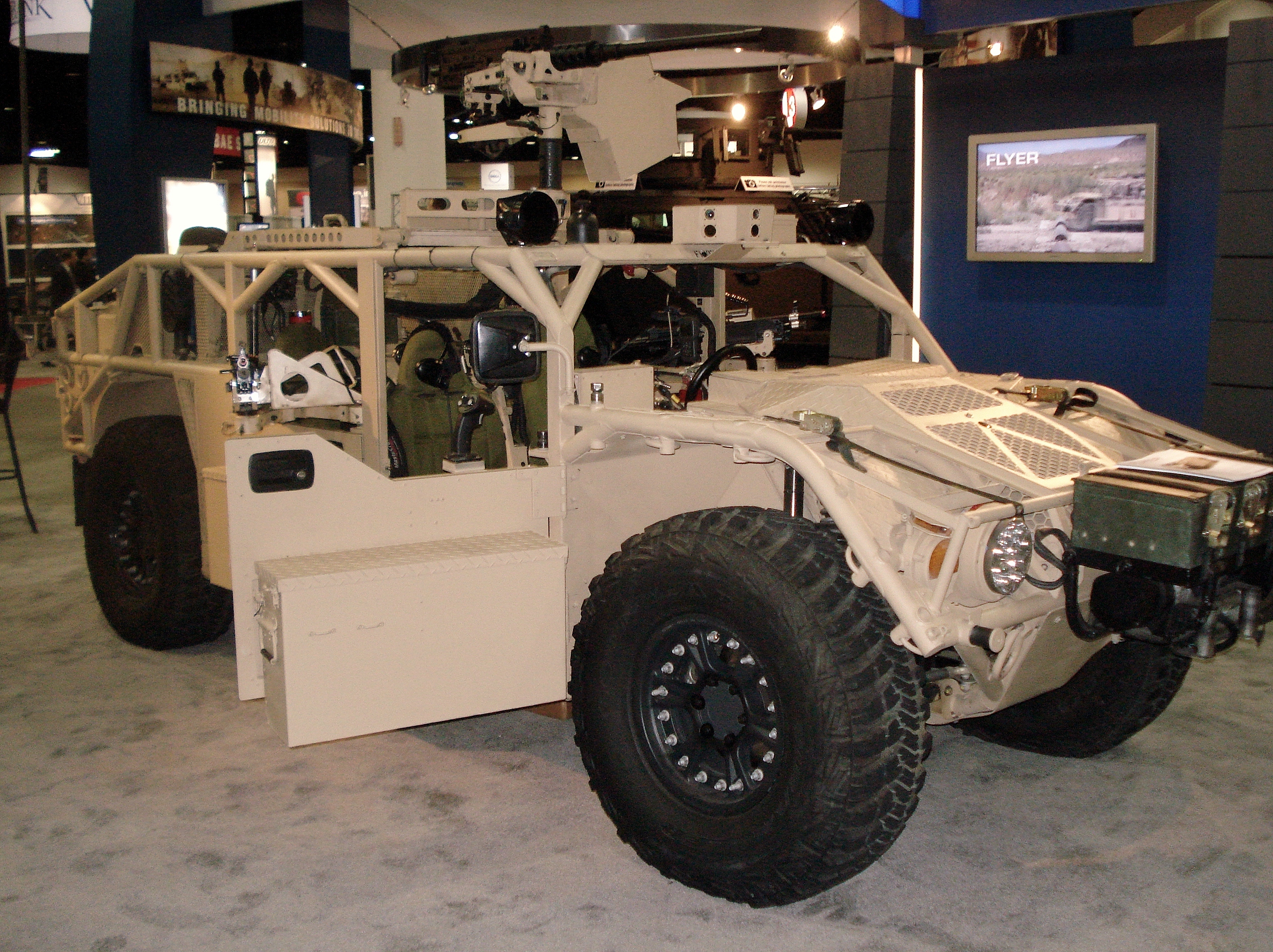
General Dynamics Flyer - Designed to provide land mobility and transportable via CV-22

MASSIF designers and manufacturers of some of the best combat apparel available.

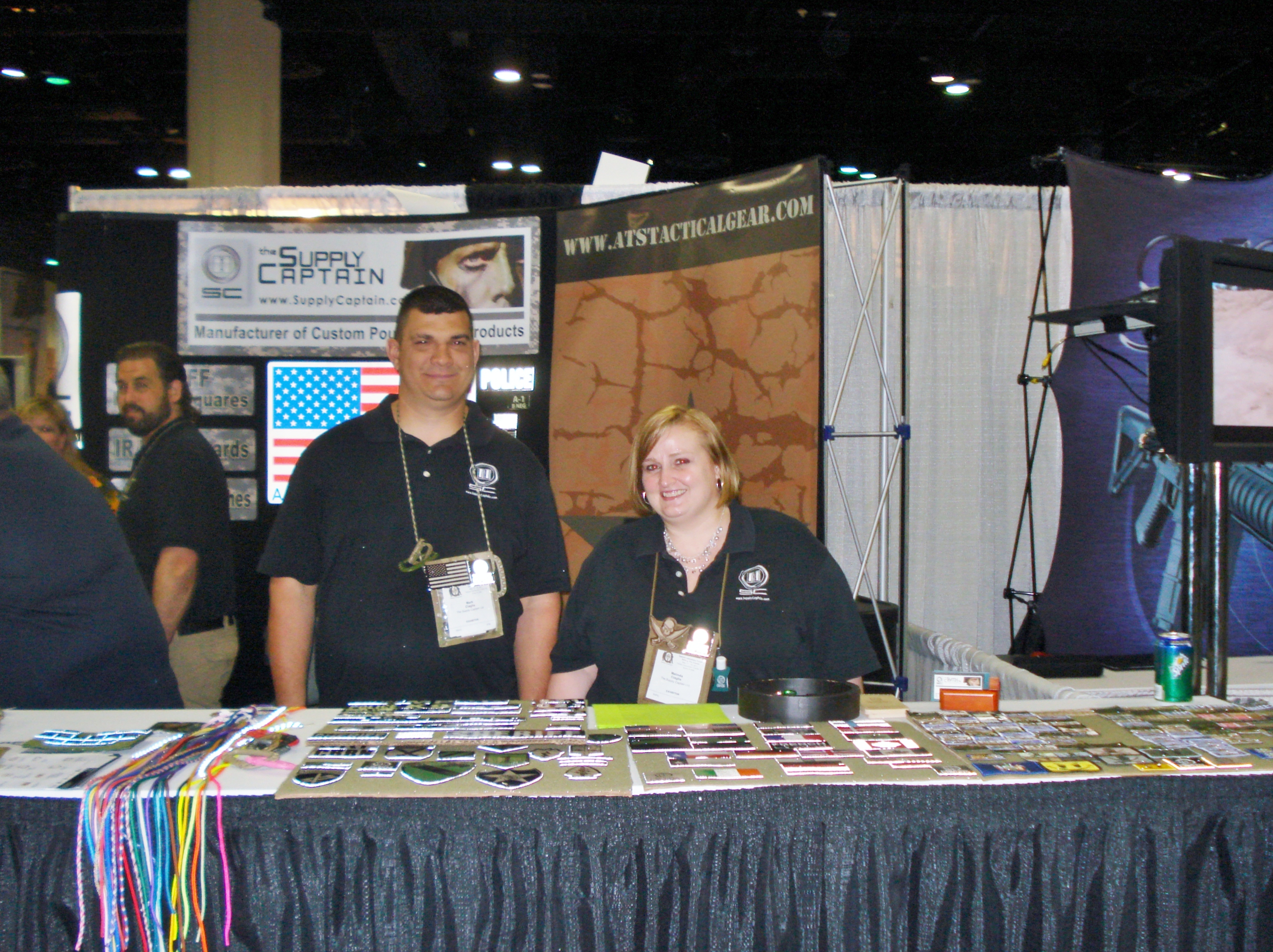
Supply Captain are purveyors of just about anything. Great folks to do business with.

Princeton Tec's MPLS - tactical personal lighting system designed for high reliability and flexibility - A small light delivering high value.

ROTINOR - Manufactures dive jets

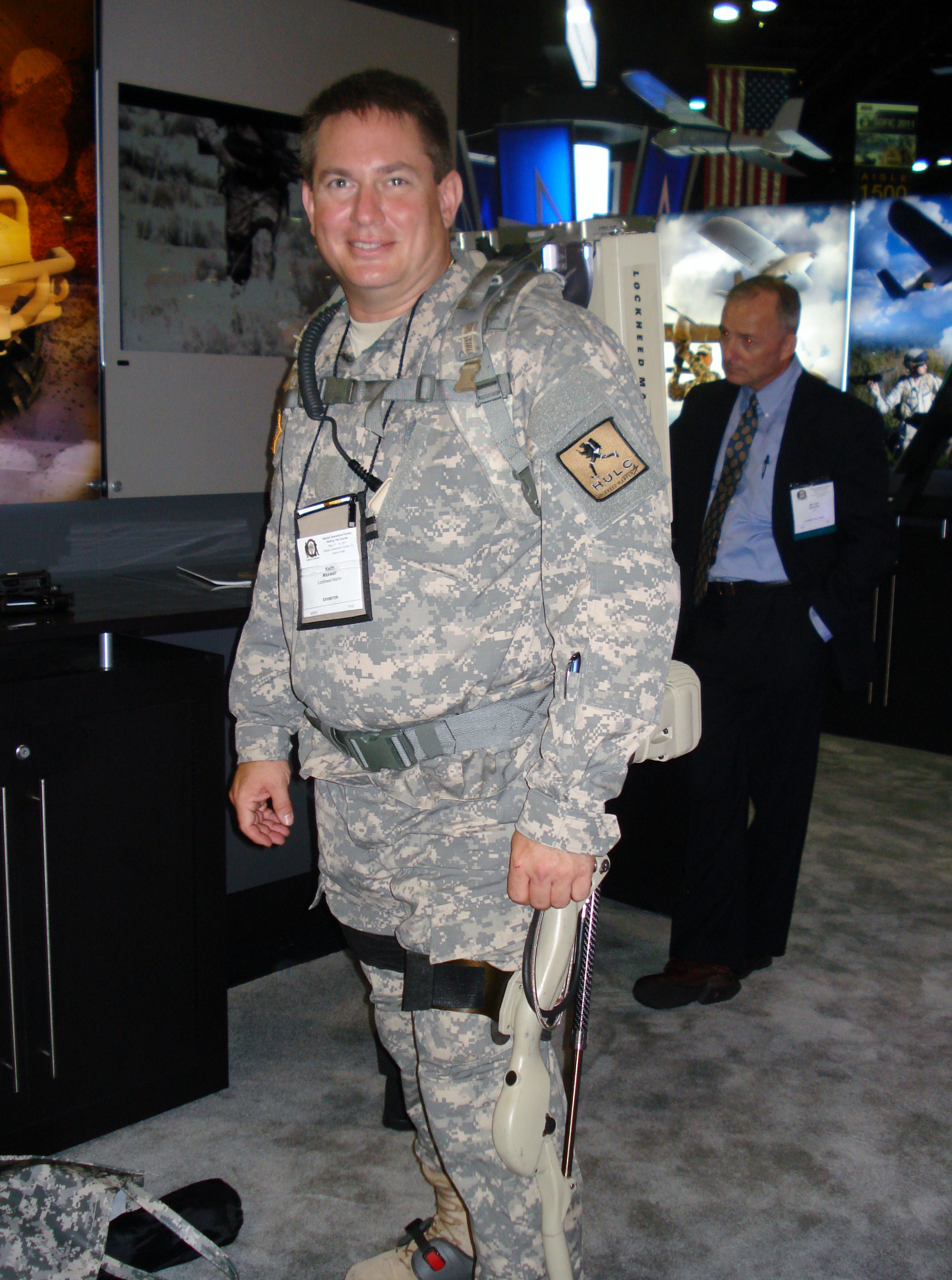
Lockheed-Martin's Exoskeleton - Take the load off.

BAE Systems - Some of the finest tactical gear available - covert plate carrier and modular plate carrier system.

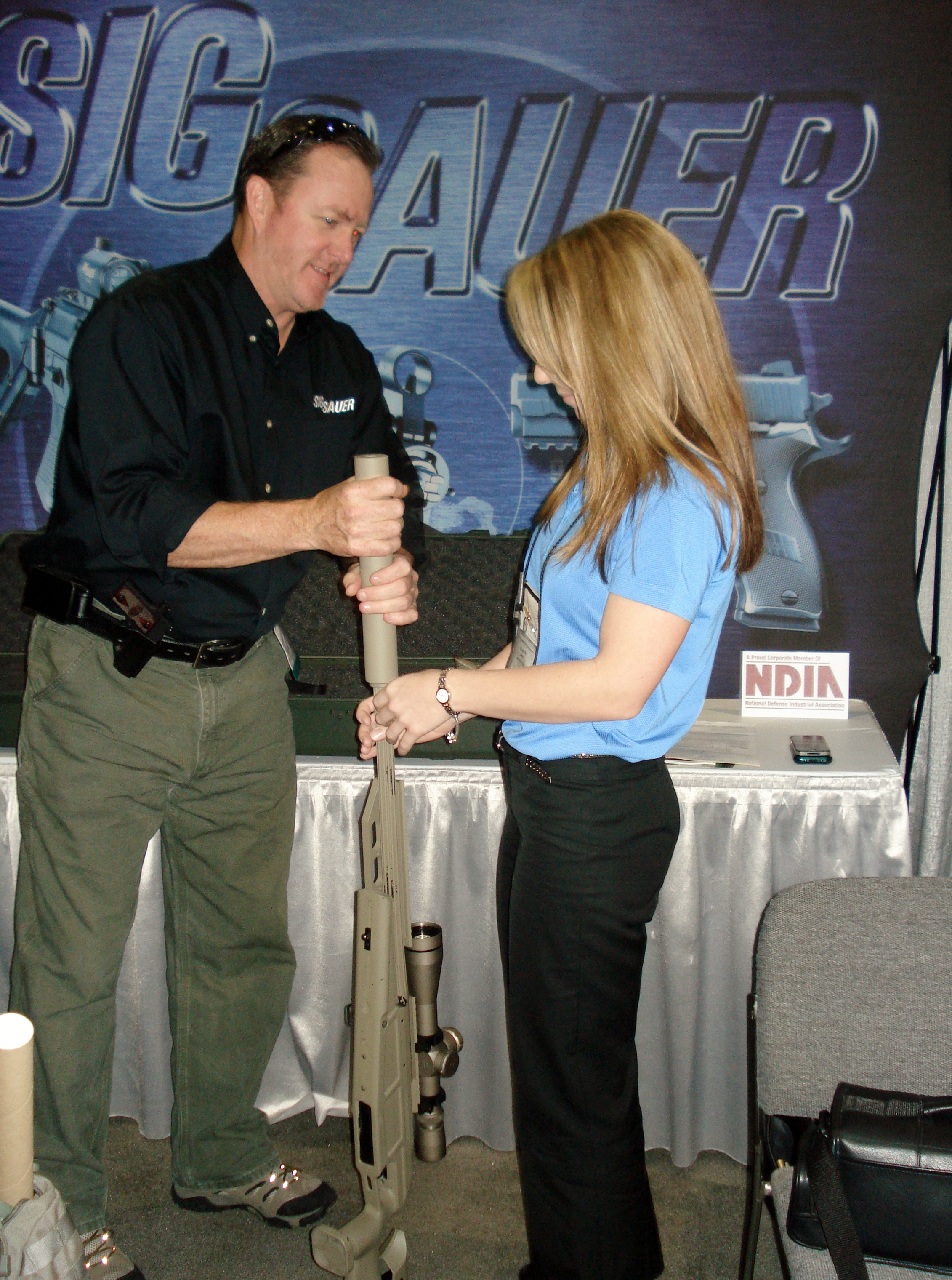
SIG ARMS - Blaser Sniper Rifle System (Shown Suppressed) - Straight Pull Action

Johnny Johnson, SIG Arms, demonstrates how easy it is to attach the suppressor - Uh hum..

Ashbury International is a diversified consulting business that also happens to manufacture highly prestigious sniper weapon systems.

Leupold Stevens - generations of superb tactical and military optics.

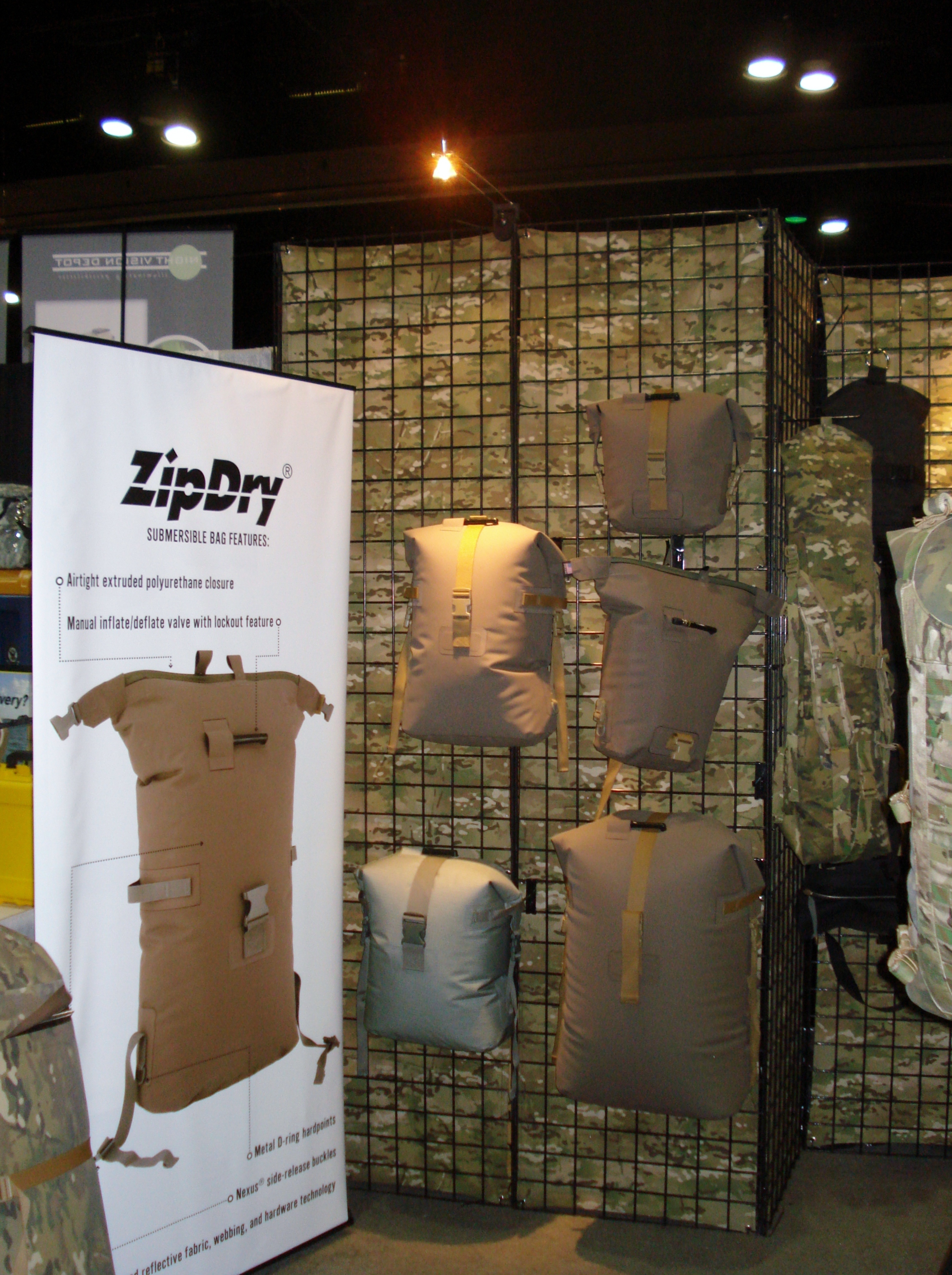
Zip Dry - designs and manufactures water tight bags, packs and pouches.

Posted in FN, Gear, Mobility, Muzzel Devices, Optics, Sniper Systems and Tools, Soldier Systems, Suppressors, Tactical Lighting, Weapon systems | Tagged , | Comments Off on SOFIC – Gallery

SOFIC 2011 – Engage

The last part of the USSOCOM equation “Understand, Communicate, Move, Engage” addresses the kinetic component of the SOCOM mission.
Active projects embraced by the engage variable include weapons, munitions, operator survivability, signature reduction, non-lethal technologies, vision augmentation and a variety of other activities that carry a classified status. Major programs and the offices responsible for development, acquisition and management are listed below:
    • Visual Augmentation SORDAC-ST
    • Target Engagement SORDAC-ST
    • Non-lethal Interdiction of People and Vehicles SORDAC-ST
    • Advanced Energetics SORDAC-ST
    • Combat Swimmer Thermal Protection System PEO-M
    • Dynamic Ride Impact Mitigation PEO-M
    • Advanced Materials for Armor and Weight Reduction SORDAC-ST
    • Multi-spectral Signature Reduction SORDAC-ST
Posted in ISR, Soldier Systems, Weapon systems | Tagged , | Comments Off on SOFIC 2011 – Engage

SOFIC 2011 – Mobility

Understanding and Communicating are all prerequisites to Engage but the equation falls apart if you can’t move your teams with safety, speed, reliability, and a modicum of comfort; a lesson learned from operations in Iraq and Afghanistan, where better than 65% of all deaths were due to Improvised Explosive Devices or IEDs. This is a staggering number and it’s no surprise that the DoD worked tirelessly to up-armor land mobility assets in theater; a move followed by all coalition partners.

The Mine Resistant Ambush Protected vehicle (MRAP), designed by the USMC and in service since 2002.

BAE

MRAP development is a DoD wide initiative but there are SOF peculiar requirements.

USSOCOM for fiscal year 2012 will fund a number of mobility projects.

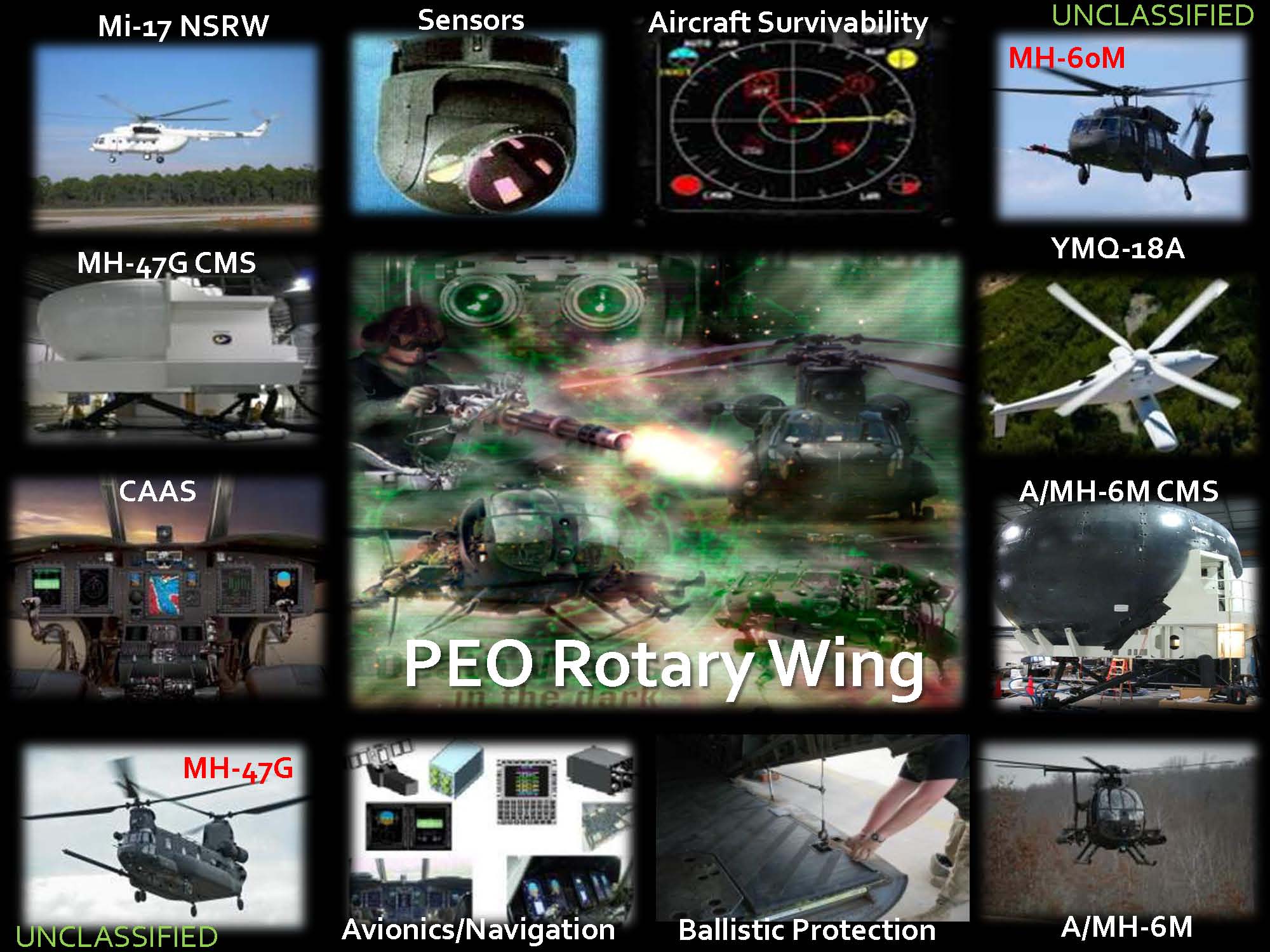
The Rotary Wing has and will continue to add aircraft, upgrade navigation, threat detection, survivability, sensors and weapon systems.

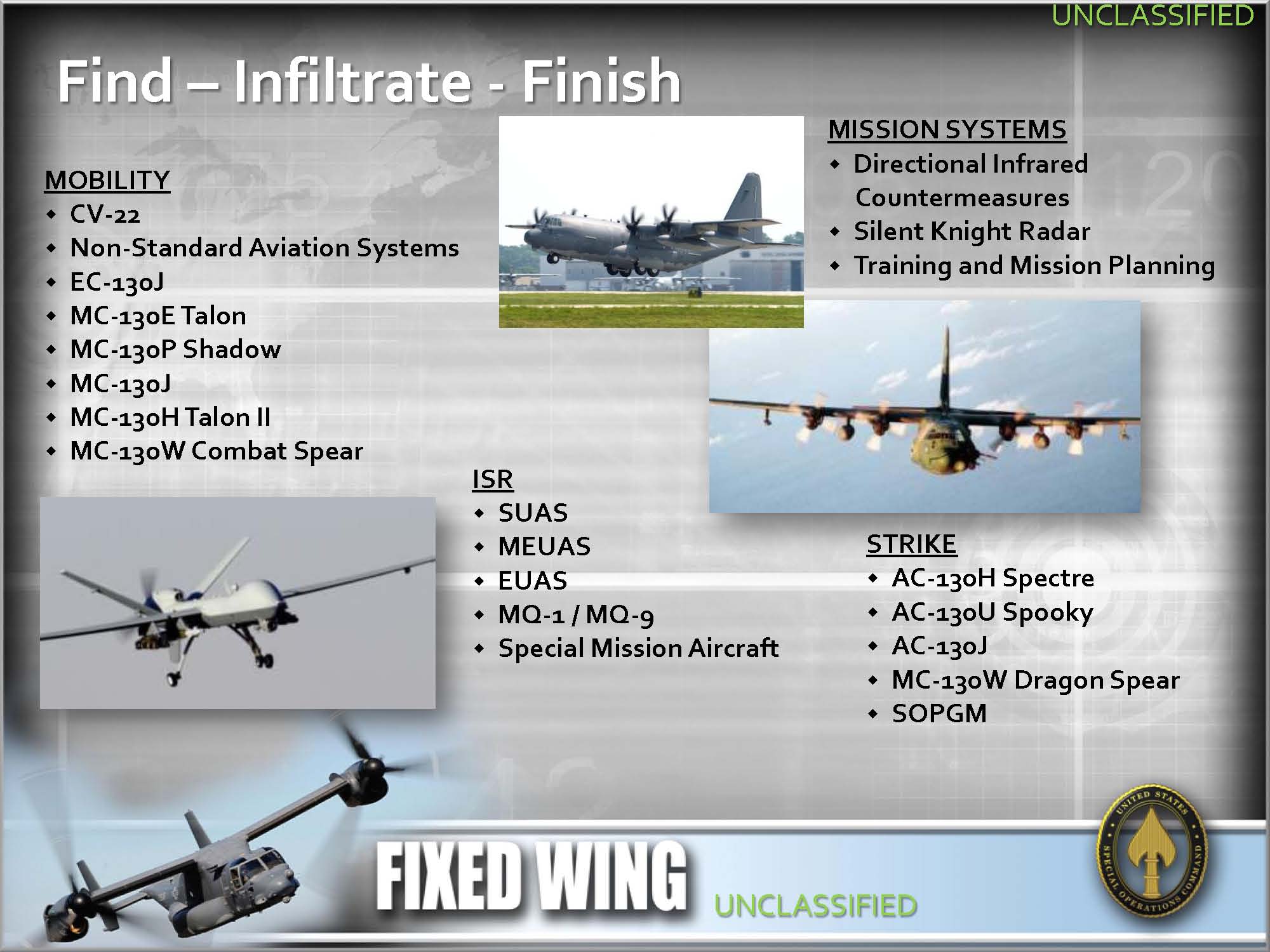
The Fixed Wing side of the house has also had a busy year with more work to be done. The slide below identifies the many projects the PEO-FW will manage.

The PEO-M, Maritime is looking at enhancements to the existing small vessel inventory to mitigate the risk of physical shock. If you’ve ever been on a ski boat or a speed boat, traversing just a small wave can impart a considerable shock to the occupants. USSOCOM wants to reduce physical shock. PEO-M will also be working towards improved sensors, improved survivability, navigation, stealth technology (visible, radar and heat signature), multi-fuel outboard engines, SEALS will be looking for reliable undersea mobility, improved batteries and a SEAL Delivery Vehicle.

Posted in Mobility | Tagged , , | Comments Off on SOFIC 2011 – Mobility

SOFIC 2011 – Communicate

In my last SOFIC 2011 post, I touched on the “Understand” component of Adm. Olson’s vision for USSOCOM post Geronimo EKIA. It is at the heart of everything that USSOCOM does but more importantly it is key to meeting our military and intelligence objectives going forward. If the NIC is correct in their assessment of our intelligence needs into 2015 and beyond; then, understanding better than the other guy will be a decisive factor as to whether we win or lose.

Communicate, on the other hand, has immediate application and there is considerable interest at all levels of USSOCOM and the DoD to improve on communications. The JTRS is a significant but not all-inclusive part of the strategic view on communications. The netcentric battlefield is alive and well even if the Army’s Future Combat Systems was scrapped.

SOFIC 2011 was a great venue to pick up on some of the discrete components. This year, I had an excellent opportunity to meet with some of the Elbit folks all of whom were kind enough to discuss Elbit Systems Land and C4I – Tadiran’s DOMINATOR®.

It’s my understanding that as of this writing, DOMINATOR® is deployed with the IDF. The Integrated Infantry Combat System, integrates voice, data and video to deliver a complete C4ISR solution. Some of the features that I was very much impressed with is VoIP support, cell phone and legacy PBX support as well as RF over IP or ROIP. I think Elbit is forward thinking and on the right track with their solution.

The video links will give you a reasonably good idea of DOMINATOR® capabilities. The complete video consists of three two-minute parts, which should all be viewed in order.

Part 1

Part 2

Part 3

Posted in Comms, Electronics, ISR, Nav Aids, Soldier Systems | Tagged , , , , | Comments Off on SOFIC 2011 – Communicate

Algiz 7 Tablet from Handheld Now Certified by Verizon Wireless

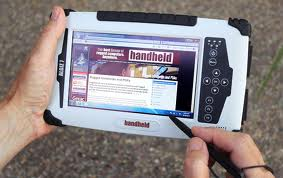
ALGIZ 7 Ruggedized Tablet

Handheld US, a North American supplier of rugged PDAs and devices, announced that its Algiz 7 rugged tablet computer is certified for connectivity on the Verizon Wireless network.

The Algiz 7 is an ultra-rugged, 7-inch widescreen tablet that runs Microsoft Windows 7 Ultimate operating system and offers users wireless communication across the globe. Optional 3G cellular capabilities provide high-speed GSM/UMTS/EVDO data transmission.

The Algiz 7 rugged tablet uses Gobi™ 2000 technology that supports both GSM and CDMA high-speed data networks, giving users their choice of wireless frequency anywhere in the world. “Many of our U.S. customers have asked for Verizon Wireless compatibility,” said Dale Kyle, president of Handheld US. “The flexibility of the Algiz 7 gives our customers the opportunity to use the mobile network that serves them best. Adding Verizon Wireless, America’s largest, and most reliable wireless network to the Algiz 7 will be a tremendous benefit.” “We are seeing many industries migrate towards a tablet for their everyday business practices,” said Aparna Khurjekar, Executive Director, Open Development, Verizon Wireless. “

Handheld has a solid business model supporting those field service industries such as transportation, retail, public safety, government, utilities, and a host of others” The Algiz 7 comes standard with Bluetooth, WLAN and GPS as well as a built-in 2-megapixel camera with an LED light. It features an Intel Atom 1.6 GHz processor with a 64 GB solid state hard drive and 2 GB of DDR2 RAM. The Algiz 7 is rated IP65 and meets stringent MIL-STD-810G military standards for withstanding humidity, vibration, drops and extreme temperatures. Weighing a mere 2.4 lbs, this compact tablet is one of the lightest rugged 7-inch tablets on the market. The Algiz 7 is available now. Current Algiz 7 rugged tablet owners can contact Handheld US for Verizon Wireless network activation.

Posted in Electronics, ISR | Tagged , , | Comments Off on Algiz 7 Tablet from Handheld Now Certified by Verizon Wireless

Coming Attractions

I will continue SOFIC 2011 coverage with some very cool maritime and aviation mobility. I’ll also have more reviews completed on some pretty interesting gear and technologies. So, stick with us.

Remember that you can always visit FOG HORN to download or read any of the reviews.

Have a great weekend.

Posted in Alerts | Tagged | Comments Off on Coming Attractions

SOG ®PowerLock® Multitool

SOG Specialty Knives and Tool, LLC. recently added a new member to their highly successful multitool family. The SOG® PowerLock® offers an array of field expedient tools. The PowerLock® uses the patented Compound Leverage™ which acts to increase the torque much like a ratcheting system.

SOG’s Marketing Director, Chris Cashbaugh, gives us a video demo.

Posted in Knives and Tools | Tagged , , | Comments Off on SOG ®PowerLock® Multitool

RANDALL’S Adventure ESEE Knife Junglas

In the realm of survival knives Randall’s Adventure Training and Equipment Group has produced some extraordinary products. Their design philosophy is an extension of their experience in Survival, Escape and Evasion Training.

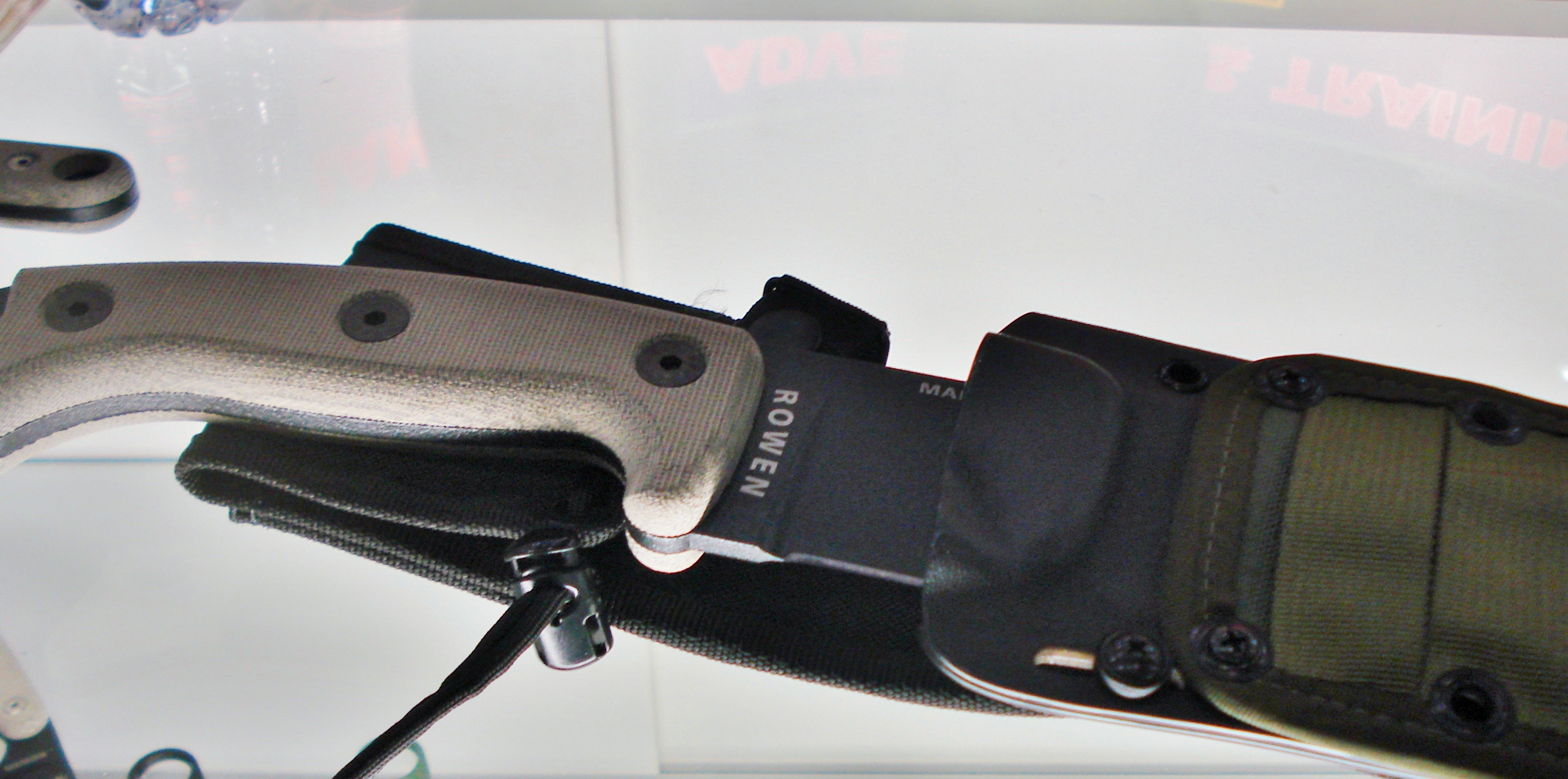
The ROWEN manufactured Junglas® fills every conceivable need from clearing brush to skinning. It is a massive blade that you can baton mercilessly without fear of breaking the point or edge. The sheath is brilliantly conceived with PAL webbing, which facilitates the attachment or other pouches – GPS or Survival to name a few. Great knife.

ESEE Junglas

ESEE Junglass Sheath with PAL Webbing - Love it!


Posted in Uncategorized | Comments Off on RANDALL’S Adventure ESEE Knife Junglas

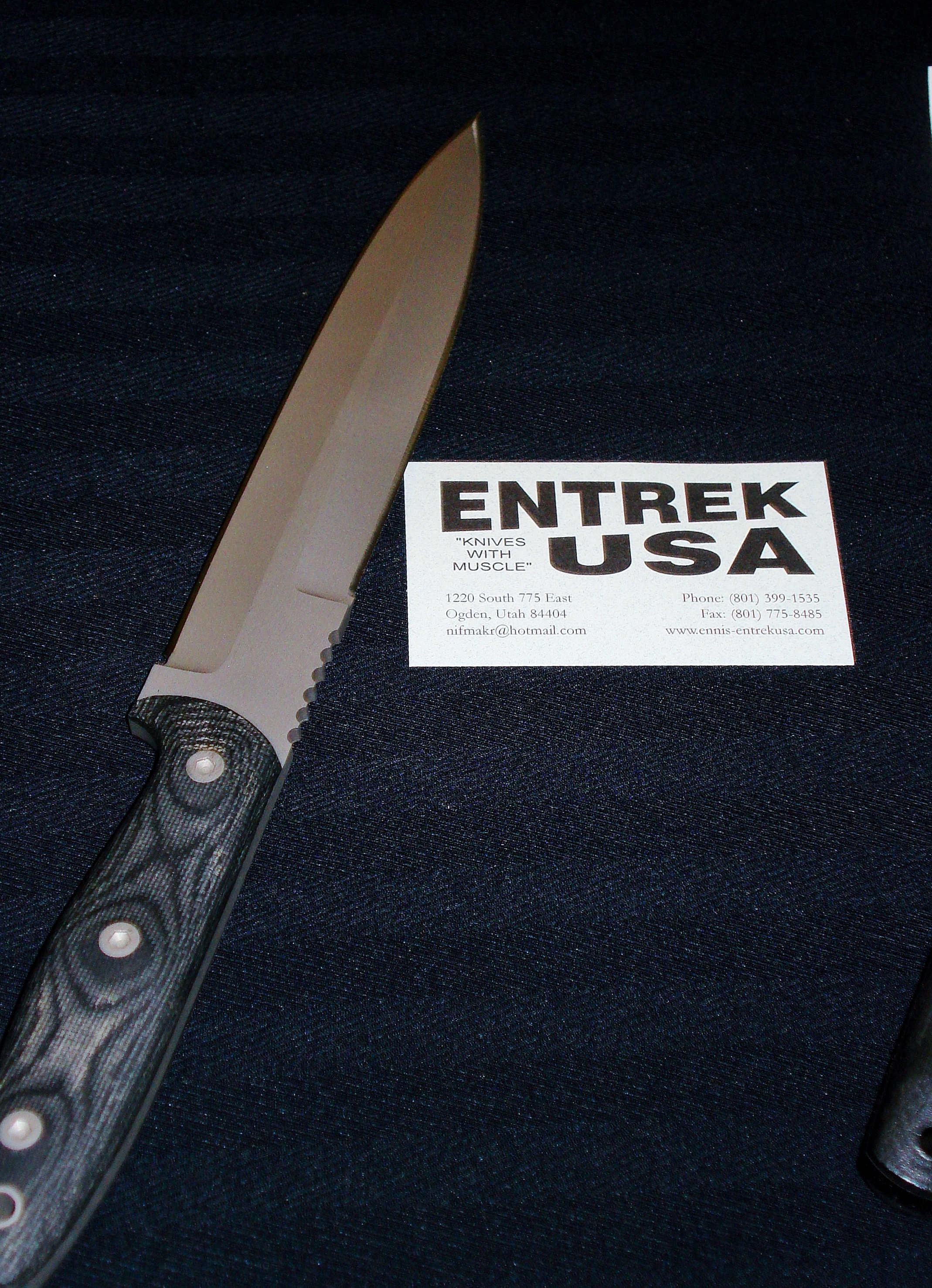
ENTREK USA Commando… Lean and Mean

Entrek USA Commando

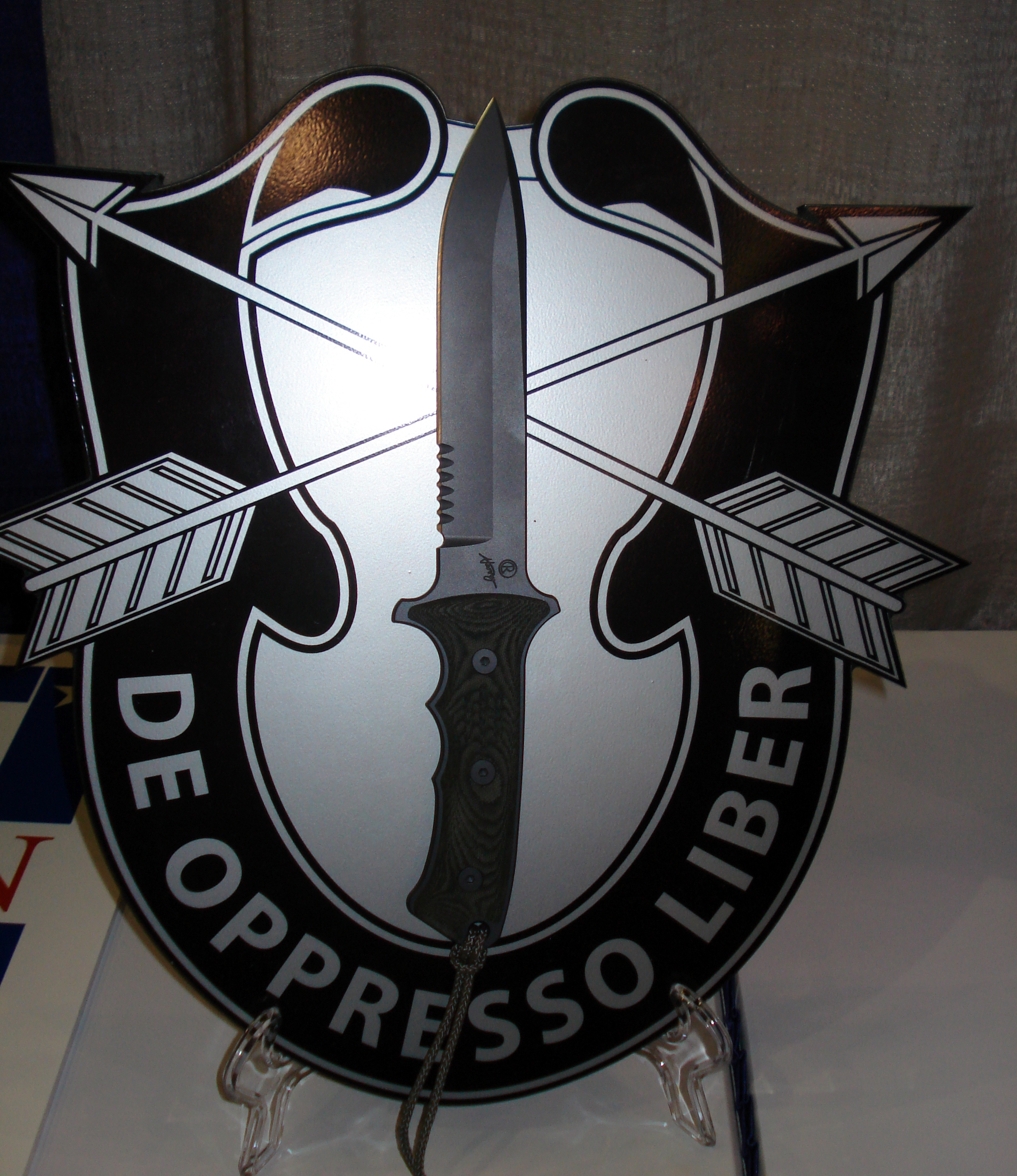
Entrek USA manufactures a small but muscular line of combat knives. Ray Ennis, Entrek’s owner and artisan has been designing knives since his teens. That experience was evident in the USA Commando pictured above. The USA Commando features a 7″ x 0.187″ 440C blade. The dagger design has an air of Sykes and Fairbairn. The Commando II comes in a black finish adding to they stealthiness of a dagger design.

Posted in Knives and Tools | Tagged , , | Comments Off on ENTREK USA Commando… Lean and Mean

MIL-TAC Knives & Tools Impressive Combat – Survival CS-2Ti

MIL-TAC Knives & Tools, Wylie, Texas is one of many young companies delivering superb products in direct support of military operations in Iraq and Afghanistan.

The company has a small but well diversified product offering that includes pistol grips (made from G10), tactical defense pens, fixed blade survival and combat knives, daggers, folding knives and rescue knives.

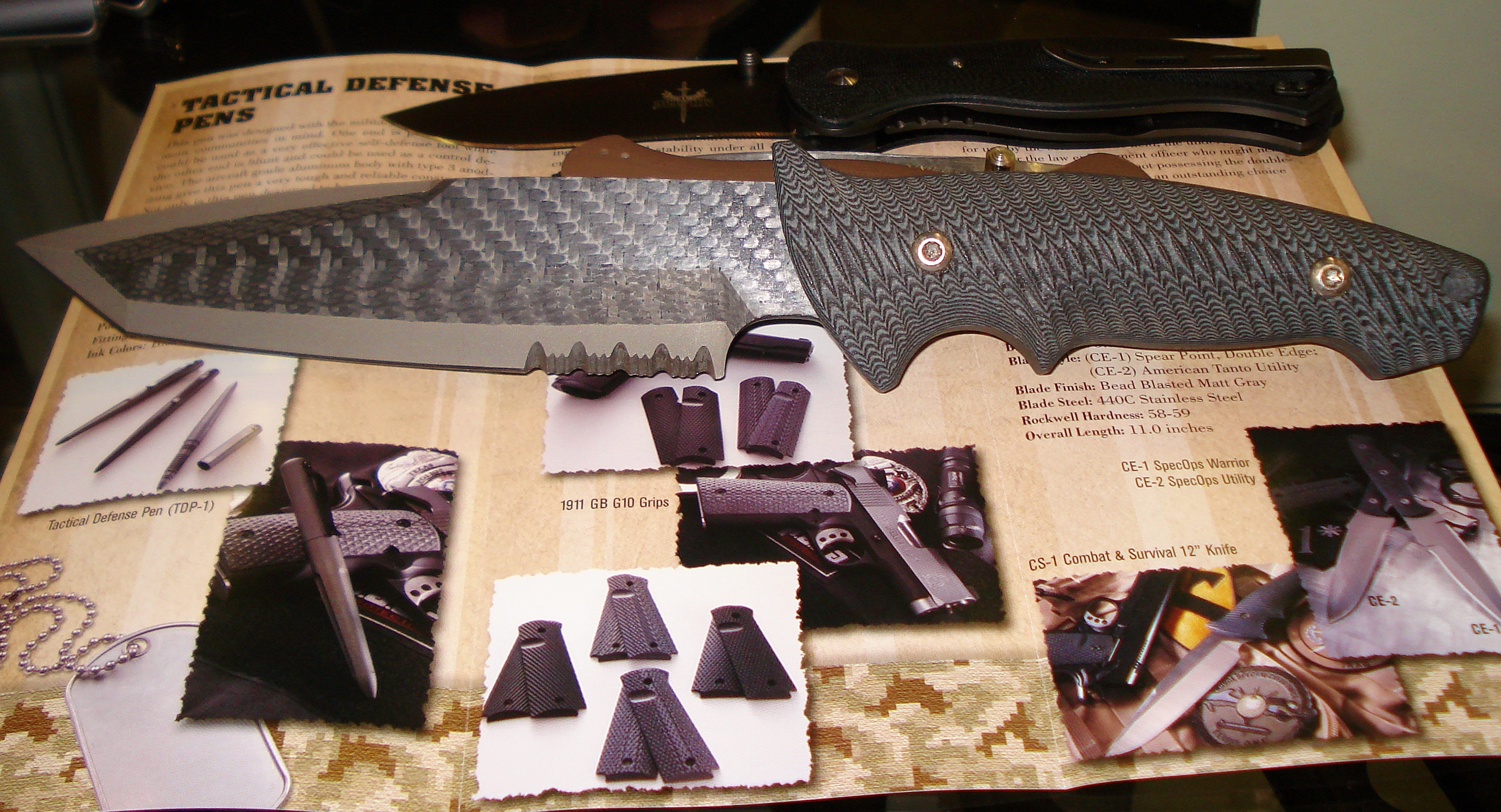
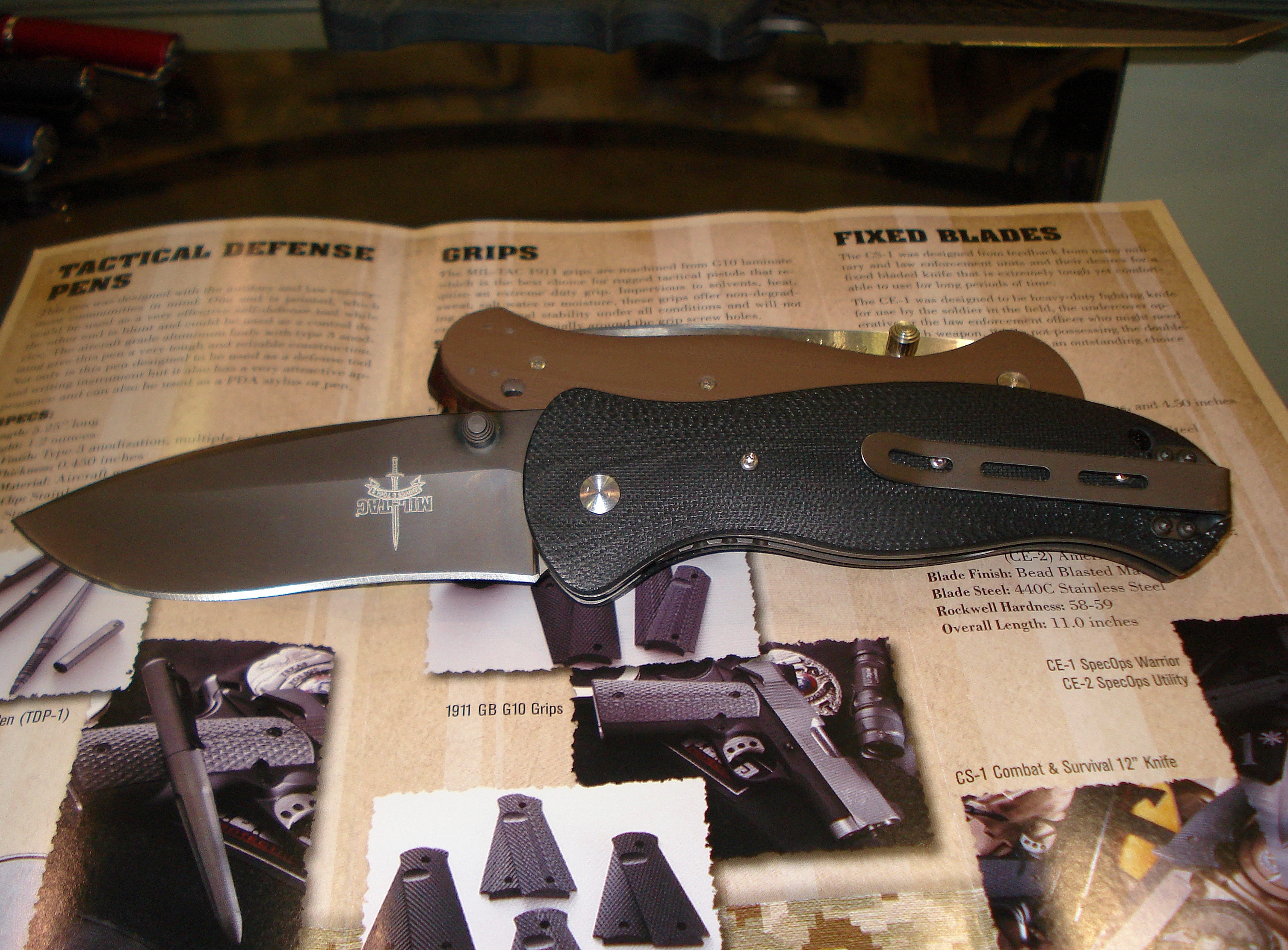
While at Blade 2011, I had an opportunity to take a close look at two of their designs. The Combat-Survival CS-2Ti, a beast of a survival knife, magnificently implemented in Titanium. The handle was broad and hand-filling wrapped around a broad full tang blade made from Titanium. Although I prefer steel, for ease of sharpening and maintenance, the CS-2Ti is extremely useful in an EOD role.


MIL-TAC Knives & Tools Combat Survival CS-2Ti


MIL-TAC Knives & Tools Folder with a beautiful recurve drop point blade.


Posted in Knives and Tools | Tagged , , | Comments Off on MIL-TAC Knives & Tools Impressive Combat – Survival CS-2Ti

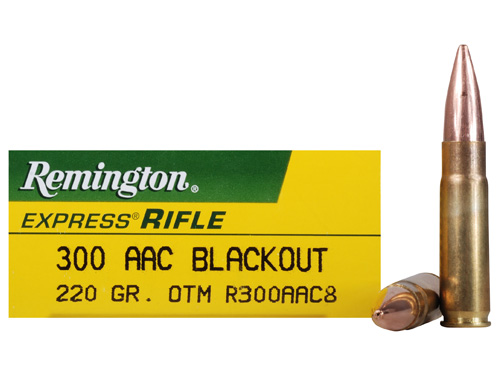
Remington’s 300 AAC Blackout Ammunition Now Commercially Available.

Remington is now delivering 300 AAC Blackout ammunition under the Remington Express® label. A total of six loads are planned, two loads are nearly ready and will be offered later in the year; three additional loads are in development.

Visit Midway’s web site to place your orders.

300 AAC Blackout Subsonic 220 grn Load.

Posted in Ammunition, Suppressors | Tagged , , , | Comments Off on Remington’s 300 AAC Blackout Ammunition Now Commercially Available.

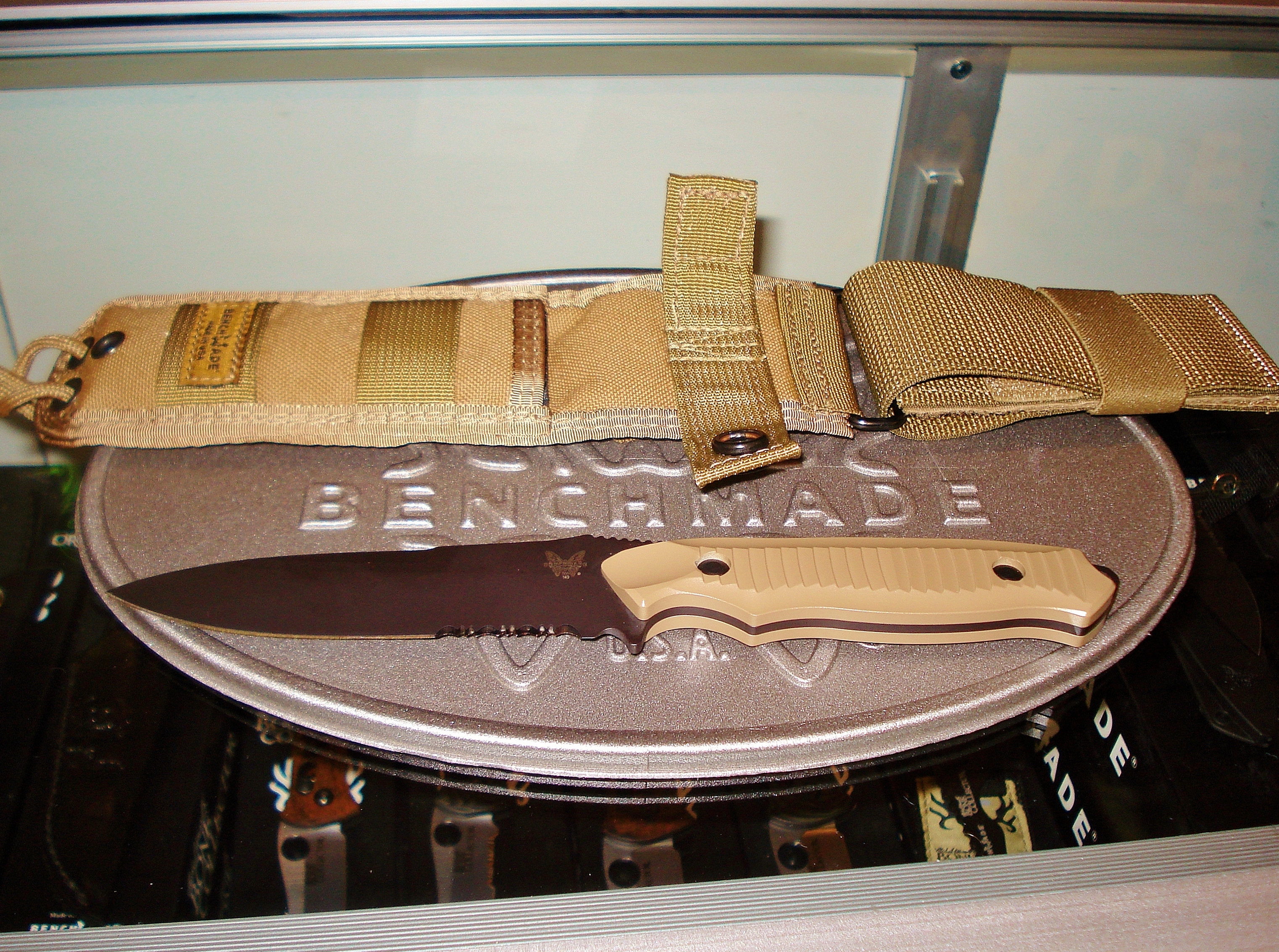
Benchmade Nimravus Now With A Redesigned Sheath

Benchmade designs and manufactures many of the world’s best military and combat knives, and the company’s products are known for quality and durability.

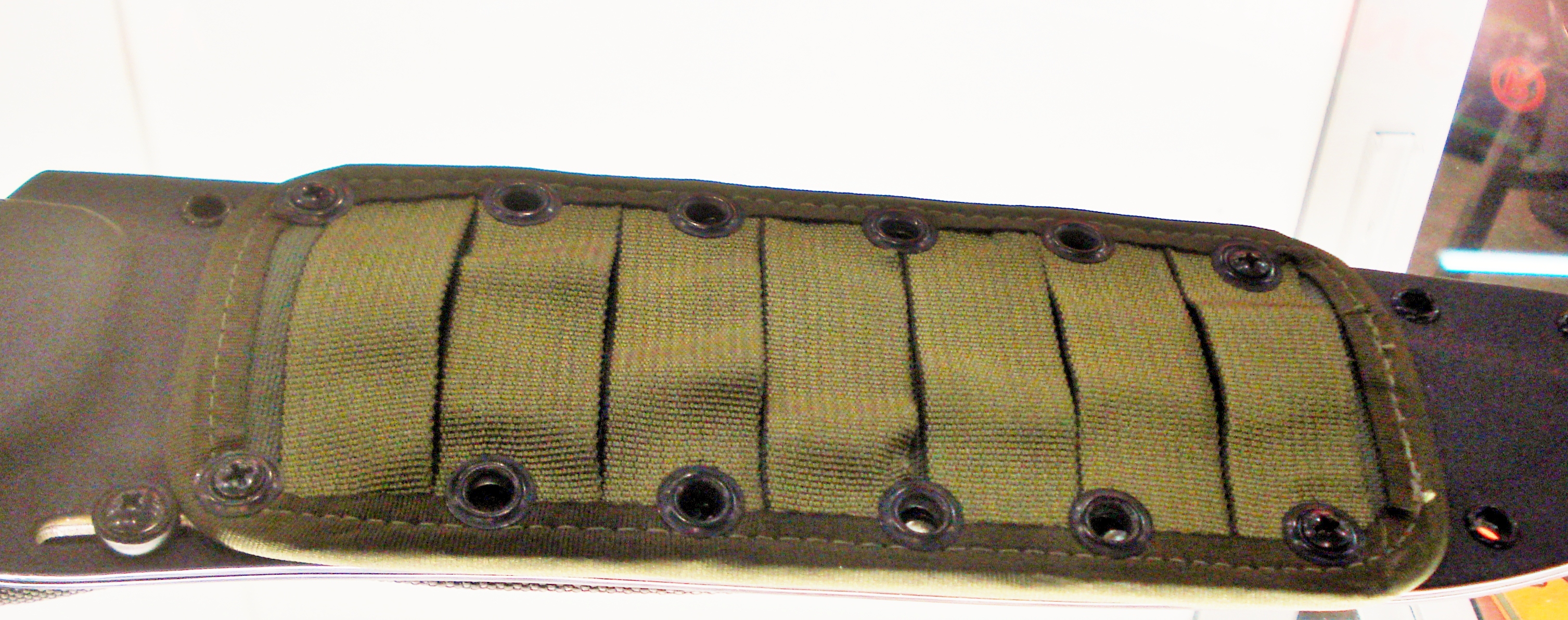
Benchmade’s Nimravus, fixed blade designs, are superbly capable combat knives but they were lacking in sheath design. This year, Benchmade turned that into a moot point with the introduction of an improved sheath for the Nimravus. The new sheath is PAL and MOLLE compliant, so the knife can be mounted to a contemporary tactical vests or plate carrier.

If you’re looking for a superb combat knife, look no further.

Benchmade's Nimravus with its redesigned sheath. An exceptional combat knife.

Posted in Knives and Tools | Tagged , , | Comments Off on Benchmade Nimravus Now With A Redesigned Sheath

Mark Knapp Custom Knives, Fairbanks Alaska at Blade Show 2011

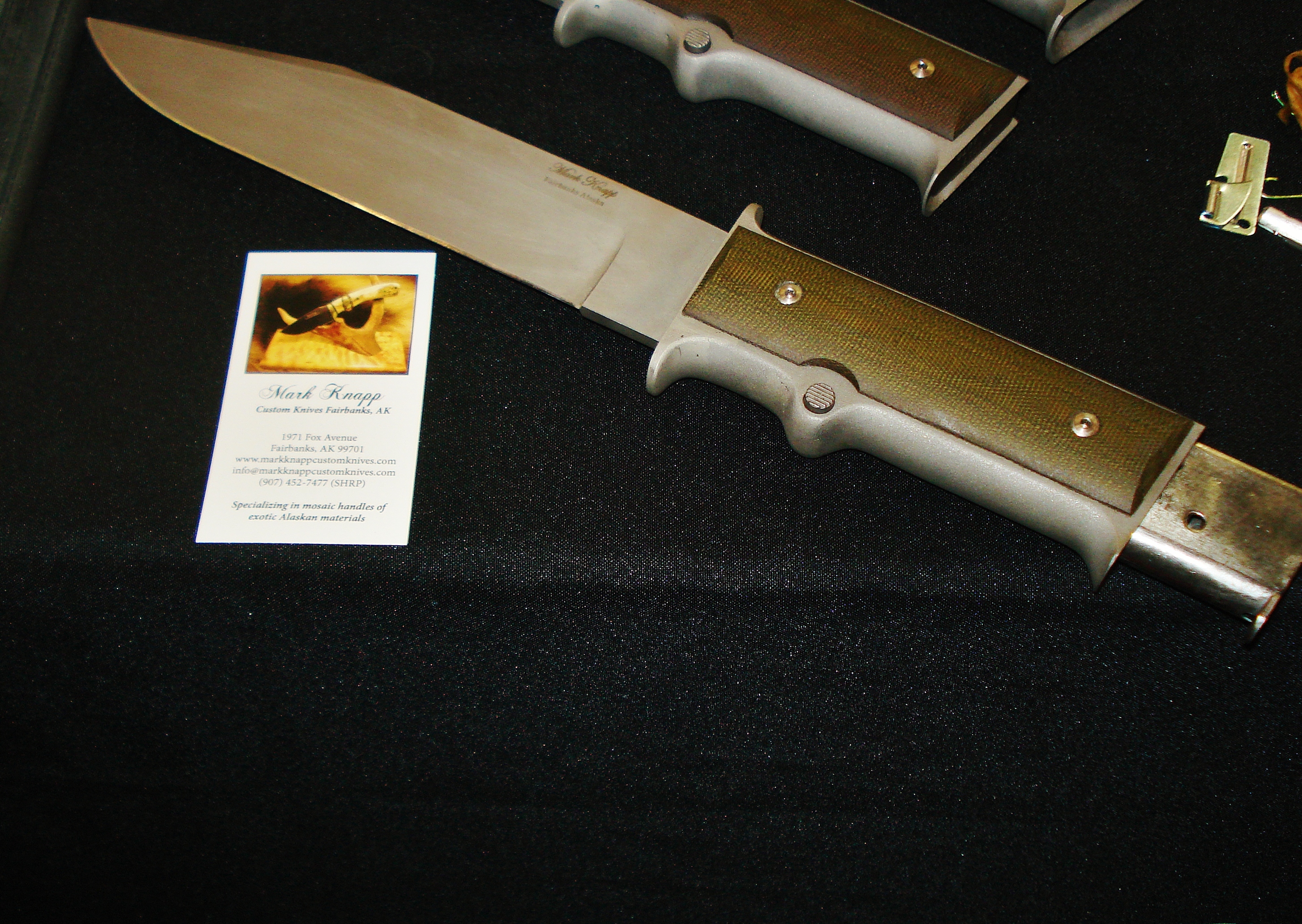
In the 1911 category, Mark Knapp of Mark Knapp Custom Knives Fairbanks, AK, delivers his vision of the 1911 knife.

The Knapp design features a fully functional 1911 magazine that Mr. Knapp claims will function in any 1911. This very serious survival knife features an 8″ blade with a beautiful clip point. 2015 prices for this knife is $750 plus $20 for shipping.

Mark Knapp Combat Survivor

Posted in Knives and Tools | Tagged , , , | 4 Comments

SOG’s Aegis Continues To Be A Strong Performer…

You won’t find many asking for an upgraded version of a Chateau Lafite Rothschild so too it is with SOG’s famously successful Aegis series. Since its introduction, several years ago, the Aegis has done extremely well for SOG and it continues to deliver.

The Aegis is an assisted opening folder featuring a 3.5″ AUS 8 stainless steel blade. Lock up is absolutely solid. The blade profile would make a Ginsu turn green with envy. It is a superb folding knife for EDC or tactical carry. The Aegis is ideally suited for slicing and cutting tasks. The DigiGrip™ handles, and tacky rubber inserts all contribute to the all important comfortable and secure grip.

SOG's Aegis Assisted Opening Folding Knife

Posted in Knives and Tools | Tagged , , | Comments Off on SOG’s Aegis Continues To Be A Strong Performer…

The Venerable 1911 Inspires More Than One Designer At Blade Show.

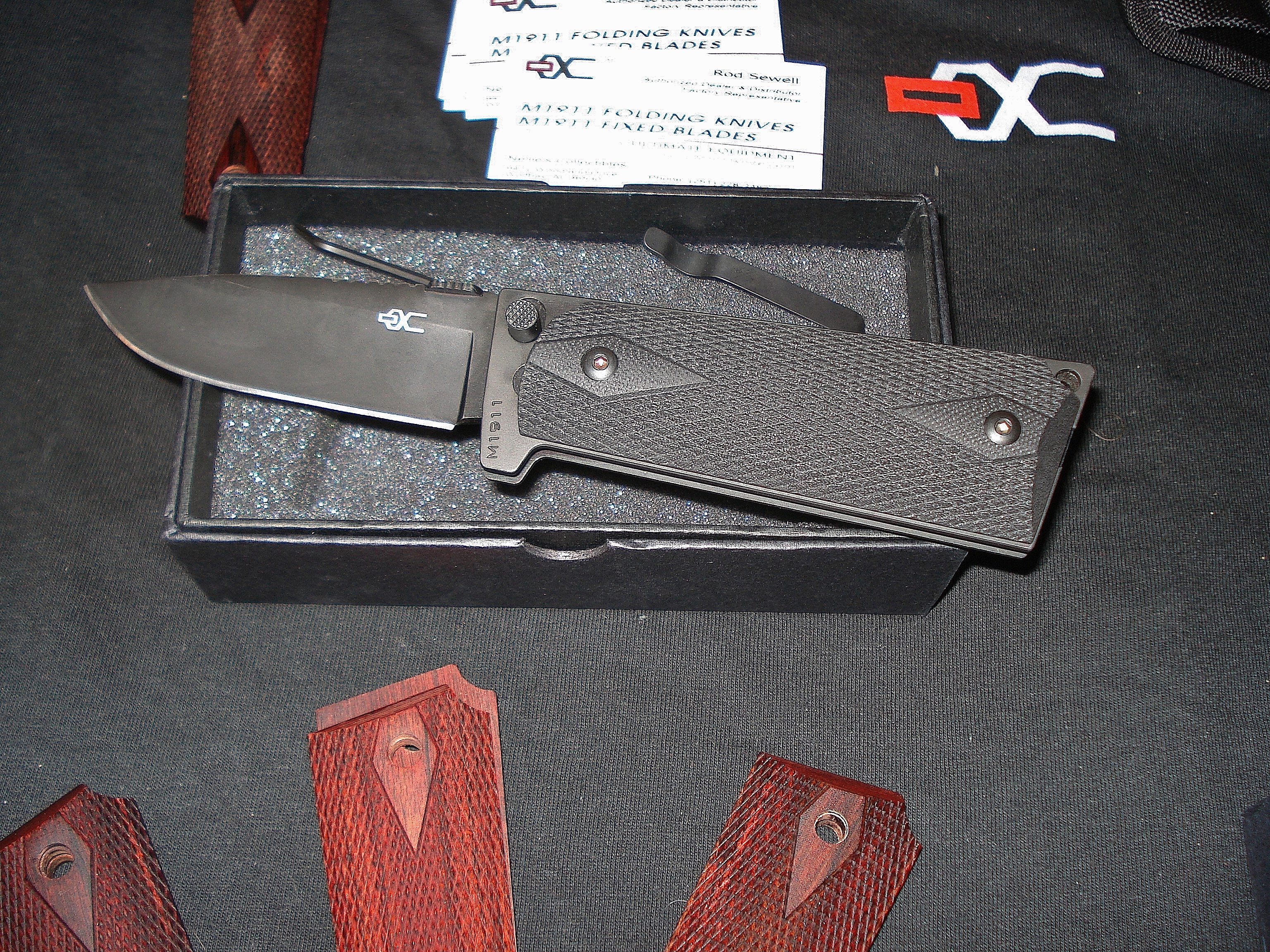
One designer ULTIMATE™ EQUIPMENT has developed an entire product line around the M1911. The company currently offers the M1911 Standard Folding Knife, M1911 Officer Compact Folding Knife and an M1911 Fixed Blade.

The folding knives are available in a 440C steel and a CPM S30V from Crucible U.S.A. The M1911 Fixed Blade comes in a 440C, 4.33″ blade length. Folders and fixed blade designs are stout and fit for duty.

M1911 Standard Folding Knife

Posted in Knives and Tools | Tagged , , | Comments Off on The Venerable 1911 Inspires More Than One Designer At Blade Show.

Reader Question (JTRS) – Could You Explain What IPv6 is?

Devices that connect to the Internet or wide area networks require a unique address, very similar to your mailing address at home. Under the current IP or Internet Protocol standard, version 4 or IPv4, there are not sufficient addresses to uniquely identify all of the devices that are accessing the Internet. Very simply, we are running out of addresses.

Implementing Internet Protocol version 6, or IPv6, gives us 2128 possible addresses. This is a simple yx function on your calculator. If you enter 2 then 128 and press yx you’ll see 3.40282366921×1038. A very large number, so the address pool is much larger and capable of accommodating growth.

IPv6 also does away with an addressing/routing strategy called NAT or Network Address Translation. There are a number of issues associated with NAT.

First let’s understand what NAT does. Local area networks like the one at home or your office are usually implemented using non-routable IP addresses. For example, IP addresses like 10.0.0.1. In order for these devices to communicate with the outside world (The Internet) they must go through a device called a router. A router performs a variety of functions that I won’t discuss here; however, one of its principal functions is NAT. So, the Internet (or Wide Area Network) sends a data stream to the router’s unique and routable IP address instead of sending it to the device requesting the information. The router receives the data stream, and using NAT, decides what node or device should receive it. The system works quite well most of the time; however, it creates a couple of problems when trying to form adhoc networks on the fly and under battlefield conditions. 

  • Problem number 1, every adhoc network has to have at least one routing device possibly more. Furthermore, it places as tremendous load or burden on the routing device because of the complexity of the routing tables needed; thus, contributing to network congestion and latency.
  • Problem number 2, nodes, or ports on nodes (like a radio with a port for video, data or voice) cannot be addressed directly as it may not have a unique routable IP address. This limits the near neural quality of the adhoc network where it may be critically important to address a single port on a device. For example, a fire control sequence to an unattended weapon station.


Hope it helps you and thanks for the question…

Posted in Comms | Tagged , , , | Comments Off on Reader Question (JTRS) – Could You Explain What IPv6 is?

BLADE 2011 – The Largest Trade Show Dedicated To Edged Weapons and Tools

The 2011 Blade Show was held June 10-12 at the Cobb Galleria in Atlanta, GA. It is the largest of its kind trade show in the world; pulling exhibitors from all over the world.

This year’s show was larger than ever, and it showed on opening day, with attendees lined around the floor waiting to enter the exhibit.

If your passion is edged weapons, you’ll find no better exhibit than Blade Show. The hobbyist and aficionado will love the plethora of artisans, knife designers and tool makers. Retailer or distributor, your buyers will have an opportunity to meet with industry representatives to get a first hand look at new or improved product offerings, and don’t forget the dickering. It’s that country fair look and feel of Blade that I love most and you will too. I wouldn’t miss it for the world.  Blade is one of those few events where you can be standing around taking in the sights and have Ken Onion or Kit Carson walk up and start talking shop. Blade is also a great family event where kids can see how knives are made and look at everything from a pocket knife to a battle-ax.

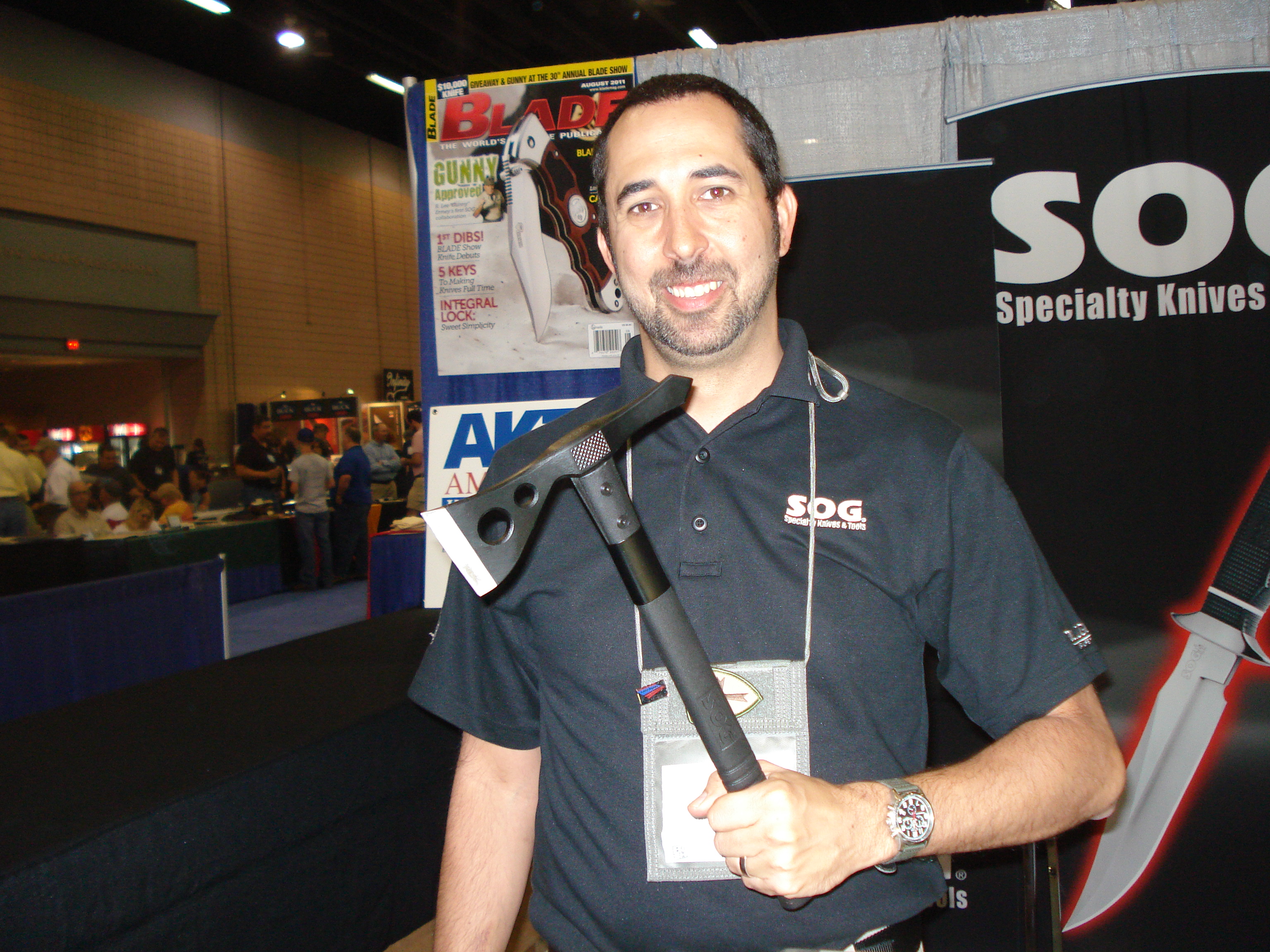
Blade 2011 and SOG was host to celebrity spokesman R. Lee Ermy, affectionately known as The Gunny. In typical Gunny fashion, Lee had them lining up for a chance to chat and an autograph. Gunny Ermy is a stalwart spokesman on Second Amendment and Knife Right issues. SOG couldn’t find a better partner.

Chris Cashbaugh From SOG Knives Insists on Line Discipline.

This year’s show had a few more gear exhibits than prior years, and with hunting season right around the corner, Blade 2011 was a great  opportunity for hunters to pick up a new pack or high performance light offered by Fenix.

The highlight of the show for me was meeting with the great folks from Randall’s Adventure & Training®. Randall’s is clearly the go to source for survival training and they’ve been doing a great job for the military and intelligence community since 1997. One of the areas of contention that I’ve had with knife manufacturers and designers, is the design concept that encourages personnel to attach their survival knives to a wood pole in order to construct a spear. Readers, the last thing you want to do is attach your survival knife to a pole and throw it at a fish or animal. It may be the last time you see it. Instead, I suggest that you invest in Randall’s survival kit as shown below.

Randall’s Adventure & Training Survival Kit

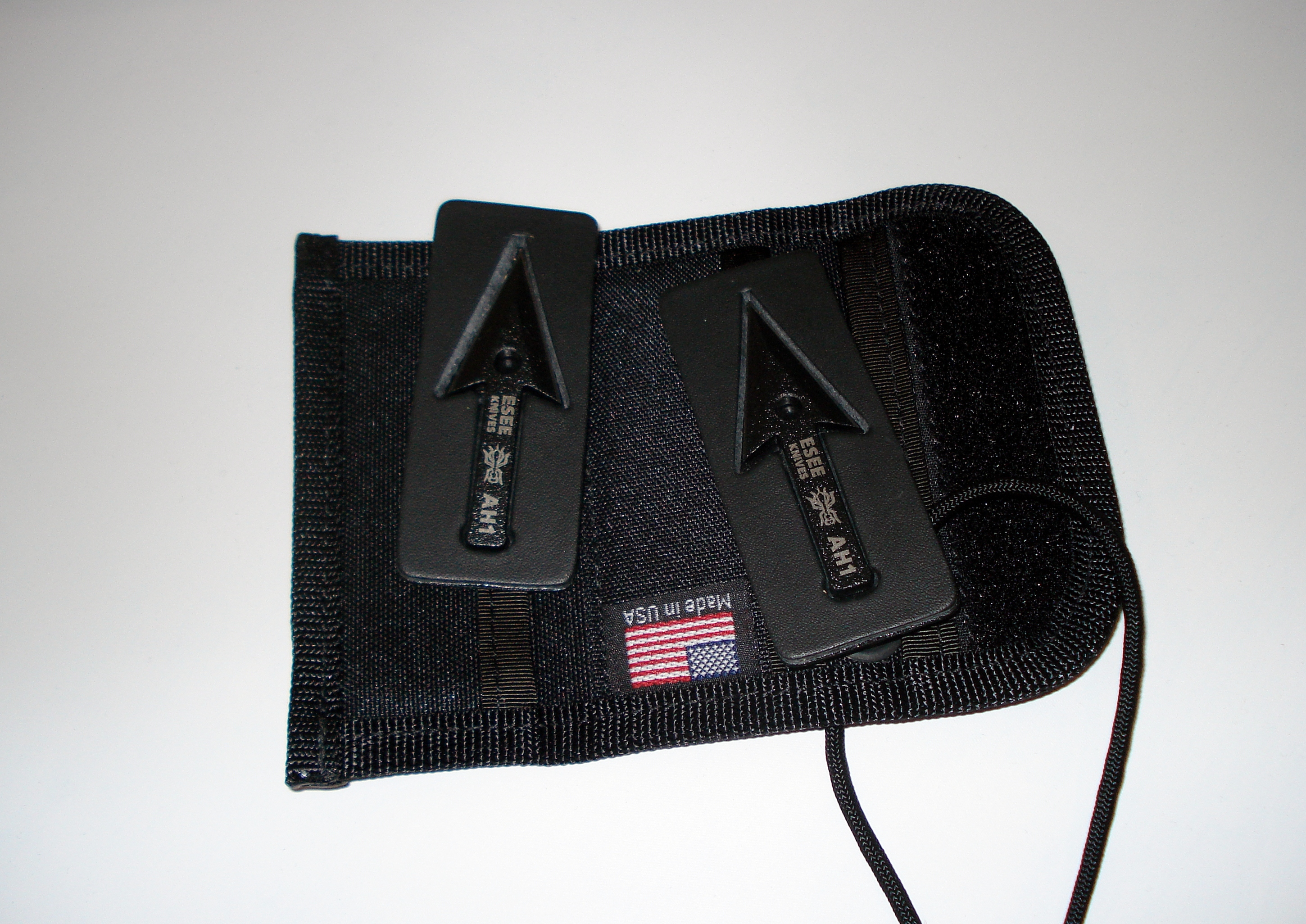
The kit includes a variety of must have items like fish hooks, purpose-built spearhead, fire starter, signaling mirror, paracord and a series of handy cards that will help you in a survival situation. According to Randall’s representative the design concept was derived from current kidnapping scenarios encountered in a number of South American countries.

Additional arrow heads are also available at a $40 to $50 price point and I strongly recommend that you consider adding Randall’s Survival Kit to your gear. It easily fits in a flight jacket or flight suit as well as in a Bug Out bag or Blow Out kit.

Arrow Heads Shown in Wallet Style Holder

Posted in Knives and Tools | Tagged , , | Comments Off on BLADE 2011 – The Largest Trade Show Dedicated To Edged Weapons and Tools

Wrapping Up JTRS

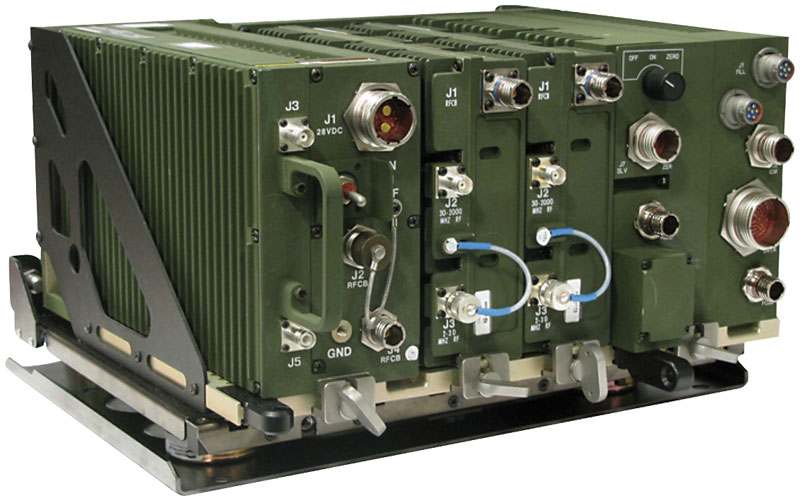
Boeing’s GMR

At the heart of the JTRS project is the concept of a software definable radio or SDR. The SDR is a hardware form much like your laptop; consisting of a processor or processors with its supporting circuitry – like memory, codecs, encryption chip and the r.f. or radio frequency components.

Like a computer, it processes instruction sets to perform specific functions. The executable instruction sets are broadly referred to as waveforms, and a waveform is what gives the SDR its identity, so a common hardware architecture can emulate a variety of fixed radios. For example, by loading a SINCGAR waveform in a software defined radio, you are able to communicate seamlessly with dedicated SINCGAR radios on a network.

Creating interoperability is the set of rules defined in the Software Communications Architecture or SCA. All hardware and software designed for JTRS must be SCA compliant. SCA is also and open architecture, meaning there are no proprietary components. This approach is critically important to the military and commercial success of the project, because it opens the doors to waveform developers. A historical example of the open architecture approach was IBM’s opening up of the desktop computer. That decision, uncharacteristically IBM, is what made the PC ubiquitous .

There are currently over 20 waveforms in the JTRS Network Enterprise Domain (NED)inventory. NED is responsible for the management, development and enhancement of the waveform library.

One waveform that seems to be at the heart of the net-centric battlefield is the Wideband Networking Waveform or WNW. Radios running the WNW will have the ability to transmit voice, data, video and imagery by tacking up 4 r.f. channels or scaling back to 2 channels as needed.

So, our ideal JTRS radio will have the capacity to emulate (computer jargon for imitate) any force radio. On the network side it will also have the ability to transmit voice, data, imagery or video concurrently by tacking up multiple communications channels as routing or bandwidth requirements dictate.

What is particularly interesting to me is the network side of JTRS. From what I’ve seen, manufacturers are dealing with voice, data and video applications by tacking up multiple channels, which appears to me to be inefficient. Regardless of the frequency spectrum, the more channels you tack up the larger bite you take out of available bandwidth.

A better approach may be to operate two channels, one broader active channel and one narrow channel for alternate routing, backup or signaling. The active channel could employ statistical time division multiplexing – a technology where time slots are allocated to the input that most need it – wrapping the encrypted data packets in IPv6, for routing. IPv6 provides 2128 network addresses.

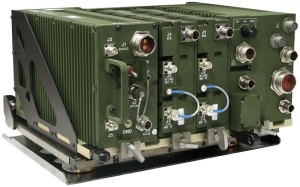
Another interesting aspect of JTRS is the frequency spectrum they operate in, for example Boeing’s Ground Mobile Radio or GMR which functions from 2 MHz to 2 GHz. The radio can operate within that envelope as needed. However, in order to support high bandwidth applications like video and imagery, JTRS will need to use the higher end of the frequency spectrum, which makes the technology line of sight. So, in difficult terrain it requires an intermediary like a UAS or satellite link to increase its operating range. That dependency may prove to be a problem, in both maritime and land application, should we find ourselves in a conflict where our space assets are denied.

JTRS holds great promise for both military and commercial applications. It will be expensive but the commercial potential is high enough that developers will be willing to commit resources to the project.

As always, pass along any questions that you have and I’ll try to answer those for you. I hope you enjoyed the JTRS series.

Note: In general, higher frequencies are more sensitive to propagation impairments, satisfy higher bandwidth requirements and require smaller antennas. Lower frequencies are less sensitive to propagation impairments, provide lower bandwidths and require larger antennas.

Posted in Comms | Tagged , , , | Comments Off on Wrapping Up JTRS

SOFIC 2011 – Understand

USSOCOM’s charter calls for near surgical precision; requiring that teams have as complete knowledge of their AOR, area of responsibility, as technology will allow. Cultural, language, situational awareness, surveillance and reconnaissance are essential to mission success.
The need to understand dictates that USSOCOM have access to integrated enabling technologies to fully support C4ISR and shortening the kill chain. These technologies include but are not limited to; attended and unattended sensors; computational enhancements – hardware and data mining; hostile force tag, track and locate (TTL); biometric data collection and analysis; special operations tactical video systems or SOTVS; Sensitive Site Exploitation (SSE) are some of the active projects that address SOCOM’s need to “Understand.”

For example, attended and unattended sensors are very much in vogue and you can be assured that development will continue to accelerate.

Sensors give SOF a standoff capability and enhance the intelligence collection function. As development of sensors accelerate, you’ll see them play an increasing role as a “soft” force multiplier.

The increasing deployment and employment of sensor technologies will place heavy demands on supporting technologies, like concealment. How do operators effectively conceal the devices used to collect, audio, video, data, positional and seismic data. Moreover, how will that data collection be transmitted to Command and Control or C2.

Should sensors continuously transmit data collected? An interesting question in that continuous transmissions will dramatically increase the risk of detection by an adversary with highly evolved SIGINT capabilities. Or, should sensors be periodically polled by a UAV or  low orbiting platform. How do we mitigate line-of-sight constraints or propagation anomalies?

Going further, what systems will be required to quickly aggregate and correlate data, from potentially hundreds of sources, so that C2 is enhanced and operators are delivered near realtime situational awareness.

These needs and concerns are representative of the challanges USSOCOM will face in the years to come. Much of their developments will be directly transferable to the “Big” Army, Navy, Marine Corps, Air Force, Coast Guard and Department of Homeland Security.

Will Congress slash budgets as they struggle with increasing and debilitating budget deficits. Will they recognize the benefits that the broader economy will derive from the advances in communications, trauma care, optics, mobility and computation needed to support the USSOCOM mission?

Only time will tell, but from this blogger’s perspective the Net Present Value (NPV) of a robust and well thoughtout Defense Budget will exceed that of mindless slashing for the sake of expediency.


Posted in Uncategorized | Tagged , , , , , | Comments Off on SOFIC 2011 – Understand

ALTAMA® Waterproof Ortho-TacX® Boot

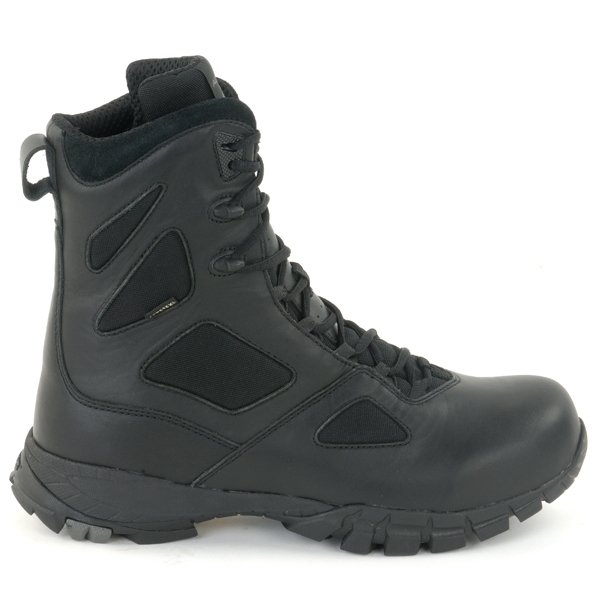
ALTAMA Waterproof Waterproof Ortho-TacX® Boot

Footwear, more than any other piece of equipment in an operator’s kit, is critically important to mobility, survivability and safety. So, I like to keep an eye out for boots and socks designed by attentive companies with that thought in mind.

While at SOFIC 2011, I had an opportunity to visit with a couple of companies, both of which are existing suppliers to the DoD and USSOCOM.  Among them is ALTAMA®, a Georgia company with years of experience in design and fabrication of exceptional footwear.

ALTAMA’s Waterproof Ortho-TacX® Boot an exceptional value at any price but at
$199.99, it’s a steal.

The Ortho-TacX® will be available in September 2011, but you can pre-order them from ALTAMA’s web site and save yourself shipping costs.

For additional details or to place your order visit  ALTAMA’s web site.

Posted in Footware | Tagged , | Comments Off on ALTAMA® Waterproof Ortho-TacX® Boot

Blade Show 2011

That’s right numb nuts, I’m not the fairy godmother or your mommy, and no I didn’t forget Blade 2011 coverage. So, I guess you’ll just have to come back to read about it won’t you. Drop and give me twenty maggot…

Gunny Drops In On The SOG Team

Posted in Knives and Tools | Tagged , | Comments Off on Blade Show 2011

Vectronix Selected To Supply 1400 MOSKITO, Commander’s Target Locator (CTL), For UK’s FIST Program.

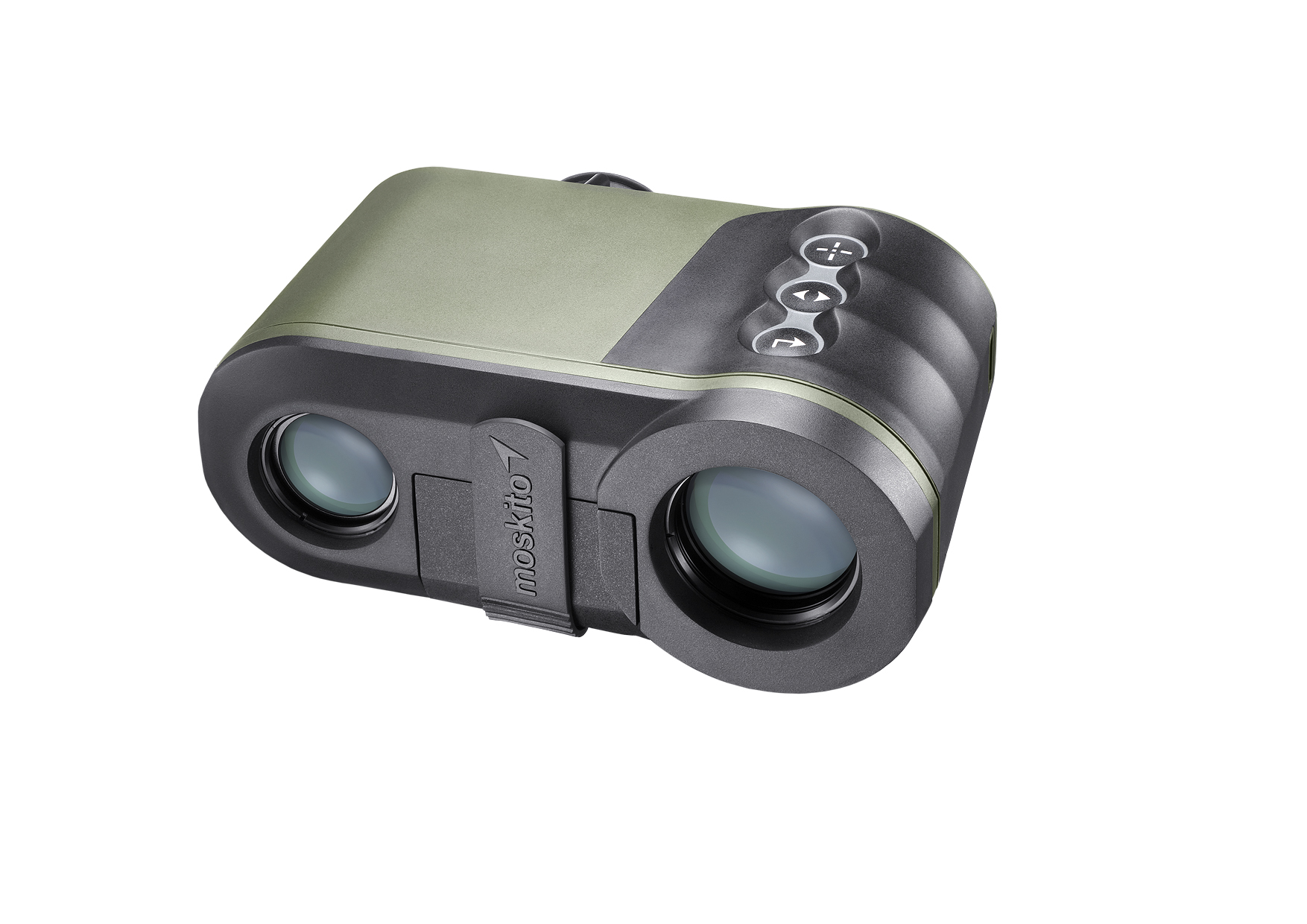
Vectronix MOSKITO CTL

Vectronix, of Heerburg Switzerland, designs and manufactures extreme high quality optical ranging devices. I’ve had the opportunity to use a variety of their equipment over the years, and I can say, without reservation, that it leaves the competition in the dust. Optics, ranging speed and accuracy are superb.

The company has been selected to provide the FIST (Future Integrated Soldier Technology) program (Thales is the leed contractor) with an additional 1400 CTL’s bringing the total order to 4000 units.

The MOSKITO will be utilized as the new Commander’s Target Locator (CTL). The unique multi-function device combines all essential day and night viewing, measuring and geo-location functions into one compact and user-friendly device weighing less than 1.2kg, including its commercially available batteries. Vectronix’s MOSKITO can be also found in sniper kit.

Posted in ISR, Range Finder, Sniper Systems and Tools, Soldier Systems | Tagged , , | Comments Off on Vectronix Selected To Supply 1400 MOSKITO, Commander’s Target Locator (CTL), For UK’s FIST Program.

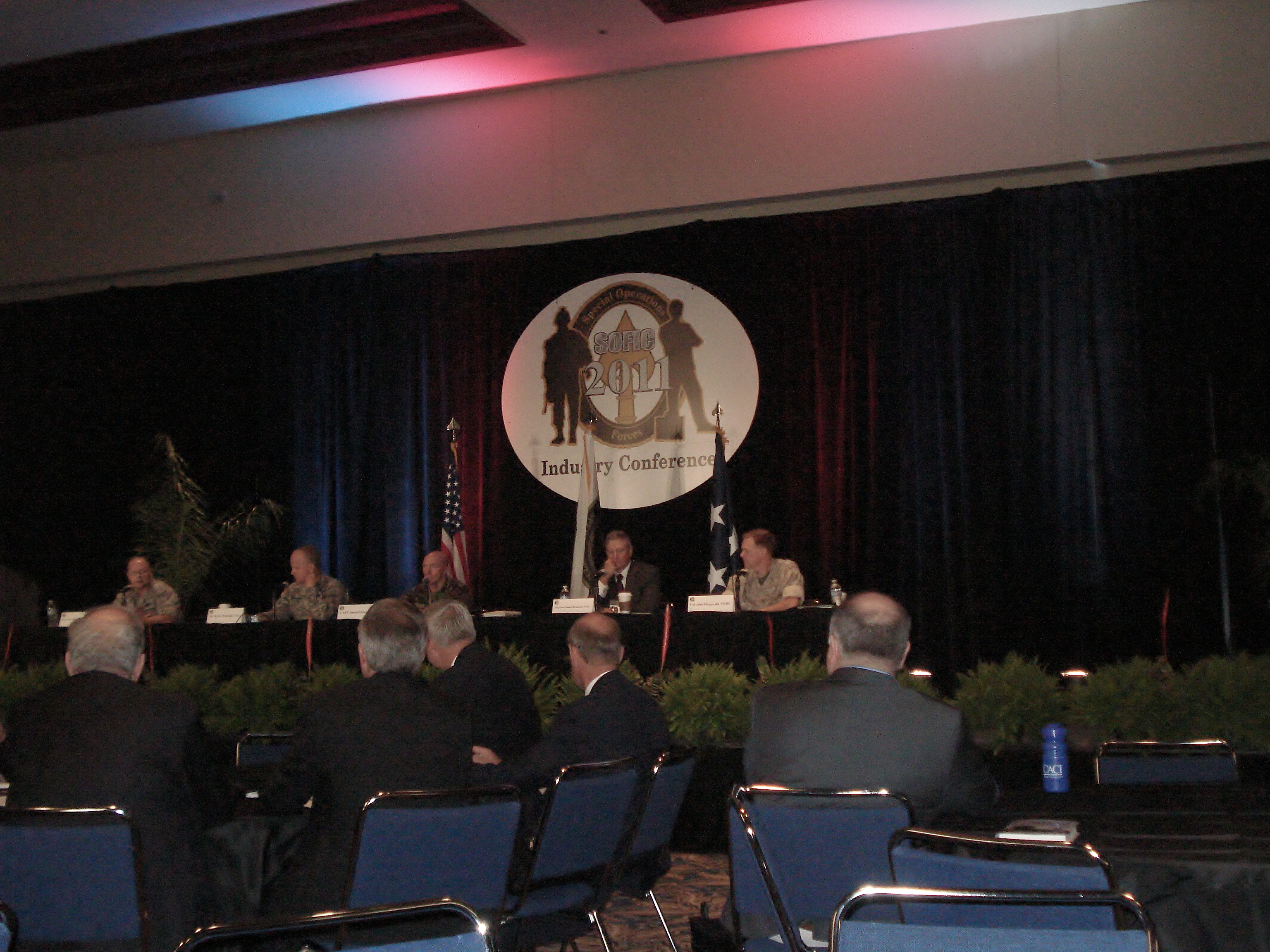
SOFIC 2011 Business Opportunities Session Reiterates a Commitment To Small Businesses.

SOFIC 2011, Tampa, FL

This year’s theme for the annual conference was “Understand, Communicate, Move and Engage” a need assessment articulated by Adm. Eric T. Olsen as he discussed his vision of USSOCOM post UBL EKIA.

SOF Forces are presently engaged in over 75 countries around the world but not all are kicking in doors and eliminating insurgents. In fact, 80% of SOF work is non-kinetic, which accounts for Adm. Olson’s emphasis on “Understand” a principle that was ever-present at this year’s event.

As in subsequent years, the conference kicked off with a Business Opportunities Session designed to embrace the hundreds of small businesses supporting USSOCOM. First up TILO, Technology and Industry Liaison Office (TILO), and the Office of Small Business
Programs, with excellent presentations. For small businesses wishing to do business with USSOCOM, TILO is an invaluable resource. A large part of their charter is to match your concepts and technology with USSOCOM priorities and connect you directly with the appropriate Program Executive Office (PEO). If you’re a small business, with that better mousetrap, I strongly encourage you to use USSOCOM TILO.

Technology and Industry Liaison Office and OSBR was followed by presentations from Margaret McCaskey, Director, Experimentation and Joint Capability Technology Demonstration (JCTD) for USSOCOM and Shawn Patterson, Program Manager, Small Business Innovative Research Program (SBIR), USOCOM. SBIR work’s closely with small business technology companies, by challenging them to solve SOCOM specific needs, and provides funding for research and development. They will assist small companies in bringing their innovation and technology to the DoD and the commercial markets.

The Business Opportunities Session concluded with AT&L Efficiencies and Contract Effects delivered by Col Kurt Bergo, USA F, Director, Procurement, USSOCOM, and Tips For Submitting Successful Proposals.

Small businesses looking for opportunities should familiarize themselves with and
frequent the following web sites.

  1. http://www.fbo.gov      Federal Business Opportunities, USSOCOM contracting actions greater than  $25,000.
  2. http://www.dodsbir.net     Small Business Opportunities are listed every November.
  3. http://www.acq.osd.mil/cto      Use this site for submitting proposal from mid-December to mid-March.
  4. http://www.acq.osd.mil/jctd/index.html Visit this website to obtain the procedure for submitting candidate proposals
    for JCTD.

I will continue SOFIC 2011 coverage and digest “Understand, Communicate, Move and Engage”, examining SOCOM’s needs in these areas and how they relate to operational requirements.

Posted in Uncategorized | Tagged , | Comments Off on SOFIC 2011 Business Opportunities Session Reiterates a Commitment To Small Businesses.

JTRS – Continued (Cleaning Up Loose Ends)

Before, I start into the software definable radio and the standards surrounding the SDR project, I’d like to clean up some loose ends.

Legacy radios, meaning radios that do not operate in the digital domain modulate the radio frequency carrier using A.M. and F.M. there are some r.f. modulation schemes that involve phase changes of the r.f carrier; however, the majority rely on modulating the r.f carrier’s amplitude or modulating its frequency.

When we enter the digital radio era, we convert the analog input (i.e. the human voice) to a digital signal using something like PCM previously discussed. We can then manipulate the digital stream applying algorithms to compress the data stream. We then modulate the carrier frequency with a digital stream representing voice, data or video information. Because we are dealing with a stream of pulses we have to concern ourselves with ways to modulate the carrier frequency so that pulse width, pulse amplitude and pulse repetition rate can be successfully retrieved at the receiving end. For that reason virtually all digital radios use combinations of frequency modulation and phase modulation schemes or amplitude modulation and phase modulation. Phase shifting, involves shifting the r.f carrier along the time domain which is represented on the x-axis of a Cartesian coordinate. We don’t alter the frequency we change its phase.

In my last three posts dealing with JTRS I presented relatively complex technical details about radio communications using some simplistic language. However, if you understood the concepts, you now have a better understanding that the average citizen.

All future posts will be strictly JTRS relevant.

Posted in Uncategorized | Comments Off on JTRS – Continued (Cleaning Up Loose Ends)

JTRS – Continued

In my opening article I wrote briefly about modulation to include FM (Frequency Modulation) and AM (Amplitude Modulation). I also discussed PCM (Pulse Code Modulation), which is in the digital domain. Virtually all  modern military communications equipment operate in the digital domain. That is, they convert the analog human input into a digital stream. Also recall that using standard PCM, we generate a data stream of 64,000 bits per second.

For the time being, I’d like you to view that digital stream as a water pipe of some diameter “d”. In the paragraphs that follow I will discuss the concept of spectrum and bandwidth utilization as it will help you understand some of the challenges designers will need to address as JTRS (jitters) is implemented.

Spectrum is the distribution or totality of the operating environment. In other words, it is the frequency range that the system can operate in given its design and antenna characteristics. Regrettably it is both costly and limited; therefore, designers need to do everything possible to optimize its utilization. On the other hand, bandwidth is the utilization of the available spectra. The graphic below should help you with that concept.

Figure 1

Figure 1 illustrates the concept of spectrum with a large circle that represents the range of frequencies that SINCGARS operates within. The smaller circles represent a communications channel. What you should take away from this graphic is that there is a limit to the number of channels that the given spectrum will accommodate. Therefore, to add additional capacity, designers must add to spectrum, reduce the bandwidth of the channel or a combination of both. This leads us to a very high level discussion on codecs (coders decoders) which is how designers address the channel bandwidth requirements or the size of the smaller circles in figure 1.

The codec, is a fixed or programmable circuit used to processes a digital stream to achieve a desired output. In voice communications where we are bandwidth limited, we use codecs that aggressively compress our 64,000 bit stream into something much smaller. The concept of compression is hard to visualize but I am going to take a stab at it.

A three-second PCM sample generates 3 x 64,000 bits or 192,000 bits, that’s a large amount of data. Keeping that in mind lets dissect a typical radio call.

  1. Sender:   Romeo Bravo. Rome Bravo. Rome Bravo this is Quebec Charlie. Radio Check Over.
  2. Receiver: Quebec Charlie this is Romeo Bravo I read you 5 by 5 Over.

In this particular transmission there is a silence between each letter and each word; rather than representing that silence with an 8 bit digital stream of zeros (00000000) we could compress it to, say, a three bit stream. For example, one bit to indicate the presence of silence and two bits to indicate its duration; effectively going from “00000000” to “001”. So, by applying this processing to our PCM stream we can successfully reduce the bandwidth requirements from 64,000 bits per second to say 12,000 bits per second, which makes it possible for us to reduce the size of the small circles in our graphic so the available spectrum will carry more channels.

The secondary benefit to compressing the data rate is that the communications stream is less vulnerable to SNR (signal to noise ratio) impairments.

So far we’ve only discussed voice communications, but consider what happens when we add video and data transmissions to the system – we’ve now placed additional demands on the available spectrum. Finally, we place further demands on spectrum when we add the concept of an IP based networkable communications architecture.

In another article I’ll give you an overview of the SDR (Software Definable Radio) and some of the standards established to ensure interoperability; so, stay tuned and send any questions or comments my way. I’ll do the best I can to answer them for you.

Posted in Comms | Tagged , | Comments Off on JTRS – Continued

FNH Displays Ballista at SOFIC 2011…

FN Herstal (FNH) is part of the FN Group sharing a prominent spot with Browning and Winchester.

FNH has been innovating and manufacturing small arms since 1889 and can claim trophies like the ubiquitous FN FAL rifles, the 9 mm HP pistol, MINIMI 5.56 LMG, FN P90 PDW and its partner the Five-sevenN tactical pistol to name just a few. More recently, the company introduced the Special Combat Assault Rifle or SCAR® under the USSOCOM SCAR program. The SCAR® rifles, available in both 5.56×45 and 7.62×51, embodies technologies previously unavailable until its introduction in 2008. The SCAR® is ergonomically correct and fully ambidextrous with an operator field replaceable barrel. Barring early issues with weaknesses in the stock, SCAR® Mk16 (5.56 x 45) and SCAR® Mk17 rifles are among the world’s most versatile and robust combat assault rifles on the market.

In January 2011, FNH introduced the FN Ballista a caliber convertible sniper platform that I predict will give Remington sleepless nights. The Ballista supports the 338 Lapua, 300 WinMag and 308 calibers. The stock, is precision machined from aluminium and collapsible. The weapon comes in at 17 lbs without optics and shares a common magazine size for all three calibers. Switching from one caliber to another is a rather simple matter making this rifle extremely versatile. In the video that follows, Mr. Jay Recto, Manager Assault Rifles, for FNH demonstrates some of its unique features.

Posted in Sniper Systems and Tools, Uncategorized, Weapon systems | Tagged , , , , | Comments Off on FNH Displays Ballista at SOFIC 2011…

Support Magpul’s Enduring Spirits Initiative !

Photo: Courtesy of Magpul Industries and Mil-Spec Monkey

Magpul Industries derives much of its operating philosophy from the ancient Japanese Bushido – a code built on courage, loyalty and fairness. In keeping with that tradition, and its affinity for Japanese warrior culture, the company has teamed up with the Mil-Spec Monkey© to deliver a limited edition patch that Magpul calls a take-off from the “Army Strong” slogan. The patch features a prominent “kanji” symbol over a brush stroked symbol representative of the Japanese flag.

The patch sells for $6.00 and is available directly from Magpul Industries’ web site http://store.magpul.com/product/MAG815/70

All proceeds go directly to the Red Cross and other charitable organizations
providing relief to the Japanese community. Please join us in supporting this
cause.
The reconstruction and cleanup work facing Japan and its people, particularly those in the affected areas, is overwhelming. Join us in supporting this promotion and order a patch for yourself and family members.

Posted in Alerts | Tagged , , | Comments Off on Support Magpul’s Enduring Spirits Initiative !

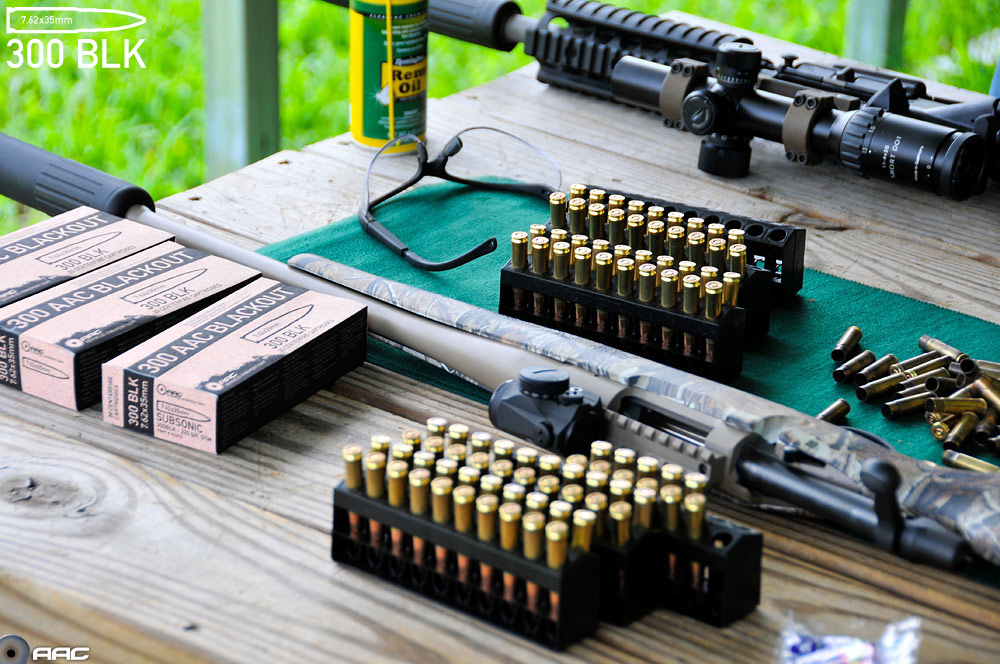
Advanced Armament Company 300 Blackout at SOFIC 2011…

Photo Courtesy of AAC

When Eugene Stoner designed and developed the M16, he probably did not envision the genius of his work. There is not a weapon system in production today that delivers the functionality, flexibility and reliability found in Stoner’s design. With a simple swap of an upper receiver, an operator can transition from a 5.56×45 platform to a 30 caliber subsonic or supersonic freight train.

By way of example, consider JD Jones’ 300 Whisper®, a cartridge manufactured from a 221 Fireball case necked up to accommodate a 30 caliber bullet. Jones’ Whisper delivered a 220 or 240 grain payload. The drag and ballistic coefficients are so high that there is very little loss in velocity. For example, at 200 yards the round looses a mere 65 fps from the initial muzzle velocity. This performance gives the 300 Whisper® massive terminal ballistics.

JD Jones intended the 300 Whisper® to be a suppressed system; however, a number of supersonic loads have been developed.

JD made the 300 Whisper® available on a standard M4 or M16 platform, designed for the 5.56×45 round, with a .30 caliber barrel chambered for the 221 Fireball. His company, SSK Industries, also offers the 300 Whisper on a bolt-action precision rifle. The cartridge gained acceptance but it still remains a boutique cartridge, which means that commercially available ammunition is hard to find.

The 30 caliber AR concept got a boost from the folks at Advanced Armament Corporation when they announced the AAC 300 Blackout. The 300 Blackout is a SAAMI compliant cartridge specifically designed to take advantage of the versatility offered by the AR platform.
Photo Courtesy of AAC

In the video below, Rob Silvers, AAC’s Director of Research and Development,  tells us 300 Blackout ammunition will be produced in quantity. If AAC and The Freedom Group delivers on its promise, it will give the 30 caliber AR a much-needed boost.

AAC will also supply a complete upper or barrel / gas system assemby as your needs require.

Posted in Ammunition, Weapon systems | Tagged , , | Comments Off on Advanced Armament Company 300 Blackout at SOFIC 2011…

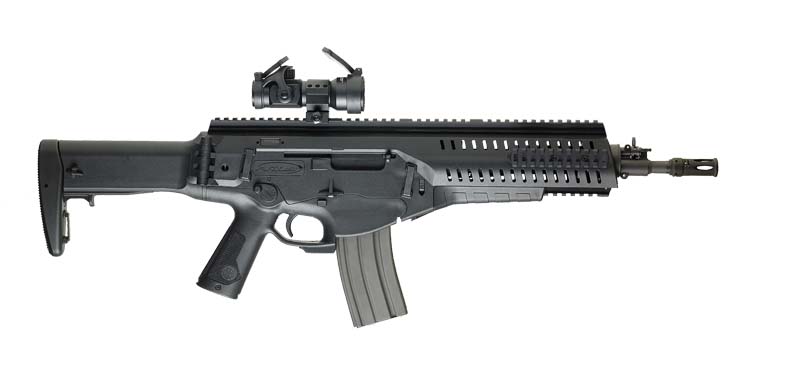
Beretta Exhibits ARX160 at SOFIC 2011…

Courtesy Beretta USA – ARX 160 carbine.

Beretta has been building firearms for quite sometime. The company enjoys an enviable position in the law enforcement, military and commercial markets offering a high quality and well diversified product portfolio.

Currently, Beretta supplies the United States Armed Forces with the M9 and M9A1 handguns.
In 2007-2008 the company developed the ARX160 carbine for the Soldato Futuro Program. After considerable testing, Beretta’s ARX160 was adopted by the Italian Army; since then, the company has been successful in placing the carbine with the Mexican government as well as other EU customers. Beretta is also a participant in the U.S. Army’s Carbine Competition.
While at SOFIC 2011, I had an opportunity to spend some time with Len Lucas, Beretta USA law enforcement and military sales, and the ARX 160 carbine.
The ARX160 was designed from the ground up to be fully ambidextrous; any control was accessible and operational on both sides of the weapon. Changing from right side to left side ejection was a snap as was swapping barrels. Take down was easily accomplished without tools and the procedure was simple – not a lot of hand movements.
Ergonomics were also superb. One of the challanges encountered by many of our small-arms manufacturers is creating a rifle that will fit any gender or body type. This is a task that is more easily verbalized than done, but Beretta seems to have accomplished that in my view.
The ARX160 uses a gas operated rotating bolt system with a cyclic rate of approximately 700 rounds per minute. The carbine uses a standard 30 round STANAG magazine but will also accept a 100 round C-mag drum.
Without a live fire test, I have to defer further comment but I like what I see and if accuracy and reliability are as good as the design itself, Beretta is sure to give contenders a run for their money.
Beretta has also developed a complimentary 40 mm grande launcher designated the GLX 160.
Watch Len Lucas as he takes us through the ARX 160.
Posted in Uncategorized, Weapon systems | Tagged , , | Comments Off on Beretta Exhibits ARX160 at SOFIC 2011…

Neilsen Kellerman at SOFIC 2011

Nielsen Kellerman exhibited their latest and greatest version of their flagship wind meter, the Kestrel HORUS ATrag wind meter. What separates their latest rendition from its other instruments is that the Kestrel HORUS ATrag is specifically designed for military and law enforcement application. Historically, snipers, designated marksmen and precision shooters have had to contend with estimating wind, wind direction, barometric pressure, altitude and relative humidity – all of which influence the trajectory of a shot fired from a precision rifle. These parameters become increasingly important as range to the target increase. With the Kestrel HORUS ATrag, the operator has at his disposal an instrument that delivers a real-time firing solution. Environmental data is updated realtime so all firing solutions are real-time.

In the video below Monica Devlin of Neilson Kellerman gives us an overview of their new meter.

The HORUS application running in the Kestrel meter was written specifically for the meter in  C making it extremely fast.

Look for incremental enhancements to the product in the display, form factor and power.

The weather meter is an indispensable part of an operators kit and if you are in a sniper or DM role, Kestrel’s meter is a must have item. If you’re unfamiliar with its capabilities I encourage you to contact Monica Devlin at Nielsen Kellerman.

Posted in Sniper Systems and Tools | Tagged , , | Comments Off on Neilsen Kellerman at SOFIC 2011

It’s A Glock!

Writing about Glock has to be a difficult task for all industry writers; I know it is for me. But, that’s not a negative. It’s simply a question of how to describe perfection.

Referring to Glock as the “people’s handgun project” is not representative of its history. Glock was not a product of the Deutsche Arbeitsfront nor was it intended to arm the populous and Gaston Glock was not a firearms designer. Yet in response to a 1980 solicitation from the Austrian Ministry of Defence Gaston Glock and a team of handpicked engineers set out to develop a pistol that met the Austrian military requirements. It took Gaston three months to produce a working prototype and in 1982 the Austrian military and police adopted the new Glock 17 as the P80. The rest of this story is history.

You’ll often hear the expression “… a Glock is a Glock…” a comment that stems from the fact that little has changed in Glock’s design since its adoption by the Austrian government in 1982. The generational changes have all been subtle design improvements like adding an integrated recoil spring assembly, changes to the magazine (floor plate and follower).

The Gen 2 model added chequering to the front strap and a steel plate forward of the trigger guard to satisfy ATF requirements for displaying the weapon’s serial number.

Gen 3 Glock pistols included an accessory rail, an improved extractor that also serves as a loaded chamber indicator and a locking block pin.

In 2010, at the Las Vegas Shot Show, Glock announced its Gen 4 designs adding enhancements that continue its 25 Years of Perfection. Listen to Glock’s Megan Harvey tell you about their Gen 4 model directly from SOFIC 2011.

Posted in Weapon systems | Tagged , | Comments Off on It’s A Glock!

Have a Great Memorial Day!

We at FOG HORN want to take a minute of your time to wish you and your loved ones a fabulous Memorial Day. More so than any other national holiday, Memorial Day gives us occasion to remember those who served and gave their lives for our country. Take a moment to remember them and their families. Teach your children the meaning of the day and its significance to freedom and the other liberties we tend to take for granted.

We are winding things down for the weekend but when we return we will continue our coverage of SOFIC to included the business opportunities, needs and constraints of doing business with USSOCOM. We will give you a look at some great weapon systems from Beretta, SIGARMS, FN Herstal and others. There will also be more on simulation and some impressive ISR technologies.

We will continue from where we left off with our silencer survey by introducing two great companies GEMTECH and Advanced Armament Company.

We will continue with our JTRS and the networked battle space.

From the crew at FOG HORN have a fun and safe Memorial Day wherever you may find yourself.

Posted in Alerts | Tagged | Comments Off on Have a Great Memorial Day!

Systems Technology, Inc. Exhibits PARASIM® at SOFIC 2011 in Tampa

Critical to the SOF mission is the depth and breath of training and 80 percent of SOF’s work is non kinetic. SOF’s success revolves around its people and how well prepared they are to execute that mission.

In the training business, we use a hackneyed cliché’ that “repetition is the mother of learning.” Wether developing muscle memory or cognitive skills, frequency and intensity of training are critical to cementing the concepts, procedures and techniques in the operators mind, so that situational responses are organic and consistent. The emergence and continuing development of simulation tools improves the training experience by orders of magnitude.

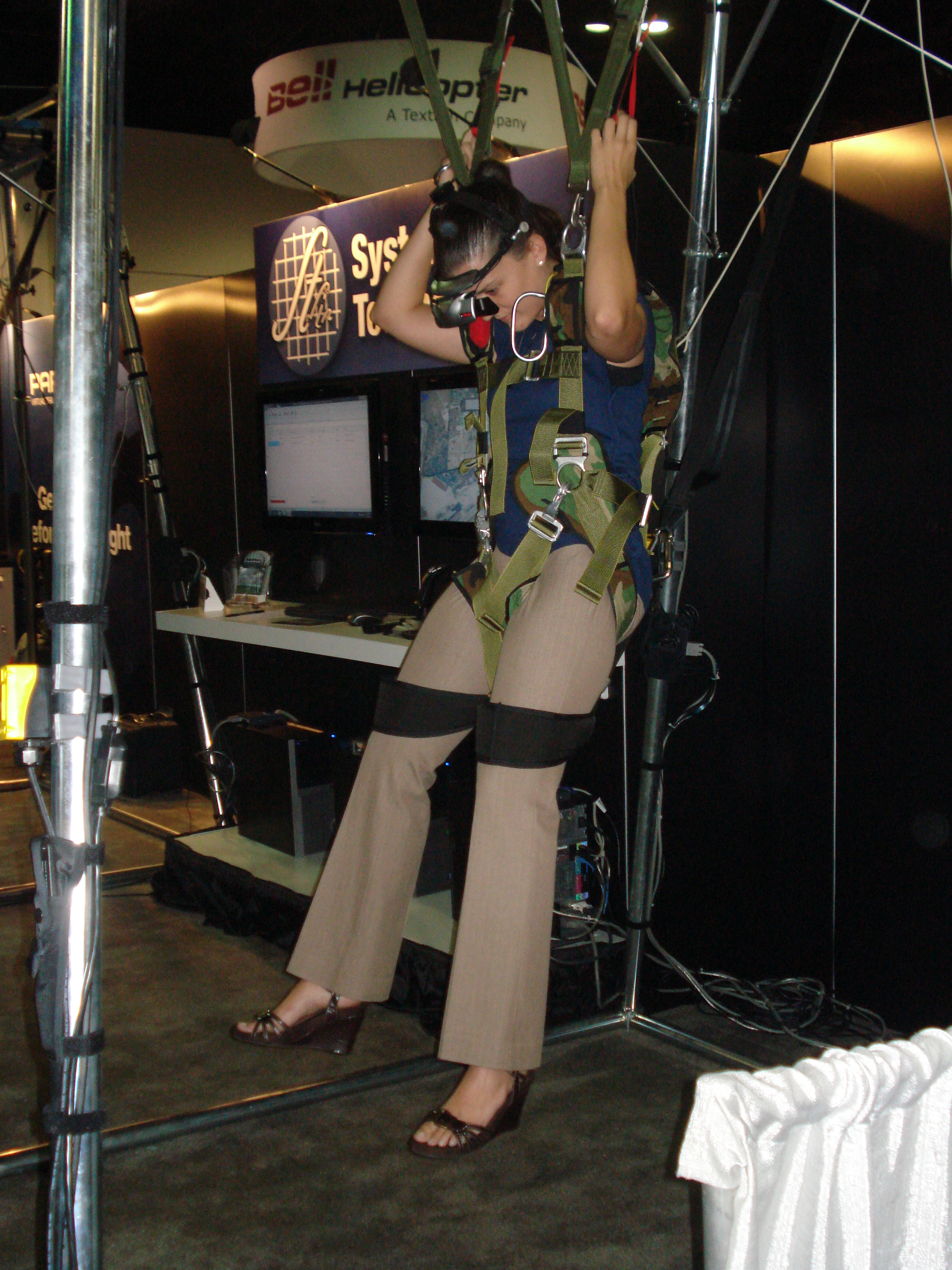
Systems Technology, Inc.  based in Hawthorne, Ca demonstrated this year at SOFIC  their latest version of PARASIM®, its virtual reality parachute simulator. Of course, I couldn’t help but try it.

I had a jump partner from one of the SFGs to my right. We began the jump at 10,000 feet and were instructed to deploy the canopy at 5,500 feet. My partner held his free fall until 3,500 feet; I opened my chute at a little over 5,200 feet. I felt a tug and tilted my head up to make sure the chute had opened. I made a right turn and was now moving up wind, movement relative to the ground was steady but I was slightly off target. I maneuvered making a series of turns; finally turning base then final. I was on the ground!

The trainee is strapped into her pack. She then slips on the goggles, which provide her with an aerial and ground view, as well as any peripheral details such as what her partner is doing.

Using the black leg straps the trainee is elevated and placed into a horizontal position in preparation for the free fall. At altitude, the free fall begins. When she reaches 5,500 feet, or any altitude stipulated, she deploys the canopy and verifies that there are no entangled suspension lines and the canopy if filled with air. The trainee then uses her brake lines to maneuver and control the fall.

Developers at Systems Technology, Inc have done an amazing job. Using PARASIM®, the trainer can simulate weather conditions, day or night, static or free fall as well as any conceivable emergency situation a trainee could encounter. Simulation, no matter how well implemented can never replace the actual event, but this is as close as you get given current technology. The only thing missing is the wind in your face.

The benefits are quite obvious: more frequent and flexible training, safer training environment and significant cost savings. Check it out!

Posted in Uncategorized | Comments Off on Systems Technology, Inc. Exhibits PARASIM® at SOFIC 2011 in Tampa