

Bodi.Me Research on Inclusive Body Type Grading
Recent blog post as seen on Bodi.Me

At 3DBODY.TECH 2026 in Lugano, Switzerland, Bodi.Me’s Lara Mazzoni, CEO, and Clementine Baldo, Calibration & Technical Fit Manager, presented insights from a two-year research study of curvy and plus-size populations across the USA, UK and EU countries. Their presentation on 21 October, “The Myth of the Proportional Curve: Data, Perception, and the Realities of Inclusive Grading,” examined the gap between real body proportions and the assumptions used to develop extended garment sizes.
Our research highlights a persistent gap in the garment industry’s knowledge and use of body data for curvy and plus-size wearers. When product development overlooks real body proportions, garments can fit poorly, restrict movement and cause discomfort. In workwear and protective clothing, poor fit can also create safety risks. Our message was clear: real body data must inform garment development, size recommendations and supply-chain decisions.
Real body data provides the evidence needed to develop garments around the people who will wear them. Research reveals how proportions vary across sizes, where garments need additional room and which grading assumptions require revision. These insights help technical teams make informed decisions about pattern blocks, garment ease and size ranges, then validate them through wearer testing. For Bodi.Me, the value of research extends through the supply chain: understanding bodies more accurately supports better size recommendations, manufacturing quantities and stock allocation.
What is Plus-Size Grading?
Plus-size grading is the development of garment patterns across an extended size range, adjusting dimensions and proportions to accommodate the intended wearers. Effective grading considers where additional room is needed, how the garment sits on the body and whether it preserves its intended fit.
A pattern may fit its original sample model beautifully. That alone does not establish that every size developed from it will work equally well.
Fixed grading increments can be useful within a validated range. The difficulty arises when manufacturers extend those rules beyond the body shapes and sizes on which they have tested them.
Plus size and curvy describe different fit needs
Plus size generally describes a size category. Curvy describes proportions, often a greater difference between waist and hip measurements. Brands use both terms differently, so neither replaces a clear description of the body shapes a garment is designed to accommodate.
A plus-size range must account for people with fuller abdomens, straighter waists, fuller hips, and other combinations. A curvy cut may suit some of those wearers while leaving others poorly served.
This is why inclusive size development needs to examine the relationship between measurements, rather than treating everyone within a size label as the same shape.
The same size label can describe very different measurements
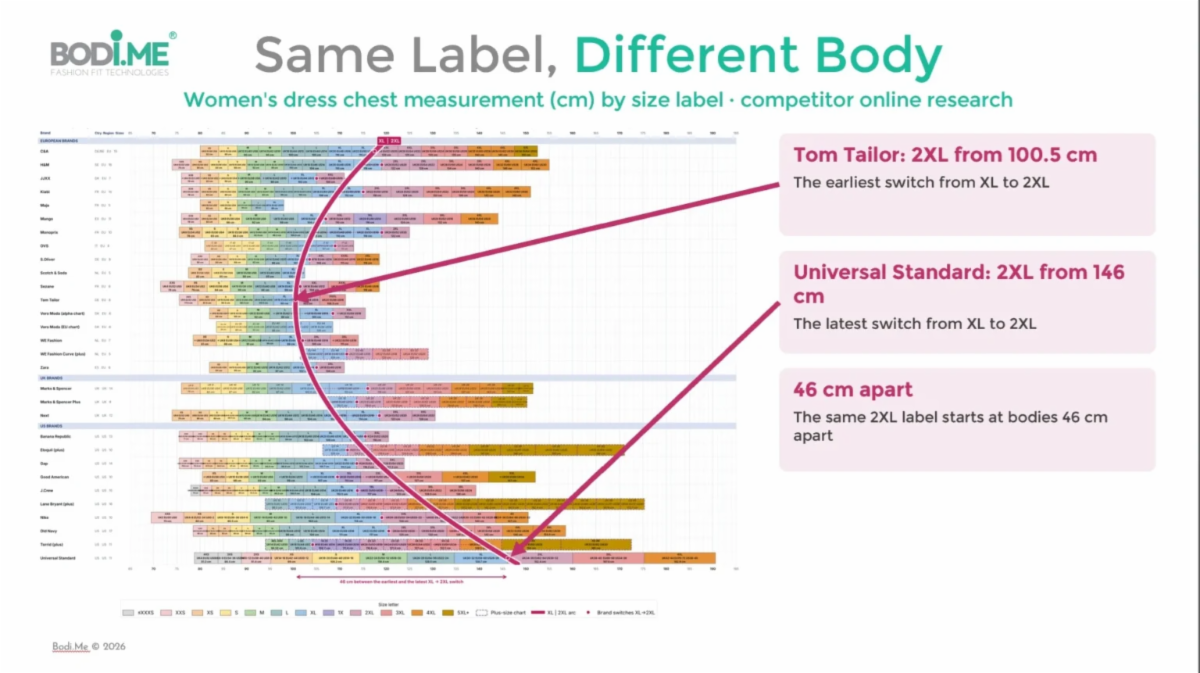
Our cross-brand size-chart comparison makes the limits of labels clear. In the research presented in Lugano, Tom Tailor’s 2XL starts at a chest measurement of 100.5 cm, while Universal Standard’s starts at 146 cm. That is a difference of 45.5 cm, approximately 46 cm, at the point where the brands move from XL to 2XL.
Where Grading Can Lose Touch with the Body
Our Lugano presentation examined the connection between body proportions, grading and the room a garment provides. Several areas deserve particular attention:
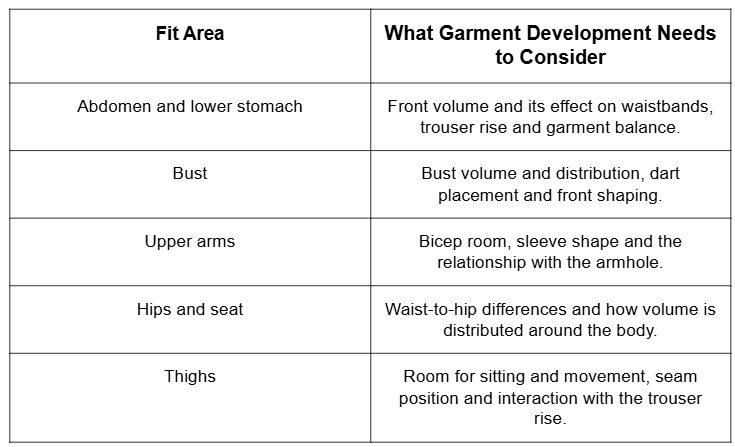 .
These relationships vary between people. Two wearers with similar hip measurements can need different shaping at the waist or seat. Increasing the overall garment size may relieve pressure at one point while creating excess fabric elsewhere.
Independent research supports closer attention to shape. A University of Oregon study presented at 3DBODY.TECH 2020 found that an established body-shape classification method needed modification to better accommodate plus-size women, including fuller abdomens.
Read the University of Oregon research abstract.
What the grading comparisons reveal
Bodi.Me’s Lugano case study compares how measurement increments and calculated garment ease change across sizes. It also explores a proposed grading approach informed by body data.
Comparing three dress grading approaches
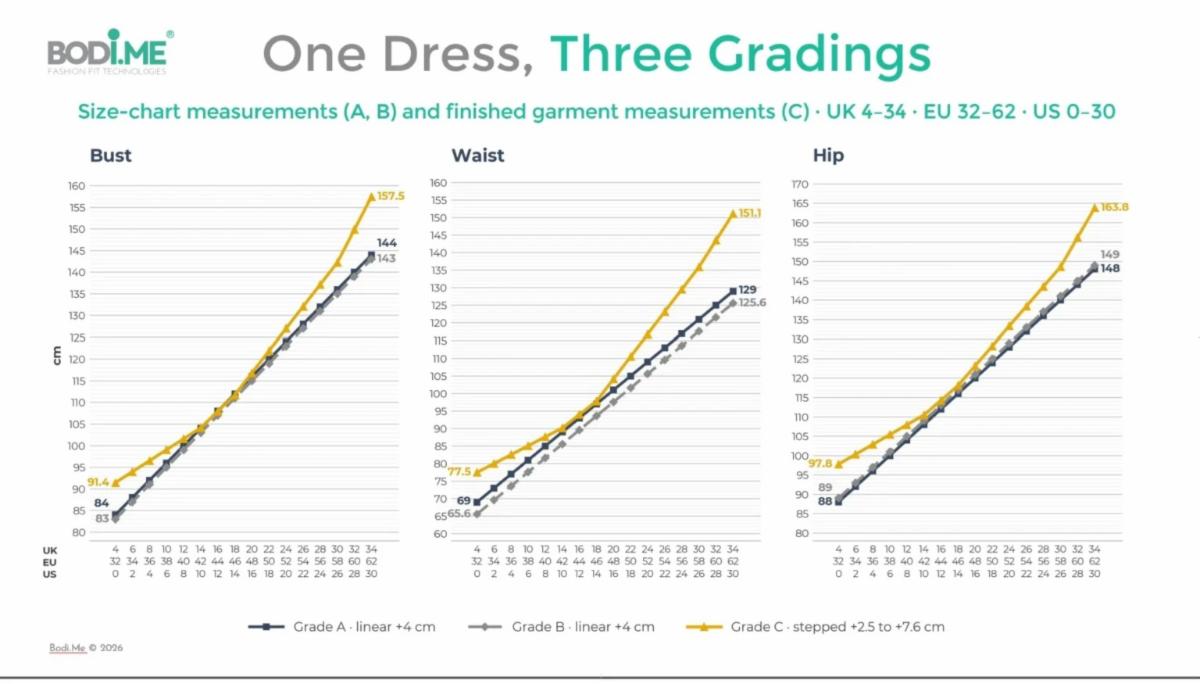
Figure: The comparison shows how measurement increments differ across a size range. A and B are body-size charts; C contains finished garment measurements, including ease. The absolute measurements therefore represent different things. Source: Bodi.Me, 3DBODY.TECH 2026, Lugano.
About Bodi.Me:
Founded in 2013, by Lara Mazzoni and partners, Bodi.Me is a UK leader in AI-powered sizing for uniforms and professional clothing. Its award-winning Size-Me platform turns simple wearer inputs into accurate, garment-specific size recommendations while generating demand data to optimize production, stock, and distribution.
Highly customizable and easy to integrate, Size-Me has delivered 1.5M+ recommendations, reduced returns by over 80 percent, achieved up to 98.7 percent accuracy, and cut overproduction by more than 70 percent.


