
We decided to write this article because mainstream media critical analysis of the situation is sadly lacking. Secondly, I want to avoid any possible stampede to local Wal-Mart’s across the land as people prepare for “Red Dawn.” It’s bad enough you can only purchase 3 boxes of anything…
There’s a considerable amount of history between Russia and the Ukraine that dates back to the Soviet Union. There are also close affiliations between the Russian Federation and Crimean Russian population, which constitutes roughly 60% of the indigenous population. There are a number of well written books detailing this relationship from a number of view points.
The Ukraine and the Crimean Peninsula are vital to the Russian Federation. Russia moves it gas and oil exports to the EU through pipelines running through Ukraine, and in fact, some of the friction between the Russian Federation and the Ukraine is Russia’s allegations that the Ukrainians were diverting oil and gas for internal consumption without payment. So there’s a vital economic interest between the two countries, and the EU is heavily dependent on Russian exports for their energy needs.
There’s also a strategic interest in that the Crimean Peninsula, provides the Russian Federation with its only warm water port. This in our view is largely inconsequential. Let’s go to a map…
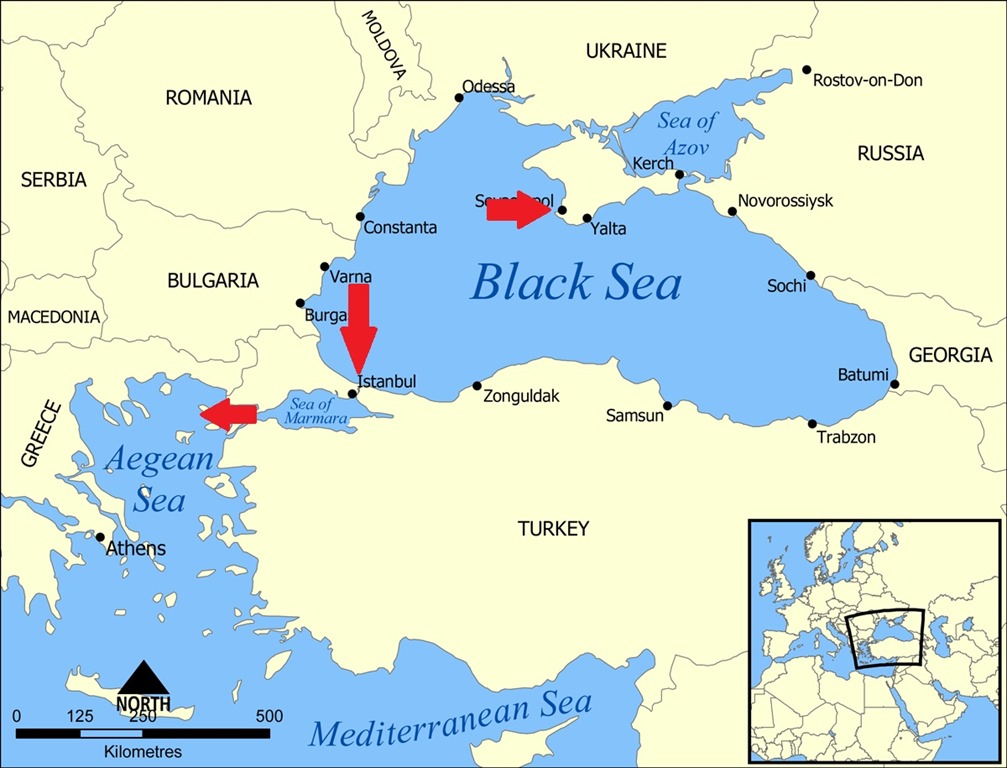
The Russian Naval Bases at Sebastopol and Yalta were a significant asset to the Soviet Union during the Cold War Era. The Old Soviet Union could engage in commerce with and project military power to its satellite countries via the Black Sea. The Black Sea also provided Soviet merchantmen and warships access to the Mediterranean via Istanbul, the Sea of Marmara and the Bosphorus Straits.
However, the geopolitical picture has changed dramatically and many of the Old Soviet Block countries are now EU and NATO members, so military use of the Black Sea other than routine operations is greatly diminished. Looking outward from its immediate sphere of influence, as you can see from the map, successfully moving a military fleet through the Bosphrous Straits in support of hostilities would have disastrous consequences. Russia’s fleet would never make it through the Turkish Straits out to the Aegean Sea. So, the Black Sea in 2014 is of importance to the Russian Federation for commerce, and having a warm water port open 365 days a year is vital to Russia’s economic interests.
Recently, we’ve witnessed a civil uprising[1] in the Ukraine. For the Russian Federation it presents some interesting challenges. First, there is a lack of clarity on who all the actors are in this uprising. The pro-EU element, although visible, may not be the group that emerges in power. In any situation where political stability is compromised, opportunities are created for radical elements to emerge. It’s no different than an opportunistic pathogen taking advantage of a weakened immune system. We saw that with the Arab Spring and more recently in Syria. The EU’s failure to act in a timely manner to provide stability has potentially opened the door for regional radical elements to infiltrate the process. So, both Russia and NATO lack a clear understanding of what forces are at play.
Because of its numerous military bases in the Crimean Peninsula, the present instability is of great concern to the Russian Federation. Observers need to keep in mind that Russia was and is a nuclear power; as such, you can bet dollars to donuts that it also has nuclear weapon storage facilities in the Crimean Peninsula, if for no other reason than to supply its surface warships and ballistic submarines. From that perspective alone, it may be highly desirable for the Russian Federation to deploy military personnel to secure those facilities until such time as the Ukrainian situation stabilizes.
From our perspective it is highly unlikely that you’ll see further expansion into Eastern Ukraine by Russian Forces and it is unlikely that you’ll see armed conflict between Ukrainian military forces and Russian forces. However, the potential for miscalculation by either side is there.
[1] The Ukraine has had free elections since 1991, which was their first. There are two elections held; one is to elect the President and the other is to elect the Rada. Both the President and Rada members are elected for a five year term. Electorate participation ranges from a low of 50% to as high as 70% with an average that is slightly higher than 60%. So there is a constitutional process for Ukrainians to change the government.


