Wrapping Up JTRS

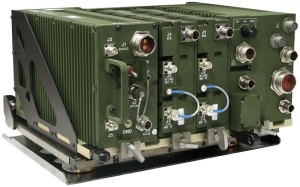
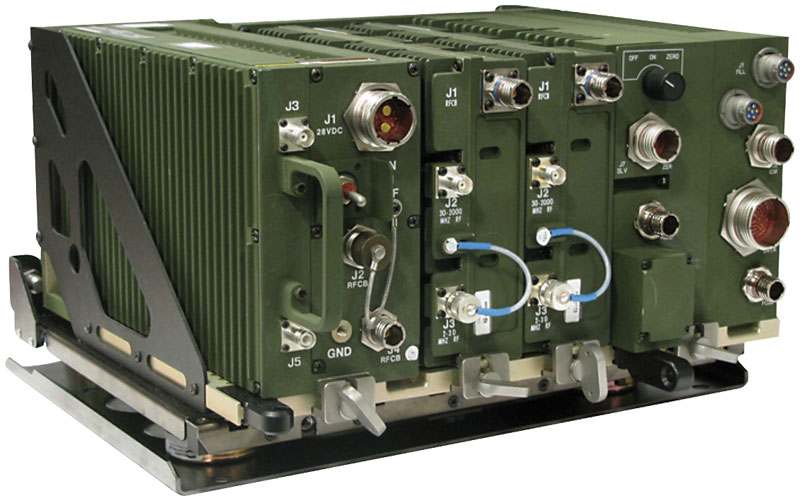
Boeing’s GMR

At the heart of the JTRS project is the concept of a software definable radio or SDR. The SDR is a hardware form much like your laptop; consisting of a processor or processors with its supporting circuitry – like memory, codecs, encryption chip and the r.f. or radio frequency components.

Like a computer, it processes instruction sets to perform specific functions. The executable instruction sets are broadly referred to as waveforms, and a waveform is what gives the SDR its identity, so a common hardware architecture can emulate a variety of fixed radios. For example, by loading a SINCGAR waveform in a software defined radio, you are able to communicate seamlessly with dedicated SINCGAR radios on a network.

Creating interoperability is the set of rules defined in the Software Communications Architecture or SCA. All hardware and software designed for JTRS must be SCA compliant. SCA is also and open architecture, meaning there are no proprietary components. This approach is critically important to the military and commercial success of the project, because it opens the doors to waveform developers. A historical example of the open architecture approach was IBM’s opening up of the desktop computer. That decision, uncharacteristically IBM, is what made the PC ubiquitous .

There are currently over 20 waveforms in the JTRS Network Enterprise Domain (NED)inventory. NED is responsible for the management, development and enhancement of the waveform library.

One waveform that seems to be at the heart of the net-centric battlefield is the Wideband Networking Waveform or WNW. Radios running the WNW will have the ability to transmit voice, data, video and imagery by tacking up 4 r.f. channels or scaling back to 2 channels as needed.

So, our ideal JTRS radio will have the capacity to emulate (computer jargon for imitate) any force radio. On the network side it will also have the ability to transmit voice, data, imagery or video concurrently by tacking up multiple communications channels as routing or bandwidth requirements dictate.

What is particularly interesting to me is the network side of JTRS. From what I’ve seen, manufacturers are dealing with voice, data and video applications by tacking up multiple channels, which appears to me to be inefficient. Regardless of the frequency spectrum, the more channels you tack up the larger bite you take out of available bandwidth.

A better approach may be to operate two channels, one broader active channel and one narrow channel for alternate routing, backup or signaling. The active channel could employ statistical time division multiplexing – a technology where time slots are allocated to the input that most need it – wrapping the encrypted data packets in IPv6, for routing. IPv6 provides 2128 network addresses.

Another interesting aspect of JTRS is the frequency spectrum they operate in, for example Boeing’s Ground Mobile Radio or GMR which functions from 2 MHz to 2 GHz. The radio can operate within that envelope as needed. However, in order to support high bandwidth applications like video and imagery, JTRS will need to use the higher end of the frequency spectrum, which makes the technology line of sight. So, in difficult terrain it requires an intermediary like a UAS or satellite link to increase its operating range. That dependency may prove to be a problem, in both maritime and land application, should we find ourselves in a conflict where our space assets are denied.

JTRS holds great promise for both military and commercial applications. It will be expensive but the commercial potential is high enough that developers will be willing to commit resources to the project.

As always, pass along any questions that you have and I’ll try to answer those for you. I hope you enjoyed the JTRS series.

Note: In general, higher frequencies are more sensitive to propagation impairments, satisfy higher bandwidth requirements and require smaller antennas. Lower frequencies are less sensitive to propagation impairments, provide lower bandwidths and require larger antennas.
Posted in Comms | Tagged , , , | Comments Off on Wrapping Up JTRS

SOFIC 2011 – Understand

USSOCOM’s charter calls for near surgical precision; requiring that teams have as complete knowledge of their AOR, area of responsibility, as technology will allow. Cultural, language, situational awareness, surveillance and reconnaissance are essential to mission success.

The need to understand dictates that USSOCOM have access to integrated enabling technologies to fully support C4ISR and shortening the kill chain. These technologies include but are not limited to; attended and unattended sensors; computational enhancements – hardware and data mining; hostile force tag, track and locate (TTL); biometric data collection and analysis; special operations tactical video systems or SOTVS; Sensitive Site Exploitation (SSE) are some of the active projects that address SOCOM’s need to “Understand.”

For example, attended and unattended sensors are very much in vogue and you can be assured that development will continue to accelerate.

Sensors give SOF a standoff capability and enhance the intelligence collection function. As development of sensors accelerate, you’ll see them play an increasing role as a “soft” force multiplier.

The increasing deployment and employment of sensor technologies will place heavy demands on supporting technologies, like concealment. How do operators effectively conceal the devices used to collect, audio, video, data, positional and seismic data. Moreover, how will that data collection be transmitted to Command and Control or C2.

Should sensors continuously transmit data collected? An interesting question in that continuous transmissions will dramatically increase the risk of detection by an adversary with highly evolved SIGINT capabilities. Or, should sensors be periodically polled by a UAV or  low orbiting platform. How do we mitigate line-of-sight constraints or propagation anomalies?

Going further, what systems will be required to quickly aggregate and correlate data, from potentially hundreds of sources, so that C2 is enhanced and operators are delivered near realtime situational awareness.

These needs and concerns are representative of the challanges USSOCOM will face in the years to come. Much of their developments will be directly transferable to the “Big” Army, Navy, Marine Corps, Air Force, Coast Guard and Department of Homeland Security.

Will Congress slash budgets as they struggle with increasing and debilitating budget deficits. Will they recognize the benefits that the broader economy will derive from the advances in communications, trauma care, optics, mobility and computation needed to support the USSOCOM mission?

Only time will tell, but from this blogger’s perspective the Net Present Value (NPV) of a robust and well thoughtout Defense Budget will exceed that of mindless slashing for the sake of expediency.


Posted in Uncategorized | Tagged , , , , , | Comments Off on SOFIC 2011 – Understand

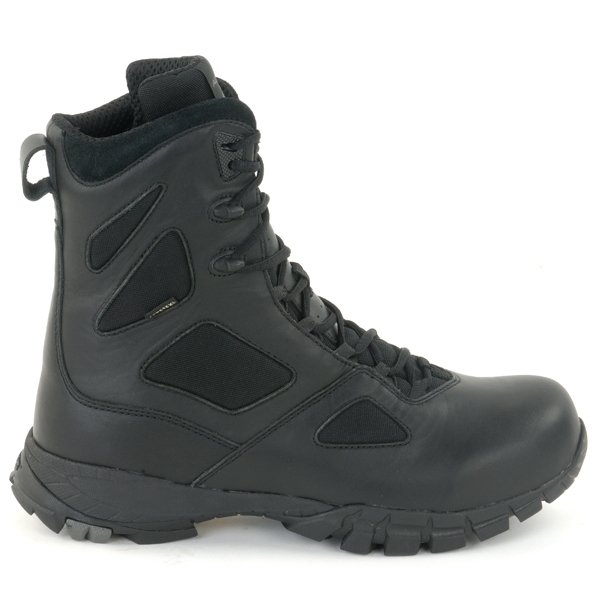
ALTAMA® Waterproof Ortho-TacX® Boot

ALTAMA Waterproof Waterproof Ortho-TacX® Boot

Footwear, more than any other piece of equipment in an operator’s kit, is critically important to mobility, survivability and safety. So, I like to keep an eye out for boots and socks designed by attentive companies with that thought in mind.

While at SOFIC 2011, I had an opportunity to visit with a couple of companies, both of which are existing suppliers to the DoD and USSOCOM.  Among them is ALTAMA®, a Georgia company with years of experience in design and fabrication of exceptional footwear.

ALTAMA’s Waterproof Ortho-TacX® Boot an exceptional value at any price but at
$199.99, it’s a steal.

The Ortho-TacX® will be available in September 2011, but you can pre-order them from ALTAMA’s web site and save yourself shipping costs.

For additional details or to place your order visit  ALTAMA’s web site.

Posted in Footware | Tagged , | Comments Off on ALTAMA® Waterproof Ortho-TacX® Boot

Blade Show 2011

That’s right numb nuts, I’m not the fairy godmother or your mommy, and no I didn’t forget Blade 2011 coverage. So, I guess you’ll just have to come back to read about it won’t you. Drop and give me twenty maggot…

Gunny Drops In On The SOG Team

Posted in Knives and Tools | Tagged , | Comments Off on Blade Show 2011

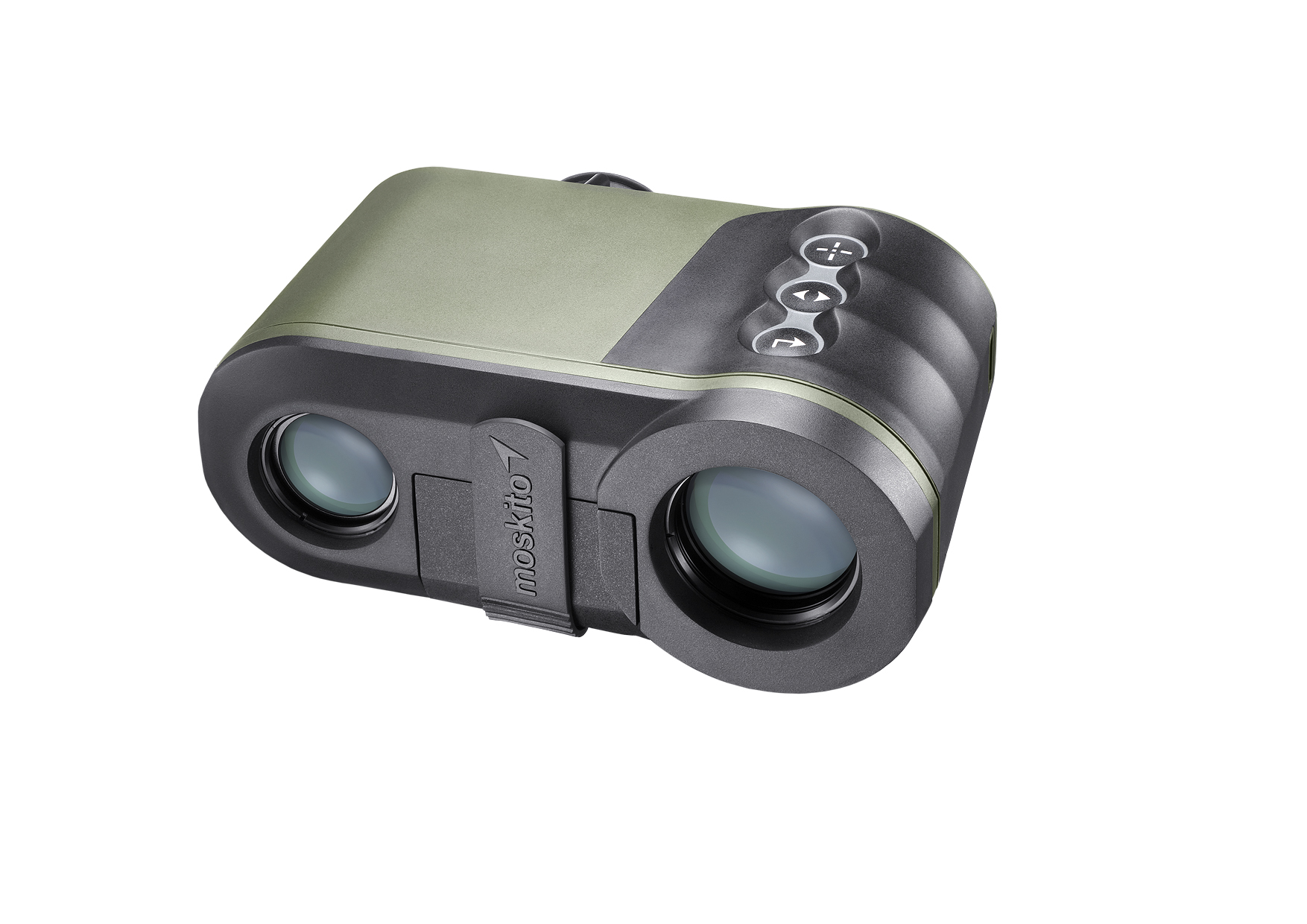
Vectronix Selected To Supply 1400 MOSKITO, Commander’s Target Locator (CTL), For UK’s FIST Program.

Vectronix MOSKITO CTL

Vectronix, of Heerburg Switzerland, designs and manufactures extreme high quality optical ranging devices. I’ve had the opportunity to use a variety of their equipment over the years, and I can say, without reservation, that it leaves the competition in the dust. Optics, ranging speed and accuracy are superb.

The company has been selected to provide the FIST (Future Integrated Soldier Technology) program (Thales is the leed contractor) with an additional 1400 CTL’s bringing the total order to 4000 units.

The MOSKITO will be utilized as the new Commander’s Target Locator (CTL). The unique multi-function device combines all essential day and night viewing, measuring and geo-location functions into one compact and user-friendly device weighing less than 1.2kg, including its commercially available batteries. Vectronix’s MOSKITO can be also found in sniper kit.

Posted in ISR, Range Finder, Sniper Systems and Tools, Soldier Systems | Tagged , , | Comments Off on Vectronix Selected To Supply 1400 MOSKITO, Commander’s Target Locator (CTL), For UK’s FIST Program.

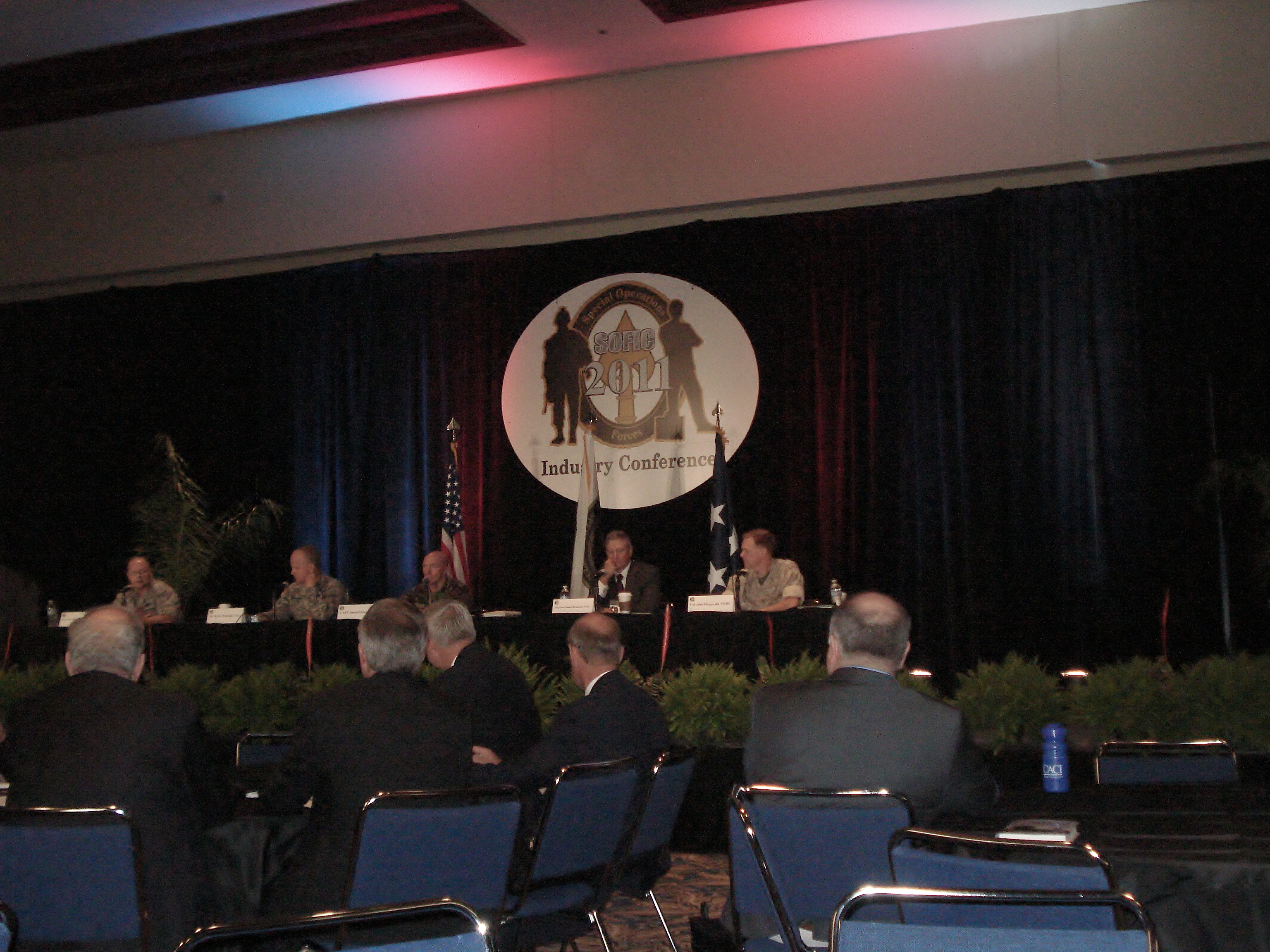
SOFIC 2011 Business Opportunities Session Reiterates a Commitment To Small Businesses.

SOFIC 2011, Tampa, FL

This year’s theme for the annual conference was “Understand, Communicate, Move and Engage” a need assessment articulated by Adm. Eric T. Olsen as he discussed his vision of USSOCOM post UBL EKIA.

SOF Forces are presently engaged in over 75 countries around the world but not all are kicking in doors and eliminating insurgents. In fact, 80% of SOF work is non-kinetic, which accounts for Adm. Olson’s emphasis on “Understand” a principle that was ever-present at this year’s event.

As in subsequent years, the conference kicked off with a Business Opportunities Session designed to embrace the hundreds of small businesses supporting USSOCOM. First up TILO, Technology and Industry Liaison Office (TILO), and the Office of Small Business
Programs, with excellent presentations. For small businesses wishing to do business with USSOCOM, TILO is an invaluable resource. A large part of their charter is to match your concepts and technology with USSOCOM priorities and connect you directly with the appropriate Program Executive Office (PEO). If you’re a small business, with that better mousetrap, I strongly encourage you to use USSOCOM TILO.

Technology and Industry Liaison Office and OSBR was followed by presentations from Margaret McCaskey, Director, Experimentation and Joint Capability Technology Demonstration (JCTD) for USSOCOM and Shawn Patterson, Program Manager, Small Business Innovative Research Program (SBIR), USOCOM. SBIR work’s closely with small business technology companies, by challenging them to solve SOCOM specific needs, and provides funding for research and development. They will assist small companies in bringing their innovation and technology to the DoD and the commercial markets.

The Business Opportunities Session concluded with AT&L Efficiencies and Contract Effects delivered by Col Kurt Bergo, USA F, Director, Procurement, USSOCOM, and Tips For Submitting Successful Proposals.

Small businesses looking for opportunities should familiarize themselves with and
frequent the following web sites.

  1. http://www.fbo.gov      Federal Business Opportunities, USSOCOM contracting actions greater than  $25,000.
  2. http://www.dodsbir.net     Small Business Opportunities are listed every November.
  3. http://www.acq.osd.mil/cto      Use this site for submitting proposal from mid-December to mid-March.
  4. http://www.acq.osd.mil/jctd/index.html Visit this website to obtain the procedure for submitting candidate proposals
    for JCTD.

I will continue SOFIC 2011 coverage and digest “Understand, Communicate, Move and Engage”, examining SOCOM’s needs in these areas and how they relate to operational requirements.

Posted in Uncategorized | Tagged , | Comments Off on SOFIC 2011 Business Opportunities Session Reiterates a Commitment To Small Businesses.

JTRS – Continued (Cleaning Up Loose Ends)

Before, I start into the software definable radio and the standards surrounding the SDR project, I’d like to clean up some loose ends.

Legacy radios, meaning radios that do not operate in the digital domain modulate the radio frequency carrier using A.M. and F.M. there are some r.f. modulation schemes that involve phase changes of the r.f carrier; however, the majority rely on modulating the r.f carrier’s amplitude or modulating its frequency.

When we enter the digital radio era, we convert the analog input (i.e. the human voice) to a digital signal using something like PCM previously discussed. We can then manipulate the digital stream applying algorithms to compress the data stream. We then modulate the carrier frequency with a digital stream representing voice, data or video information. Because we are dealing with a stream of pulses we have to concern ourselves with ways to modulate the carrier frequency so that pulse width, pulse amplitude and pulse repetition rate can be successfully retrieved at the receiving end. For that reason virtually all digital radios use combinations of frequency modulation and phase modulation schemes or amplitude modulation and phase modulation. Phase shifting, involves shifting the r.f carrier along the time domain which is represented on the x-axis of a Cartesian coordinate. We don’t alter the frequency we change its phase.

In my last three posts dealing with JTRS I presented relatively complex technical details about radio communications using some simplistic language. However, if you understood the concepts, you now have a better understanding that the average citizen.

All future posts will be strictly JTRS relevant.

Posted in Uncategorized | Comments Off on JTRS – Continued (Cleaning Up Loose Ends)

JTRS – Continued

In my opening article I wrote briefly about modulation to include FM (Frequency Modulation) and AM (Amplitude Modulation). I also discussed PCM (Pulse Code Modulation), which is in the digital domain. Virtually all  modern military communications equipment operate in the digital domain. That is, they convert the analog human input into a digital stream. Also recall that using standard PCM, we generate a data stream of 64,000 bits per second.

For the time being, I’d like you to view that digital stream as a water pipe of some diameter “d”. In the paragraphs that follow I will discuss the concept of spectrum and bandwidth utilization as it will help you understand some of the challenges designers will need to address as JTRS (jitters) is implemented.

Spectrum is the distribution or totality of the operating environment. In other words, it is the frequency range that the system can operate in given its design and antenna characteristics. Regrettably it is both costly and limited; therefore, designers need to do everything possible to optimize its utilization. On the other hand, bandwidth is the utilization of the available spectra. The graphic below should help you with that concept.

Figure 1

Figure 1 illustrates the concept of spectrum with a large circle that represents the range of frequencies that SINCGARS operates within. The smaller circles represent a communications channel. What you should take away from this graphic is that there is a limit to the number of channels that the given spectrum will accommodate. Therefore, to add additional capacity, designers must add to spectrum, reduce the bandwidth of the channel or a combination of both. This leads us to a very high level discussion on codecs (coders decoders) which is how designers address the channel bandwidth requirements or the size of the smaller circles in figure 1.

The codec, is a fixed or programmable circuit used to processes a digital stream to achieve a desired output. In voice communications where we are bandwidth limited, we use codecs that aggressively compress our 64,000 bit stream into something much smaller. The concept of compression is hard to visualize but I am going to take a stab at it.

A three-second PCM sample generates 3 x 64,000 bits or 192,000 bits, that’s a large amount of data. Keeping that in mind lets dissect a typical radio call.

  1. Sender:   Romeo Bravo. Rome Bravo. Rome Bravo this is Quebec Charlie. Radio Check Over.
  2. Receiver: Quebec Charlie this is Romeo Bravo I read you 5 by 5 Over.

In this particular transmission there is a silence between each letter and each word; rather than representing that silence with an 8 bit digital stream of zeros (00000000) we could compress it to, say, a three bit stream. For example, one bit to indicate the presence of silence and two bits to indicate its duration; effectively going from “00000000” to “001”. So, by applying this processing to our PCM stream we can successfully reduce the bandwidth requirements from 64,000 bits per second to say 12,000 bits per second, which makes it possible for us to reduce the size of the small circles in our graphic so the available spectrum will carry more channels.

The secondary benefit to compressing the data rate is that the communications stream is less vulnerable to SNR (signal to noise ratio) impairments.

So far we’ve only discussed voice communications, but consider what happens when we add video and data transmissions to the system – we’ve now placed additional demands on the available spectrum. Finally, we place further demands on spectrum when we add the concept of an IP based networkable communications architecture.

In another article I’ll give you an overview of the SDR (Software Definable Radio) and some of the standards established to ensure interoperability; so, stay tuned and send any questions or comments my way. I’ll do the best I can to answer them for you.

Posted in Comms | Tagged , | Comments Off on JTRS – Continued

FNH Displays Ballista at SOFIC 2011…

FN Herstal (FNH) is part of the FN Group sharing a prominent spot with Browning and Winchester.

FNH has been innovating and manufacturing small arms since 1889 and can claim trophies like the ubiquitous FN FAL rifles, the 9 mm HP pistol, MINIMI 5.56 LMG, FN P90 PDW and its partner the Five-sevenN tactical pistol to name just a few. More recently, the company introduced the Special Combat Assault Rifle or SCAR® under the USSOCOM SCAR program. The SCAR® rifles, available in both 5.56×45 and 7.62×51, embodies technologies previously unavailable until its introduction in 2008. The SCAR® is ergonomically correct and fully ambidextrous with an operator field replaceable barrel. Barring early issues with weaknesses in the stock, SCAR® Mk16 (5.56 x 45) and SCAR® Mk17 rifles are among the world’s most versatile and robust combat assault rifles on the market.

In January 2011, FNH introduced the FN Ballista a caliber convertible sniper platform that I predict will give Remington sleepless nights. The Ballista supports the 338 Lapua, 300 WinMag and 308 calibers. The stock, is precision machined from aluminium and collapsible. The weapon comes in at 17 lbs without optics and shares a common magazine size for all three calibers. Switching from one caliber to another is a rather simple matter making this rifle extremely versatile. In the video that follows, Mr. Jay Recto, Manager Assault Rifles, for FNH demonstrates some of its unique features.

Posted in Sniper Systems and Tools, Uncategorized, Weapon systems | Tagged , , , , | Comments Off on FNH Displays Ballista at SOFIC 2011…

Support Magpul’s Enduring Spirits Initiative !

Photo: Courtesy of Magpul Industries and Mil-Spec Monkey

Magpul Industries derives much of its operating philosophy from the ancient Japanese Bushido – a code built on courage, loyalty and fairness. In keeping with that tradition, and its affinity for Japanese warrior culture, the company has teamed up with the Mil-Spec Monkey© to deliver a limited edition patch that Magpul calls a take-off from the “Army Strong” slogan. The patch features a prominent “kanji” symbol over a brush stroked symbol representative of the Japanese flag.

The patch sells for $6.00 and is available directly from Magpul Industries’ web site http://store.magpul.com/product/MAG815/70

All proceeds go directly to the Red Cross and other charitable organizations
providing relief to the Japanese community. Please join us in supporting this
cause.
The reconstruction and cleanup work facing Japan and its people, particularly those in the affected areas, is overwhelming. Join us in supporting this promotion and order a patch for yourself and family members.

Posted in Alerts | Tagged , , | Comments Off on Support Magpul’s Enduring Spirits Initiative !

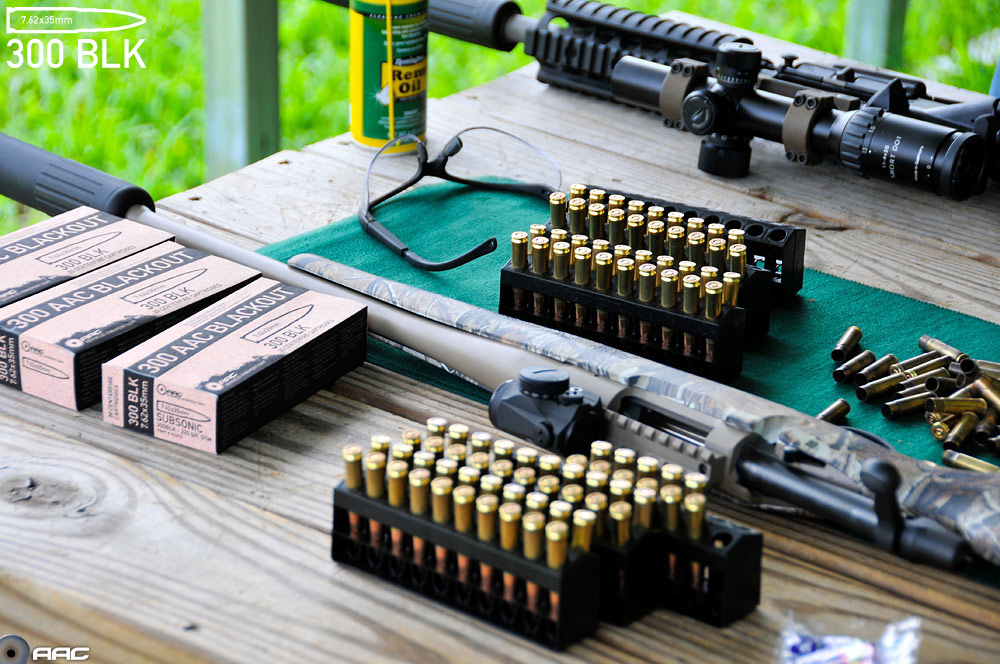
Advanced Armament Company 300 Blackout at SOFIC 2011…

Photo Courtesy of AAC

When Eugene Stoner designed and developed the M16, he probably did not envision the genius of his work. There is not a weapon system in production today that delivers the functionality, flexibility and reliability found in Stoner’s design. With a simple swap of an upper receiver, an operator can transition from a 5.56×45 platform to a 30 caliber subsonic or supersonic freight train.

By way of example, consider JD Jones’ 300 Whisper®, a cartridge manufactured from a 221 Fireball case necked up to accommodate a 30 caliber bullet. Jones’ Whisper delivered a 220 or 240 grain payload. The drag and ballistic coefficients are so high that there is very little loss in velocity. For example, at 200 yards the round looses a mere 65 fps from the initial muzzle velocity. This performance gives the 300 Whisper® massive terminal ballistics.

JD Jones intended the 300 Whisper® to be a suppressed system; however, a number of supersonic loads have been developed.

JD made the 300 Whisper® available on a standard M4 or M16 platform, designed for the 5.56×45 round, with a .30 caliber barrel chambered for the 221 Fireball. His company, SSK Industries, also offers the 300 Whisper on a bolt-action precision rifle. The cartridge gained acceptance but it still remains a boutique cartridge, which means that commercially available ammunition is hard to find.

The 30 caliber AR concept got a boost from the folks at Advanced Armament Corporation when they announced the AAC 300 Blackout. The 300 Blackout is a SAAMI compliant cartridge specifically designed to take advantage of the versatility offered by the AR platform.
Photo Courtesy of AAC

In the video below, Rob Silvers, AAC’s Director of Research and Development,  tells us 300 Blackout ammunition will be produced in quantity. If AAC and The Freedom Group delivers on its promise, it will give the 30 caliber AR a much-needed boost.

AAC will also supply a complete upper or barrel / gas system assemby as your needs require.

Posted in Ammunition, Weapon systems | Tagged , , | Comments Off on Advanced Armament Company 300 Blackout at SOFIC 2011…

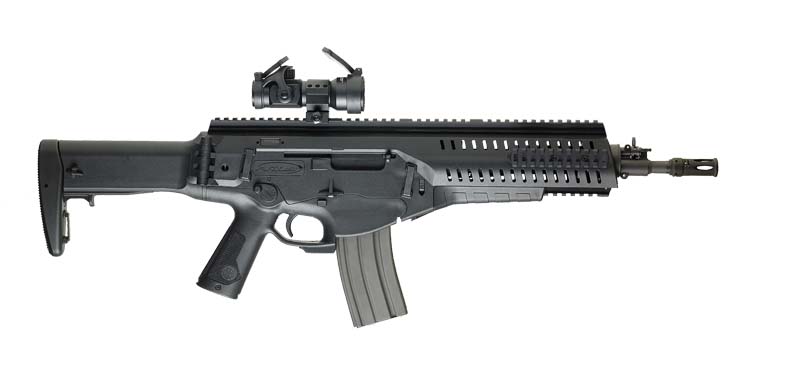
Beretta Exhibits ARX160 at SOFIC 2011…

Courtesy Beretta USA – ARX 160 carbine.

Beretta has been building firearms for quite sometime. The company enjoys an enviable position in the law enforcement, military and commercial markets offering a high quality and well diversified product portfolio.

Currently, Beretta supplies the United States Armed Forces with the M9 and M9A1 handguns.
In 2007-2008 the company developed the ARX160 carbine for the Soldato Futuro Program. After considerable testing, Beretta’s ARX160 was adopted by the Italian Army; since then, the company has been successful in placing the carbine with the Mexican government as well as other EU customers. Beretta is also a participant in the U.S. Army’s Carbine Competition.
While at SOFIC 2011, I had an opportunity to spend some time with Len Lucas, Beretta USA law enforcement and military sales, and the ARX 160 carbine.
The ARX160 was designed from the ground up to be fully ambidextrous; any control was accessible and operational on both sides of the weapon. Changing from right side to left side ejection was a snap as was swapping barrels. Take down was easily accomplished without tools and the procedure was simple – not a lot of hand movements.
Ergonomics were also superb. One of the challanges encountered by many of our small-arms manufacturers is creating a rifle that will fit any gender or body type. This is a task that is more easily verbalized than done, but Beretta seems to have accomplished that in my view.
The ARX160 uses a gas operated rotating bolt system with a cyclic rate of approximately 700 rounds per minute. The carbine uses a standard 30 round STANAG magazine but will also accept a 100 round C-mag drum.
Without a live fire test, I have to defer further comment but I like what I see and if accuracy and reliability are as good as the design itself, Beretta is sure to give contenders a run for their money.
Beretta has also developed a complimentary 40 mm grande launcher designated the GLX 160.
Watch Len Lucas as he takes us through the ARX 160.
Posted in Uncategorized, Weapon systems | Tagged , , | Comments Off on Beretta Exhibits ARX160 at SOFIC 2011…

Neilsen Kellerman at SOFIC 2011

Nielsen Kellerman exhibited their latest and greatest version of their flagship wind meter, the Kestrel HORUS ATrag wind meter. What separates their latest rendition from its other instruments is that the Kestrel HORUS ATrag is specifically designed for military and law enforcement application. Historically, snipers, designated marksmen and precision shooters have had to contend with estimating wind, wind direction, barometric pressure, altitude and relative humidity – all of which influence the trajectory of a shot fired from a precision rifle. These parameters become increasingly important as range to the target increase. With the Kestrel HORUS ATrag, the operator has at his disposal an instrument that delivers a real-time firing solution. Environmental data is updated realtime so all firing solutions are real-time.

In the video below Monica Devlin of Neilson Kellerman gives us an overview of their new meter.

The HORUS application running in the Kestrel meter was written specifically for the meter in  C making it extremely fast.

Look for incremental enhancements to the product in the display, form factor and power.

The weather meter is an indispensable part of an operators kit and if you are in a sniper or DM role, Kestrel’s meter is a must have item. If you’re unfamiliar with its capabilities I encourage you to contact Monica Devlin at Nielsen Kellerman.

Posted in Sniper Systems and Tools | Tagged , , | Comments Off on Neilsen Kellerman at SOFIC 2011

It’s A Glock!

Writing about Glock has to be a difficult task for all industry writers; I know it is for me. But, that’s not a negative. It’s simply a question of how to describe perfection.

Referring to Glock as the “people’s handgun project” is not representative of its history. Glock was not a product of the Deutsche Arbeitsfront nor was it intended to arm the populous and Gaston Glock was not a firearms designer. Yet in response to a 1980 solicitation from the Austrian Ministry of Defence Gaston Glock and a team of handpicked engineers set out to develop a pistol that met the Austrian military requirements. It took Gaston three months to produce a working prototype and in 1982 the Austrian military and police adopted the new Glock 17 as the P80. The rest of this story is history.

You’ll often hear the expression “… a Glock is a Glock…” a comment that stems from the fact that little has changed in Glock’s design since its adoption by the Austrian government in 1982. The generational changes have all been subtle design improvements like adding an integrated recoil spring assembly, changes to the magazine (floor plate and follower).

The Gen 2 model added chequering to the front strap and a steel plate forward of the trigger guard to satisfy ATF requirements for displaying the weapon’s serial number.

Gen 3 Glock pistols included an accessory rail, an improved extractor that also serves as a loaded chamber indicator and a locking block pin.

In 2010, at the Las Vegas Shot Show, Glock announced its Gen 4 designs adding enhancements that continue its 25 Years of Perfection. Listen to Glock’s Megan Harvey tell you about their Gen 4 model directly from SOFIC 2011.

Posted in Weapon systems | Tagged , | Comments Off on It’s A Glock!

Have a Great Memorial Day!

We at FOG HORN want to take a minute of your time to wish you and your loved ones a fabulous Memorial Day. More so than any other national holiday, Memorial Day gives us occasion to remember those who served and gave their lives for our country. Take a moment to remember them and their families. Teach your children the meaning of the day and its significance to freedom and the other liberties we tend to take for granted.

We are winding things down for the weekend but when we return we will continue our coverage of SOFIC to included the business opportunities, needs and constraints of doing business with USSOCOM. We will give you a look at some great weapon systems from Beretta, SIGARMS, FN Herstal and others. There will also be more on simulation and some impressive ISR technologies.

We will continue from where we left off with our silencer survey by introducing two great companies GEMTECH and Advanced Armament Company.

We will continue with our JTRS and the networked battle space.

From the crew at FOG HORN have a fun and safe Memorial Day wherever you may find yourself.

Posted in Alerts | Tagged | Comments Off on Have a Great Memorial Day!

Systems Technology, Inc. Exhibits PARASIM® at SOFIC 2011 in Tampa

Critical to the SOF mission is the depth and breath of training and 80 percent of SOF’s work is non kinetic. SOF’s success revolves around its people and how well prepared they are to execute that mission.

In the training business, we use a hackneyed cliché’ that “repetition is the mother of learning.” Wether developing muscle memory or cognitive skills, frequency and intensity of training are critical to cementing the concepts, procedures and techniques in the operators mind, so that situational responses are organic and consistent. The emergence and continuing development of simulation tools improves the training experience by orders of magnitude.

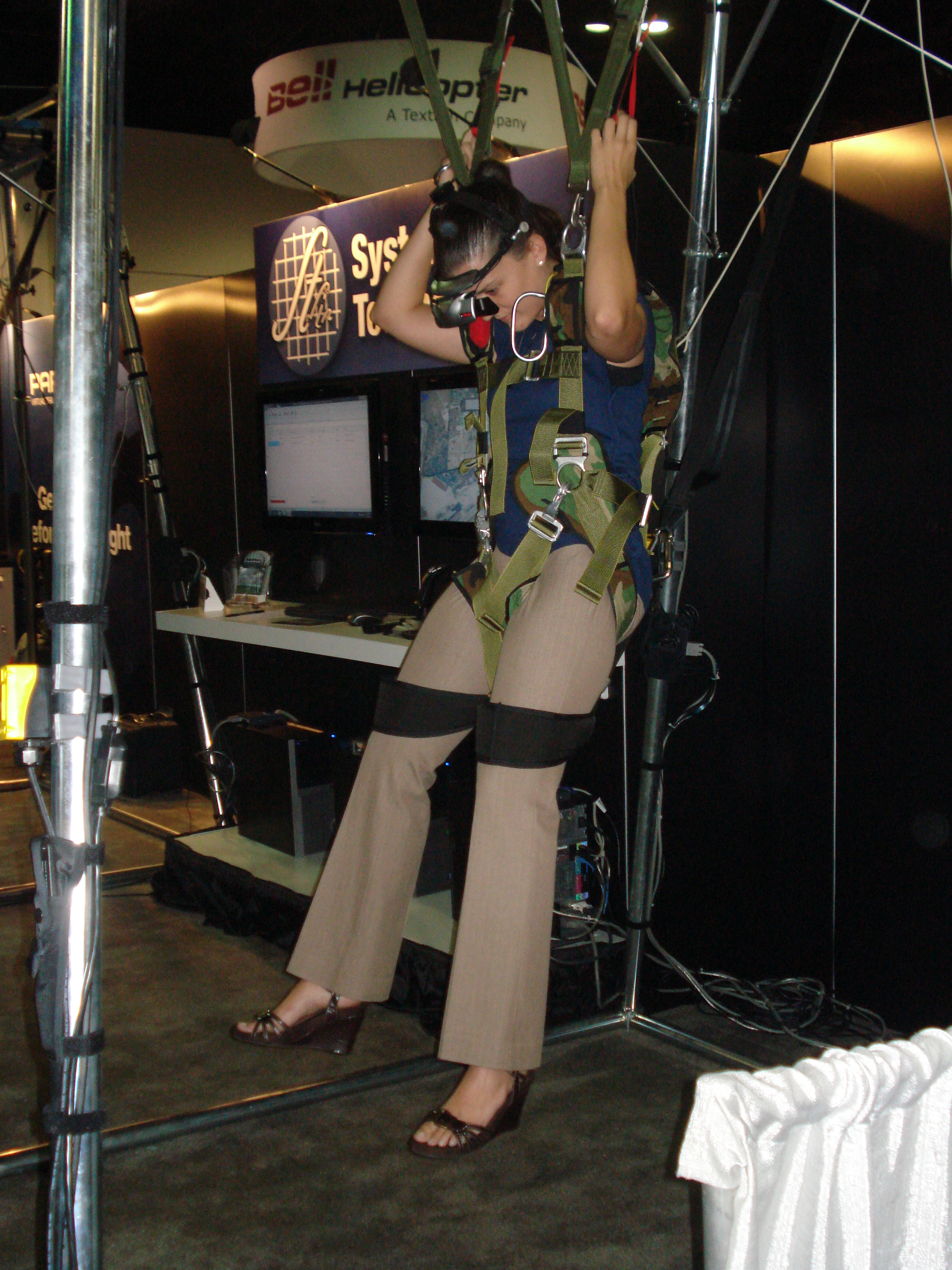
Systems Technology, Inc.  based in Hawthorne, Ca demonstrated this year at SOFIC  their latest version of PARASIM®, its virtual reality parachute simulator. Of course, I couldn’t help but try it.

I had a jump partner from one of the SFGs to my right. We began the jump at 10,000 feet and were instructed to deploy the canopy at 5,500 feet. My partner held his free fall until 3,500 feet; I opened my chute at a little over 5,200 feet. I felt a tug and tilted my head up to make sure the chute had opened. I made a right turn and was now moving up wind, movement relative to the ground was steady but I was slightly off target. I maneuvered making a series of turns; finally turning base then final. I was on the ground!

The trainee is strapped into her pack. She then slips on the goggles, which provide her with an aerial and ground view, as well as any peripheral details such as what her partner is doing.

Using the black leg straps the trainee is elevated and placed into a horizontal position in preparation for the free fall. At altitude, the free fall begins. When she reaches 5,500 feet, or any altitude stipulated, she deploys the canopy and verifies that there are no entangled suspension lines and the canopy if filled with air. The trainee then uses her brake lines to maneuver and control the fall.

Developers at Systems Technology, Inc have done an amazing job. Using PARASIM®, the trainer can simulate weather conditions, day or night, static or free fall as well as any conceivable emergency situation a trainee could encounter. Simulation, no matter how well implemented can never replace the actual event, but this is as close as you get given current technology. The only thing missing is the wind in your face.

The benefits are quite obvious: more frequent and flexible training, safer training environment and significant cost savings. Check it out!

Posted in Uncategorized | Comments Off on Systems Technology, Inc. Exhibits PARASIM® at SOFIC 2011 in Tampa

For The Sixth Year In A Row, Glock, Inc. Donates $100,0000 To Special Operations Warrior Foundation

Glock Continues Its Support for SOWF

At SOFIC 2011, Glock, Inc. continues its support of the Special Operations Warrior Foundation (SOWF) with a $100,000 check bringing its total contribution to $600,000 over the last 6 years.

SOWF was formed in 1995 when the Family Liaison Action Group, which was established to support the families of the 53 Iranian hostages; and the Spectre (Air Force gunship) Association Scholarship Fund; merged to form the Special Operations Warrior Foundation.

The Foundation is committed to providing scholarship grants, not loans, to more
than 800 children. These children survive more than 700 Special Operations
personnel who gave their lives in service to their country, including those who
died fighting our nation’s war against terrorism, as part of “Operation Enduring
Freedom” in Afghanistan and the Philippines; as well as “Operation Iraqi
Freedom.”

The SOF community has been selfless in their contributions to our country, so join Glock, Inc and other contributors in funding the wonderful work that SOWF does. Individuals or organizations desiring to contribute visit the Foundation’s website.

Posted in Uncategorized | Tagged , | Comments Off on For The Sixth Year In A Row, Glock, Inc. Donates $100,0000 To Special Operations Warrior Foundation

Extrema Ratio Annouces “Landing Force”

Extrema Ratio Via Tourcoing, 59100 Prato, Italy 0574 574322 supplies many of the world’s elite operating forces with their extraordinary edged tools and weapons. Their folding and fixed blade knives are unsurpassed in design, ruggedness and functionality; earning Extrema a global reputation for excellence.

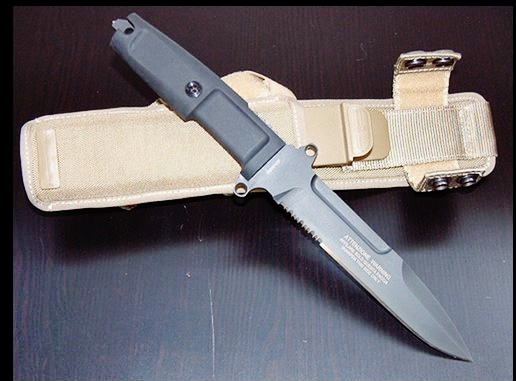
The company recently announced the Landing Force, a new designs that adds one more tool for those engaged in mine detection and clearing operations. The Landing Force is a fixed blade design weighing 6.9 ounces with a 7 inch fixed blade. This knife is made from nonmagnetic titanium.

Extrema Ratio Landing Force

Posted in Uncategorized | Comments Off on Extrema Ratio Annouces “Landing Force”

Streamlight Exhibits at SOFIC 2011

Streamlight designs,  manufactures and markets a variety of portable lighting products including a  broad range of miniature, rechargeable and standard battery,  precision-engineered flashlights and lanterns for professional fire fighting, law enforcement, military,  industrial, outdoor and automotive applications.

The company can trace its roots in illumination technologies back to the early seventies. Currently, Streamlight supplies tactical lighting products to all branches of the U.S. armed forces. They’ve worked closely with the services to develop products that address specific needs emerging from prosecution of the GWOT.

Weapon Mounted White and IR Illumination

One of its many success stories is the TLR-VIR, which provides the warfighter with impressive white and IR illumination.

Streamlight also has a very strong presence in the law enforcement community offering a variety of weapon mount and handheld tactical illumination products.

Streamlight’s success is largely due to their ability to deliver a high performance, high reliability product at a price point that austere budgets love. For Streamlight, this is an important comparative advantage that will contribute to increased market share in a DoD and DHS that will no longer spend like a drunken sailor.

Watch and listen to the excellent overview of their tactical lineup!

Posted in Tactical Lighting | Tagged , , | Comments Off on Streamlight Exhibits at SOFIC 2011

Raytheon and Motion Reality Inc develop 3D military applications.

The pressing need for versatile, timely and cost-effective training was obvious at this year’s SOFIC and an outgrowth of the GWOT. In the current operational environment, SOF operators need to construct flexible and accurate training scenarios, like the ones used to bring down Usama Bin Ladin. Regrettably, the fight continues with no end in sight and companies with a vision, like Raytheon Systems and Motion Reality Inc., are teaming to combine advanced military applications with exceptional hardware providing unparalleld training systems.

The video that you’ll see below requires some explanation. Here, the operators are equipped with goggles and other hardware. They move and respond to scenarios constructed in software and displayed on their goggles. The application analyzes the operator movement and displays it on monitors that may be viewed by trainers. It’s remarkable technology and very much in vogue. Look for more of this type of resource for both military and law enforcement.

MRI’s CEO Dr. Tom McLaughlin explains: “this real-time, untethered experience is enhanced by muscle stimulation technology, and the systems can be networked from multiple locations for distributed training,”

“[Our] technology is unrivaled in its ability to accurately capture full-body 3-D motion. The immersive 360-degree systems support force-on-force training and virtual artificially intelligent avatars that respond to actions and voice commands.”

Posted in Training | Tagged , , , | Comments Off on Raytheon and Motion Reality Inc develop 3D military applications.

A Weapon is Only as Good as the Ammunition Fired and Liberty Ammunition is on the Cutting Edge.

I’ve you’ve been alive over the last 9 years you know the DoD has been struggling with the lethality issue; much if not all of it has been fomented by the media in response to baseless allegations that the M4 and M9 are unreliable and lack lethality. One exhibitor at this year’s SOFIC Conference has a slightly different idea.

Liberty Ammunition based in Clearwater, Fl. was founded by PJ Marx in 2005. PJ is an extraordinarily cool guy with his roots in the music industry. Yes I said the music industry. It’s fair to say that I like where his head is at when it comes to ammunition, which he calls HALO -POINT. A rather interesting name but if it sends your target to heaven, I’m happy to let God sort them all out.

For example its line of 9mm ammunition offers a 55 grain nickle/silver round that delivers a muzzle velocity of 1900 to 2000 fps. with less than a 2 inch dispersion at 25 meters. The round is capable of defeating Type III body armor and creates an immense wound cavity.

Liberty Ammunition enhances terminal performance in all military calibers by a balance of bullet composition, geometry and velocity.

Posted in Ammunition, Weapon systems | Tagged | Comments Off on A Weapon is Only as Good as the Ammunition Fired and Liberty Ammunition is on the Cutting Edge.

You Didn’t Hear It From Me But…

While at SOFIC 2011 I spent  quality time with a quite a few exhibitors and I’ll be covering those discussions in subsequent posts. Due to the nature of SOF, some of what is presented at SOFIC Conferences is sensitive; however, I can talk around some topics and here are two that I know will be of interest to you.

Look for HORUS to release a new reticle. Thanks to the folks at Schdmit-Bender and Horus I had the opportunity to peek through the eye piece and I haven’t stopped drooling yet. I can also tell you that if you were to name this reticle you’d call it the “TreMor2.” I’ll have more on this revolutionary reticle later in the year. However, if you are in a sniper or DM role military or LE, I’d put this right at the top of my WANT list.

The second thing I can’t talk about is our friends at SIGARMS. Look for some interesting partnerships and teaming to deliver some new shoulder fired weapon systems. You’ll see an official release later in the year, and I’ll certainly be giving you a closer look at it.

Posted in Alerts, Optics, Weapon systems | Tagged , | Comments Off on You Didn’t Hear It From Me But…

Diving Officer Make Your Depth 65 Feet – Raising #2 Periscope – No Shadows, No Shadows, Scope Breaking, Scope Out.

Tampa, Fl.

Just got back from a great two weeks so there’s quite a bit to talk about. One of those, was SOFIC 2011; it was outstanding and gets better year-over-year. However, before I set the pencil to paper, I would like to thank the great folks at NDIA and USSOCOM for the hard work that goes into making SOFIC such a success. I especially enjoyed Adm. Eric T. Olson’s opening remarks – enlightened, relevant and on point –  and the various panels and breakout sessions.

I continue to advance the concept that if you are in the industry but are not part of NDIA you are limiting your horizons.

Posted in Uncategorized | Tagged , , , | Comments Off on Diving Officer Make Your Depth 65 Feet – Raising #2 Periscope – No Shadows, No Shadows, Scope Breaking, Scope Out.

Top N Reasons Where N = 10 Usama Bin Laden is Pissed.

10.     His new accommodations are way too damp.

9.      He’s been there only a week and already he’s got a case of the crabs.

8.     Nobody ever said he’d be living next door to a Jew, Jimmy Hoffa.

7.     He wanted a house warming but no one can find it.

6.     He can’t tell which way is Mecca.

5.     The power company wants a $25 million security deposit.

4.     He’s always wanted beachfront property but this is ridiculous.

3.     He used to think that bird shit was bad, but nobody said anything about whale
shit.

2.     Not Insha Allah, Insha Navy.

1.     The World Trade Center Twin Towers get a mosque he only got…

Posted in Fun Stuff, Morale Builders | Tagged , | Comments Off on Top N Reasons Where N = 10 Usama Bin Laden is Pissed.

Chief of the Watch Lower All Masts and Antennas. Diving Officier Make Your Depth 200 Feet 10° Down Bubble!

Readers, I will be incommunicado for a couple of weeks but I’ll be making up for that silence when I return to writing. I appreciate your comments, questions and suggestions. This past week has been an exceptional day at the office. We’ve manged to decrease the world’s supply of miscreants by two: Saif al-Arab Gadaffi and Usama Bin Ladin.

This is not a celebration over the death of these individuals but a celebration of freedom from fear and opperession for all mankind. All too often, morons and tyrrants exercise undo influence over our lives. Don’t yield to that influence with fear, meet it head on.

Well done!

Posted in Uncategorized | Comments Off on Chief of the Watch Lower All Masts and Antennas. Diving Officier Make Your Depth 200 Feet 10° Down Bubble!

A-TACS® Gets a Thumbs Up From FOG HORN

Photo: Courtesy of Advanced Tactical Concealment Systems

I have been keeping an eye on the A-TACS® pattern, since it surfaced at Ft. Benning, GA, Oct 2009. The pattern was developed by Digital Concealment Systems (DCS) and I have to say that, in my opinion, it does more things well than any other design I’ve run across. In fact, I like it so much that were I standing up an Army it would be my choice for a UCP.

I still wouldn’t allow my self to be backlit and standing on a ridge just yet but FOG HORN likes A-TACS® as it appears to work well in arid, urban and semi-forested (not jungle) areas.

Readers interested in finding more out about A-TACS® should seek that knowledge at Soldier System. They are definitive source and purveyor of all things “camo” on the internet. Eric and the rest of his folks have done more to answer and clarify questions surrounding the Army’s quest for new camouflage patterns than anyone online.

Posted in Gear | Tagged | Comments Off on A-TACS® Gets a Thumbs Up From FOG HORN

Reader Question Re: JTRS – What is a Software Definable Radio?

This is jumping the gun as I’m still developing the JTRS articles, so hang with me as we develop this relatively complex technology and synthesize it into something that is digestible by a non-technical reader.

The Joint Services presently own a plethora of radio communications equipment all of which are limited to specific functionality and expensive to maintain. The Joint Tactical Radio System or JTRS attempts to greatly reduce the number of discrete radio types and models by implementing a software definable radio (SDR).

Think of the SDR as a computer running a number of emulations interconnected by a standard multithreaded operating environment like UNIX (this is an example to help you visualize the concept).

You’ll hear the term waveform used in conjunction with the JTRS project. As the term is used in JTRS a waveform represents the entire functionality of an existing communications product. For example, SINCGARS radios are used extensively by ground forces. The JTRS product will be able to load, in software, a SINCGARS waveform. Under the control of this software load, the JTRS radio will emulate all of the functionality of a SINCGARS radio. That functionality includes the codec, encryption, modulation and frequency band as well as the frequency hopping characteristics.

JTRS is a complex technology but hang in there and I’ll get you through it.

Posted in Comms | Tagged , , | Comments Off on Reader Question Re: JTRS – What is a Software Definable Radio?

U.S. Army Wants To Reconfigure M110 SASS.

In a sources sought solicitation, number: W15QKN-11-X-F015, PEO Soldier Project Manager Soldier Weapons seeks to reconfigure some or all M110 SASS sniper platforms. The M110 fielded in 2008 was intended to replace the venerable M24, now being upgraded by Remington Arms to meet the demands of Afghanistan.

Here’s what the PMSW is looking for in the reconfigured version.

  • 1. Operation: Semi-automatic
  • 2. Caliber: Compatible with 7.62x51mm NATO cartridges
  • 3. Accuracy: Capable of 1.3 minute of angle dispersion or greater with
  • match ammunition
  • 4. Size: Overall length shall be reduced using a shorter barrel and/or
  • collapsible buttstock. Maximum length not to exceed 39 without suppressor.
  • Desired minimum length is less than 36 with stock collapsed.
  • 5. Weight: Weight shall be under 9.0 lb for unloaded rifle without optics
  • and accessories
  • 6. Grip: A modular, adjustable pistol grip f.
  • 7. Trigger: A non-adjustable match style trigger.
  • 8. Hand guard: A forend that includes a fixed 12 o’ clock rail with
  • configurable 3, 6, and 9 o’ clock rails.
  • 9. Sound suppressor: A muzzle mounted, detachable sound suppressor.
  • 10. Muzzle device: A compensator/muzzle break compatible with the sound
  • suppressor.
  • 11. Bipod: Tool-less detachment featuring cant and pan/track capability.
  • 12. Day optic: An Army specified variable power day optic and compatible
  • rings.
  • 13. Back up sights: Iron sights offset 45 deg from the DOS.
  • 14. Sling attachment: Flush cup, quick detach sling attachment points.
  • In addition to the above listed enhancements, the upgraded M110 must meet the
  • operational and environmental requirements that were fulfilled by the original
  • M110 SASS.

From my experience with the SASS it’s already there with exception of the overall length and weight, the adjustable grip, pan track/scan bipod and the offset iron sights (which I see as a bad call).

I would prefer a quick detach scope mount keeping the iron sights on the horizontal plane or perhaps an auxiliary red dot sight ring mounted on the scope.

Posted in Weapon systems | Tagged , , , | Comments Off on U.S. Army Wants To Reconfigure M110 SASS.

Congratulations DEVGRU 6

On behalf of all Americans, and others around the world, congratulations on your exceptional performance. If I had the ability it would be burgers and beers for all at Boll Weevils, Coronado – and that’s from the heart shipmates.

Congratulations to all USSOCOM as this success was the results of a cumulative effort over a long period of time. Your tenacity and relentless effort paid off.

Well done!

6 May, 2011

I’ve already heard from the internet gerbils and closet commandos that DEVGRU 6 is in Dam Neck, VA. Gentlemen rest assured that I am intimately acquainted with every square foot of VA Beach. However, Coronado is where they started out and NO ONE makes a better burger than Boll Weevils. I’ll even provide the cuchi how’s that Buckwheat!

Posted in Uncategorized | Comments Off on Congratulations DEVGRU 6

What is a wipe?

I received an e-mail from a reader requesting some information on wipes. I apologize for that omission. In modern suppressor designs they are the exception and not the rule but it does merit discussion.

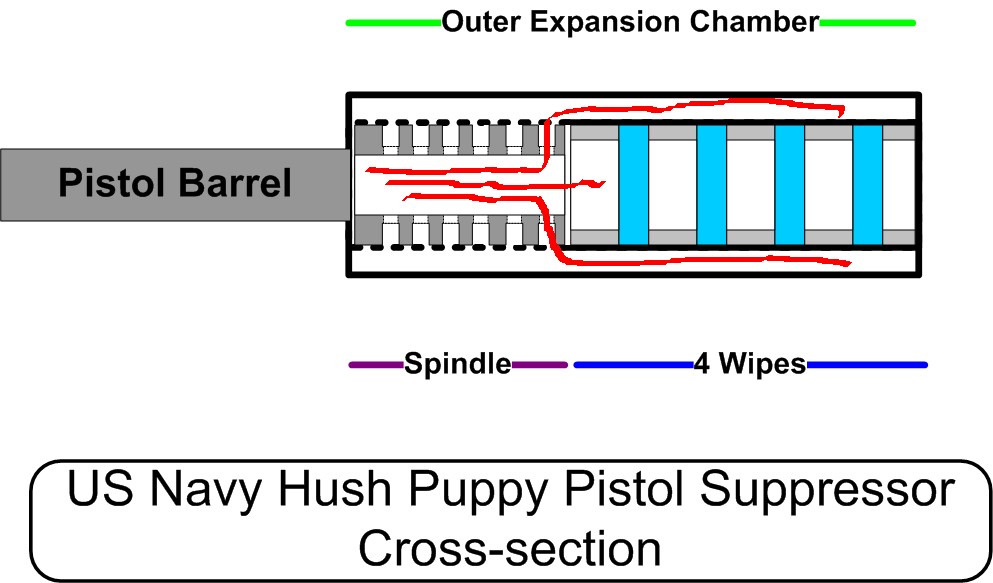
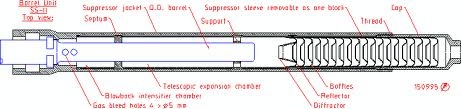
A wipe is a replaceable baffle usually made from a polypropylene or polyurethane material. These disks can be placed at any point along the length of the suppressor but are generally found closer to the exit point where gases are at a lower pressure and temperature.

When the weapon is fired, the bullet punches through the wipe exiting the suppressor on its way down range. The perforation made in the wipe exactly matches the bullet’s diameter creating a reasonably tight seal adding considerable resistance to the propellant gases. The wipe is usually good for 10 or 20 rounds, no more than a magazine or two, then it had to be replaced.

The best way to illustrate a wipe is to show you a cross-section of the U.S. Navy’s Hush Puppy – used extensively during the Vietnam War.  I’ve marked it up to show what the propellent gases are doing.

US Navy Hush Puppy Cross Section (wipes are blue disks)

Because the bullet punches through a solid disk, manufacturers prefer that users restrict the ammunition used to ball; avoiding the use of hollow points. The reasoning is that wipe material would fill the hollow point and adversely affect its terminal performance. I am have my doubts about that; however, the possibility of premature bullet expansion does exist. You can avoid this by using a wipe that’s be punched for the bullet diameter.

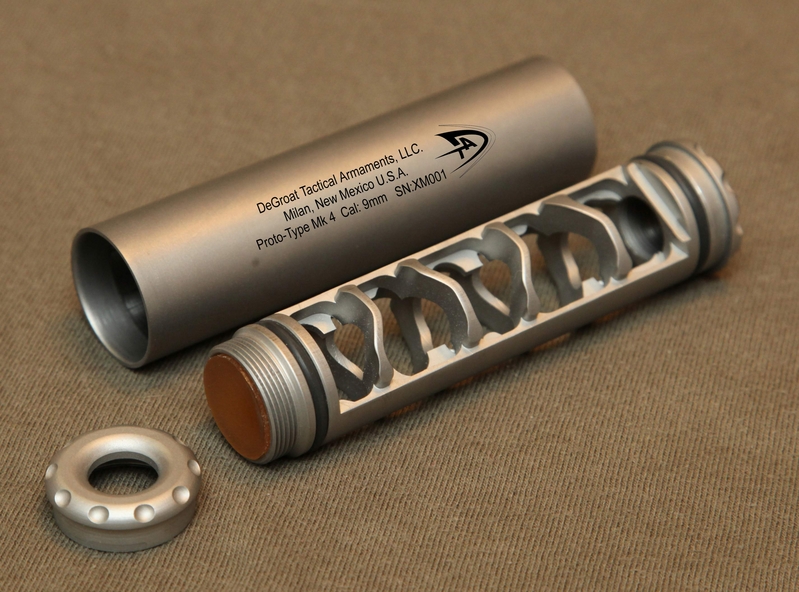
Some modern designs like the DeGroat Tactical Nano offer the opportunity to install a wipe at the exit point or suppressor muzzle.

When combined with modern suppressor designs the wipe does add a level of attenuation. I’ve not measured that performance but in my subjective assessment it provides a level of attenuation as well as lowering the characteristic resonance of the suppressor. High frequencies are highly directional, so any time you can dampen a higher frequency signature it’s a positive – in this writer’s mind.

Posted in Suppressors | Tagged , , | 2 Comments

Good’ole Yankee Inginuity

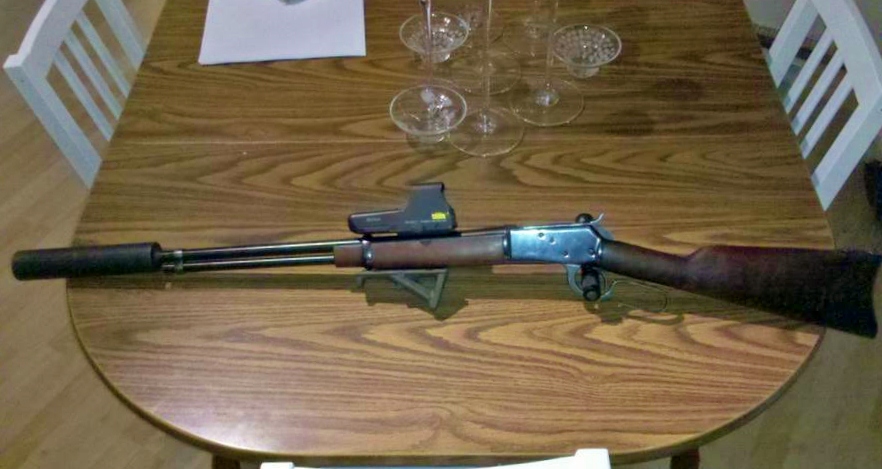
Tactical Lever Action or Future Combat Rifle

While perusing the Firearm Blog I ran across this and haven’t stopped laughing. This is an example of what makes our country great. We are a society filled with incredible talent and imagination – as well as those too willing to take credit for it.

How can you top a suppressed lever-action tactical carbine.  If only General George Armstrong Custer had these…

Credit where credit is due:

This came to us by way of the Firearm Blog who got it via ARFCOM who got it from SayUncle

Posted in Morale Builders | Tagged , | Comments Off on Good’ole Yankee Inginuity

Insight Technology Now Shipping The LED Upgrade Kits for the M6X.

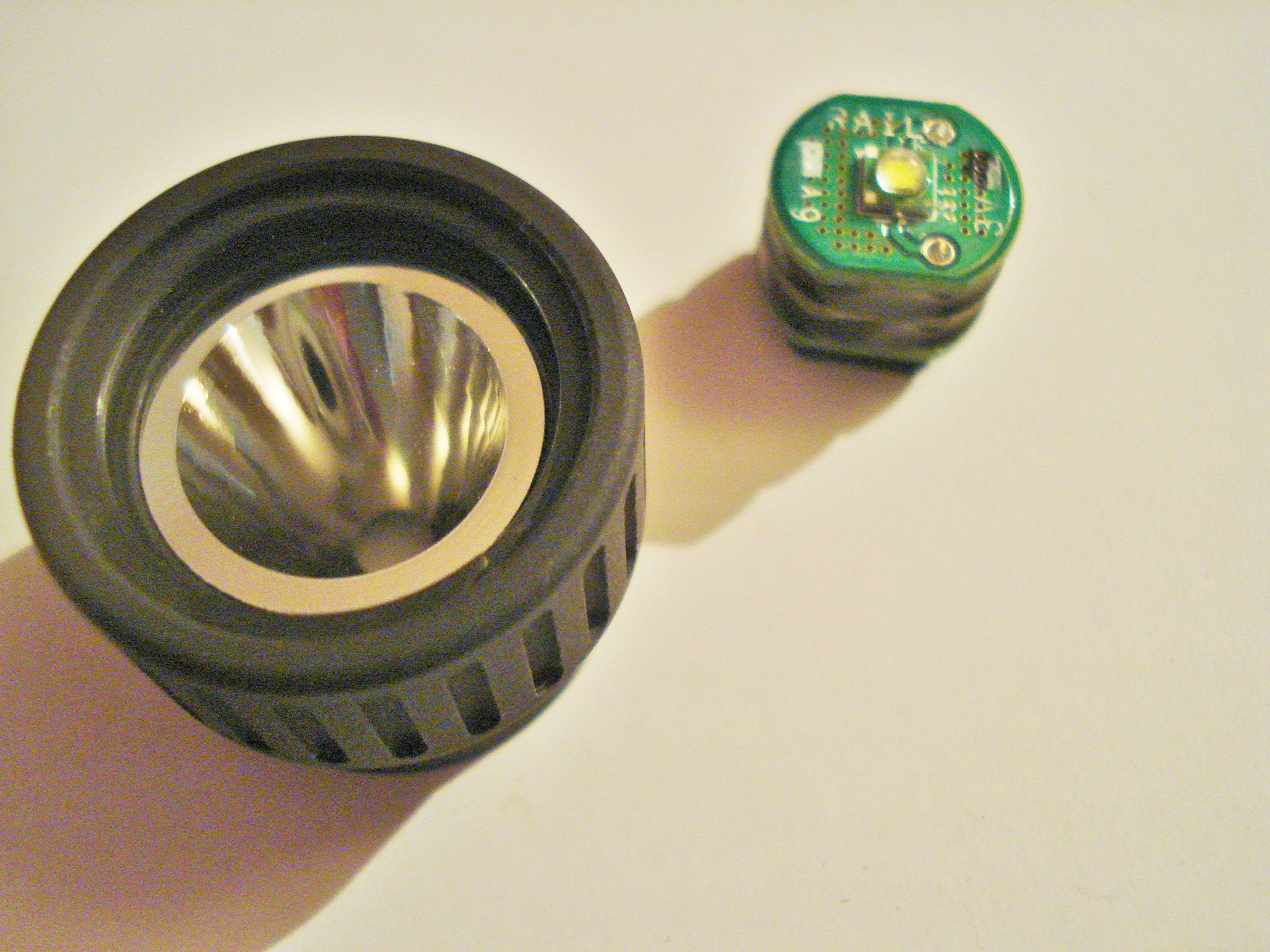
Yesterday, I spoke with the folks at Insight Tech Gear to get a status on the LED upgrade kits for the M6X and X2 family of weapon mounted lights. Direct from the “horse’s mouth”, they are now shipping into their retail channels so it is available and carries an MSRP of just under $75.

Owners of the M6X, X2 or X2L weapon mounted lights are strongly encouraged to upgrade your lights. It is truly worth the modest cost.

X2 L.E.D. Upgrade Kit - Insight Technologies

Posted in Tactical Lighting | Tagged , , | Comments Off on Insight Technology Now Shipping The LED Upgrade Kits for the M6X.

Suppressors Current State of the Technology – Part 7 – AWC Systems Technology.

AWC Systems Technology is a Division of Special Technologies Group Inc. with offices at 1515 W. Deer Valley Rd., Suite 105A, Phoenix, AZ 85027-2031. It’s impossible to discuss firearm suppressors without discussing AWC Systems Technology, and I have personally had the opportunity to use the very highly regarded ThunderTrap™ – also produced in Titanium – with its characteristic “hiss”. However, without regard to my latter, AWC Systems Technology stands in my mind as a company who has elevated the integrally suppressed weapon to an art form. In my view, the company produces the best integrally suppressed weapons in the world.

Integral reflex suppressor

The integral suppressor is designed around the ported bore of the actual platform with a surrounding tube to provide containment and expansion of gases, and the baffles. Full powered loads will remain subsonic when fired through an integrally suppressed weapon.

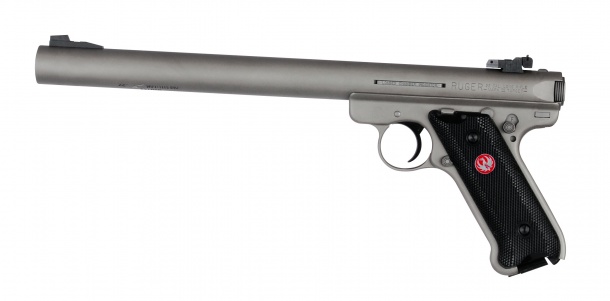
Integrally suppressed weapons can be produced in all calibers; however, by orders of magnitude, the .22lr leads the pack; a tradition that dates back to the days of Col. Donovan’s Office of Strategic Services (OSS). Where as the OSS silenced pistol was built on the HiStandard .22 lr, AWC Systems Technology builds its world-famous Amphibian on Ruger’s MkIII™.

AWC Systems Technology Amphibian - S

The Amphibian S is in its 13th variation over the last 29 years. The primary baffle system components are made from Titanium and 303 stainless steel, secondary baffles are made from 6061T6. The combination has achieved a significant weight reduction without compromising durability. The Amphibian design can be fired wet or dry and has been designed from its inception to survive the abuse of salt water.

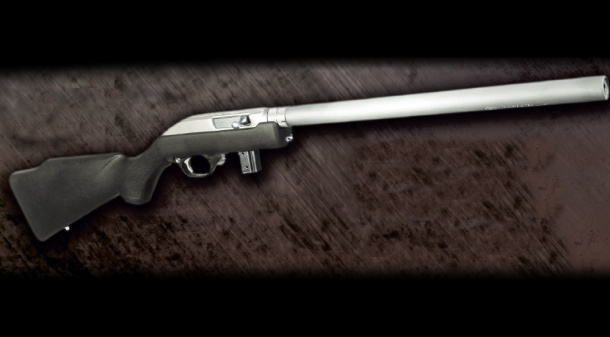
An equally popular and highly regarded integrally suppressed platform, based on the ubiquitous and highly reliable Ruger 10/22 semi automatic .22lr , is AWC’s Ultra II™

AWC Systems Technology Ultra II Semi Automatic.

AWC Systems Technology manufactures a variety of thread on pistol and rifle suppressors covering the caliber spectrum. As of this writing, the company does not make a quick attach/detach mount believing that thread mount suppressors offer superior sound reduction and overall performance.

AWC Systems Technology has been around since 1983 manufacturing superb weapon suppressors; many of which are still in service with all branches of the military and numerous law enforcement units.

For a comprehensive product list and documents visit the company’s website at http://www.awcsystech.com/

Note: Photographs of the Amphibian -S™ and Ultra II™ are courtesy of AWC Systems Technology. They are the sole property of AWC Systems Technology and may be protected by Copyright and Trademark regulations.

Posted in Suppressors | Tagged , , | Comments Off on Suppressors Current State of the Technology – Part 7 – AWC Systems Technology.

JTRS – Joint Tactical Radio System An Overview.

This post kicks off my JTRS project. My objective is to give the reader a 50,000 ft. MSL view of an emerging communications technology and the role it plays in the netcentric battlefield. The concept of a software defined radio is hardly new, but before it could become reality technology had to deliver the processors and codecs needed to support the software defined architecture. Those developments are still expanding and will continue to drive better utilization of the spectrum.

I have assumed the reader has a casual understanding of radio communications and for that reason my first three posts are of an introductory nature designed to build on that casual understanding so that the more advanced topics that I’ll present make sense.

Introduction 

We all take radio communications for granted, knowing that we
speak into a microphone and some one at the other end hears what we’re saying
and we hear them back. It ‘s a natural process that we intuitively perform 24×7.
However, audio frequencies do not propagate well over long distances and when
miles or even hundreds of miles separate the source and sink, audio frequencies
are impractical and a transport or carrier mechanism needs to be used.

Human voice wave form.

The human voice occupies the 300 Hz to 3400 Hz space within the audio frequency spectrum of 20 Hz to 20,000 Hz. Frequencies below 20 Hz will be felt before they are heard and frequencies above 20,000 Hz are beyond hearing rage in all but a few cases.

A human voice cannot be effectively transmitted over distances we must use some other medium. That medium is a radio frequency (r.f.), or a light source like a laser. In either case, we use the audio signal to alter (modulate) the radio frequency or light source.

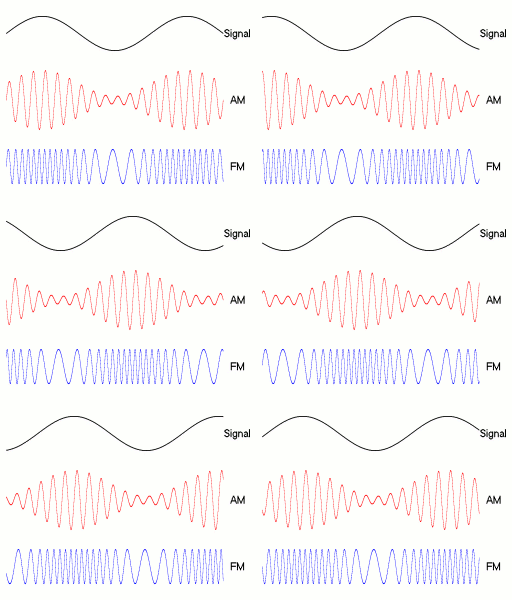
Modulating Signal – Amplitude Modulation – Frequency Modulation

The simplest form of modulation is amplitude modulation or AM. In amplitude modulation, we alter the carrier frequency’s amplitude over time. The rate at which we modulate the carrier’s amplitude is determined by the audio frequency. The amplitude deviation of the carrier frequency is determined by the audio signal’s amplitude.

In frequency modulation, or FM, we alter the carrier frequency with the amplitude of the audio signal. The rate at which we alter the carrier signal is determined by the frequency of the audio signal.

In order for the receiving end to hear the operator, on a communications channel, his equipment needs to exactly duplicate the transmitters voice in his or her headset. Because the transmitter’s voice is encoded in the modulated carrier frequency, the receiving end can detect the transmitter’s amplitude and frequency so it can exactly duplicate what was
said, processes called demodulation. Any modulation or encoding involves the changing of a carrier frequency over time.

A 1 sec. sample of the signal generates a 64,000 bit per second data stream. Each sample point is described using an 8 bit word.

In the digital domain, we sample the audio signal 8000 times per second. Each point in the sample is described by an 8 bit binary word producing a continuous binary stream of 64,000 bits per second. Silence is also sampled which creates one of many opportunities for compression techniques.
Although the digital domain will never precisely duplicate an analog voice signal, it does create an opportunity for compression and coding techniques previously unavailable. More importantly, the digital bit stream can now be processed by a computer and can be routed using TCP/IP.

In my next JTRS post I will expand on these digital techniques but remember that the objective remains the same and that is to alter the carrier frequency so that we encode or embed the desired information.

Video Simulations of Carrier Modulation:

Posted in Comms | Tagged , | 4 Comments

HORUS HDMR™ H58 Military Promotion

Horus Vision of San Bruno, CA is extending special and limited time promotional pricing on their new HDMR™ rifle scope with the H58 reticle. The HDMR is a joint offering with Bushnell Outdoor Products.

The HDMR™ is delivered with a 34mm tube made from hammer forged T6061 aluminum. The large tube allows improved light transmission and a whopping 26 mils of elevation, 5 mils per rotation in 1/10 th mil increments. The HDMR™ is Argon filled, 100% waterproof and shock proof. The HDMR™ is multi-caliber across a wide range of platforms.

This scope ships with the H58 reticle, specifically designed for the tactical market where speed and accuracy are essential.

The HDMR™ H58 should prove to be an excellent optic at a great price point.

HORUS Vision HDMR H58 3.5 - 21 x 50

H58 reticle pattern

The HDMR™ H58 Riflescope is currently available for military personnel
only, and a US Military ID must be provided to purchase.

Promotional Pricing = $849

All orders are direct through Horus Vision (650) 588-8862

Posted in Optics | Tagged , , | 2 Comments

Things To Come…

A few months ago I talked about doing some work on JTRS and the netcentric concept. I became interested in the subject because I am an X-ELINT type and want to gain a better than casual understanding of the technology. More importantly, understanding the structural fabric that will bring a variety of data streams to bear on the battlefield. Will it enhance C2 or overload the command. Will additional applications need to be layered on top of data management tools, and will those layers increase the exposure to cyber countermeasures? These are some of the questions that I will attempt to address or at a bare minimum broach.

I’ve been giving some thought on how to kick this off without getting into an engineering treatise, but in order to help the reader with the concepts underlying codecs and pulse coded modulation it’s necessary that I introduce some of the basic modulation schemes like AM, FM and FSK (Frequency-Shift Keying). I think it will go a long way to provide some clarity on why spectrum availability will be an ongoing concern.

FOG HORN’s axiom: Like disk drive capacity all available spectrum will be consumed, principally because we lack the discipline to manage it properly.

Look for my first post on JTRS in April.

I’m also working on a very detailed review of HORUS ATrag-MX, which is simply outstanding, and that will be completed in April as well.

Posted in Comms, Electronics, Uncategorized, Weapon systems | Tagged , | Comments Off on Things To Come…

FOG HORN Top n Reasons where n=10 Why You Should Give Up Sushi.

10.    The yellow tail in your tuna is plutonium.

 9.    Benihana’s wise guy with the knife is wearing a canary suit.

 8.    Ginzu is now selling Geiger Counters.

 7.    Sushi houses got rid of table candles. They let the sashimi handle mood lighting.

 5.    Prime Minister Taro is really pissed that his aburage is crackling.

 4.    Japanese tako now has more than eight legs.

 3.    Sea urchin is no longer available with spines.

 2.    The only Sake you’ll get is in a bottle.

 1.    You don’t want to deal with impetigo a second time in your life.

Posted in Morale Builders | Tagged | Comments Off on FOG HORN Top n Reasons where n=10 Why You Should Give Up Sushi.

New Fiber Technology Could Improve Body Armor Ballistic Performance.

Military body armor consists of layers of fabrics woven from Kevlar (DuPont) or Twaron (Teijin Aramid) with pockets for multistrike ceramic or metal plates. The layered fabric is highly effective against pistol calibers and the plates provide ballistic protection for the higher energy rifle rounds. On impact, the layered fabric  absorbs the projectiles kinetic energy and spreads it out over a large area; eventually stopping the round. The degree to which the fibers in the fabric remain intact determines how effective the soft armor will be.

Researchers are now looking to carbon nanotubes, which can be woven into Kevlar or Twaron to deliver the next generation of ballistic protection. Carbon nanotubes exhibit exceptional elasticity and a superb resistance to strain.

Apparently, these atomic level structures are so strong that when woven into a polymer ballistic tile are capable of deforming or fragmenting a projectile on impact. If further development and experimentation proves this claim out, carbon nanotubes could be just what the doctor ordered to make body armour more effective and substantially lighter.

Additional details are available from The Center for Knowledge Management of Nanoscience and Technology  at Secunderabad, India.

Posted in Uncategorized | Tagged | Comments Off on New Fiber Technology Could Improve Body Armor Ballistic Performance.

Sphinx Pistols To Be Distrubited Through KRISS USA.

In November 9, 2010, KRISS Arms, manufacturer of the highly acclaimed KRISS Super V System (KSVS) and  the KRISS Vector SMG announced its acquisition of Sphinx Systems Ltd. and its only a matter of time before KRISS Arms began U.S. distribution. This is part of their lineup with more to come as the two companies begin joint development efforts.

Additional details can be obtained directly from:

KRISS USA

PO Box 8928
Virginia Beach, VA 23450
USA

(757) 821-1089

http://www.kriss-tdi.com/

Posted in Uncategorized | Comments Off on Sphinx Pistols To Be Distrubited Through KRISS USA.

Maj. Elliott Caggins and Bob Galeazzi from PEO_Soldier_Weapons Address M24 Enhancements.

Sean Pillai with IDGA.org  interviews Maj. Elliott Caggins and Bob Galeazzi.

Nothing of an earth shattering nature; however, it does provide a clearer snapshot of the deployment dates. It was interesting to see that the Army may be transitioning from the mildot to a reticle pattern that uses ranging stadia. The mildot is considerably slower to use and error prone.

It’s a good interview so check it out.

Posted in Weapon systems | Tagged , , | Comments Off on Maj. Elliott Caggins and Bob Galeazzi from PEO_Soldier_Weapons Address M24 Enhancements.