
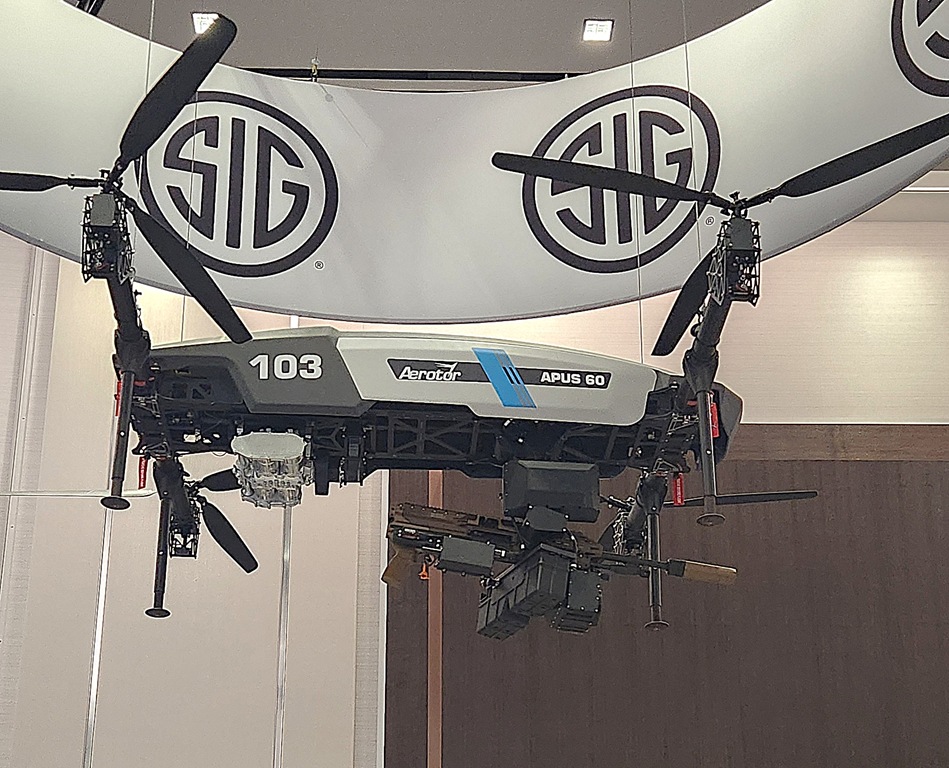
The Fire Storm 250
In the rapidly evolving landscape of unmanned warfare, the collaboration between Israeli aerospace innovator Aerotor Unmanned Systems, Israel Aerospace Industries (IAI), and US firearms giant SIG Sauer has produced a groundbreaking platform: the Fire Storm 250.
At the heart of this system is the Apus 60 (often referenced within the broader Apus family, including the Apus 25 tactical variant), a high-endurance quadcopter that bridges the gap between small, battery-limited drones and heavy, manned helicopters.
The Platform: Aerotor Apus Family
The Apus series is designed to overcome the “battery wall” that plagues traditional quadcopters. While typical electric drones struggle to stay airborne for more than 40 minutes, the Apus utilizes a Central Steering System (CSS) and a heavy-fuel engine to achieve helicopter-like persistence.
Key Technical Specifications
-
Propulsion: A centrally located Internal Combustion Engine (ICE) running at a fixed RPM. It supports heavy fuels like JP-5, JP-8, Jet A1, and standard gasoline.
-
Steering Mechanism: Unlike standard drones that change motor speeds to steer, the Apus uses a variable-pitch mechanism (similar to a helicopter’s rotor) to control lift and movement.
-
Endurance: Capable of staying on station for up to 3 to 9 hours depending on the specific model (Apus 25 vs. Apus 60) and payload weight.
-
Operational Ceiling: Up to 14,000 feet, making it nearly silent to ground observers once it exceeds 1,000 feet in altitude.
The Partnership: SIG Sauer & IAI
In early 2026, SIG Sauer officially joined IAI’s armed quadcopter program. This partnership transforms the Apus from a reconnaissance tool into a precision-strike loitering platform known as the Fire Storm 250.
SIG Sauer’s Contribution: The Airborne Machine Gun
SIG Sauer has integrated its M250 Light Machine Gun (LMG)—the lightweight belt-fed weapon selected for the U.S. Army’s Next Generation Squad Weapon (NGSW) program—onto the drone.
-
Micro-RCWS: The weapon is mounted on a proprietary Micro Remote-Controlled Weapon System. This mount is gyrostabilized to compensate for the drone’s movement and the weapon’s recoil.
-
Ammunition: The system typically carries 200 rounds of either 7.62x51mm NATO or the high-pressure 6.8x51mm (.277 SIG Fury) ammunition.
-
Precision Optics: The drone utilizes a SIG-developed electro-optical system with 10x optical zoom and 5x infrared zoom, allowing for target detection at ranges up to 25 kilometers.
Tactical Role and Capabilities
The Fire Storm 250 is not designed for “kamikaze” missions. Instead, it is a reusable asset intended for Persistent Close Air Support (PCAS).
-
Loitering Capability: Because it can stay airborne for hours, it can provide “overwatch” for a moving convoy or a forward operating base (FOB), ready to engage threats immediately.
-
Urban Warfare: Its VTOL (Vertical Take-Off and Landing) nature allows it to operate from narrow streets or rooftops, providing a “sniper in the sky” capability that is difficult for enemies to track.
-
Recoil Management: Demonstration videos have shown the Apus platform firing rapid semi-automatic or burst fire with minimal “drift,” thanks to the CSS which makes micro-adjustments to the rotor pitch in real-time to counteract the gun’s kick.
Why This Matters
This collaboration represents a shift in military doctrine. Traditionally, small units had to call in expensive jets or vulnerable helicopters for air support. The Aerotor/SIG Sauer/IAI partnership puts that same lethality directly into the hands of ground commanders.
By combining long-endurance fuel propulsion with battle-proven small arms, the Fire Storm 250 provides a level of persistent lethality that battery-powered drones simply cannot match.
To understand its value, it’s best to compare it against the dominant “Group 3” VTOL competitors used by modern militaries in 2026, such as the AeroVironment JUMP 20 and the Shield AI V-BAT.

 FOG HORN