
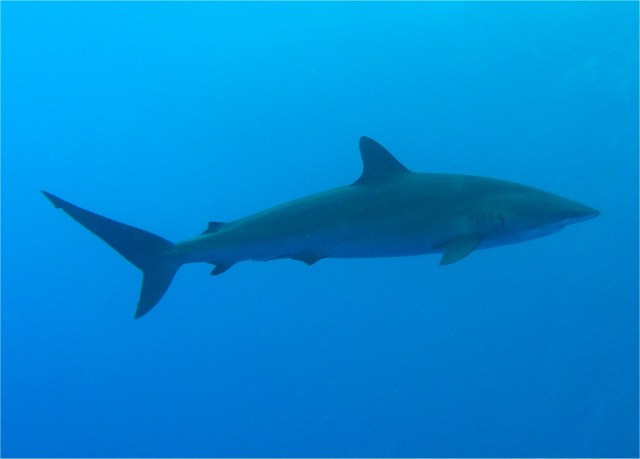
We’re going to kick off this weekend with a shark attack shoot-the-shit . As with all shoot-the-shit discussions, you can make unsupported comments, insult anyone you please, use profanity (even at a boatswain mate level) without feeling that you’ll be censored. Furthermore, because we believe that philosophers, psychologists and psychiatrist are living proof that free market economies produce sufficient surpluses to support what would otherwise be considered useless, you will never see a bill from this publication. So, let’s talk sharks…
A shark, of virtually any species, is nothing more than an ambulatory abdominal with serrated razor sharp teeth. In the overwhelming majority of conditions, you won’t find one in every cubic foot of water. They’re all carnivores, with the possible exception of the Baskin shark species. Sharks don’t have a large brain; they don’t swim around plotting an attack. Their vision is rather poor, but they have a highly refined bioelectrical sensory system concentrated around the snout and gill area. They can detect body fluids miles away from the source and they can detect vibration associated with thrashing miles away. Once stimulated by fluid and / or vibration they lack conscious control and will attack what it thinks is its pray. Prior to its attack, a membranous lid closes over the eyes to protect them from bone or other matter; it literally does not see.
If you’re a diver the chances of being attacked by a shark are lower than you being hit by space debris. Snorkelers are at a slightly greater risk for no other reason than you’re close to the surface; therefore, backlit. Snorkeler behavior may also add to that increased probably, and I’ll touch on that later in my article. The overwhelming majority of shark attacks are close to shore in warm water of considerable turbidity and highly oxygenated from surf and/or tidal activity.
To avoid or survive a shark attack you need to identify conditions, behavior and control your actions. So, let’s talk about that.
If you ever find yourself in travel brochure like waters, with pristine white sand ocean floors and crystalline aquarium like water, live it up. You may see an occasional sardine but that’s about it. These waters indicate a barren ecosystem absent of any flora to serve as a nutritional source. No nutrients, no herbivores; thereby, no carnivores. It’s only when you get out to the outer reefs where you get plant life and ecosystems that support a food chain. In fact if you see a shark within an inner reef it’s likely the shark was caught in tidal activity and is waiting for a high tide to get out of Dodge.
Turbidity in ocean water comes from surf and tidal activity as well as an abundance of plant matter much of which is microscopic in size. This is particularly true in coastal areas where you have residual fertilizer runoff. Shallow, warm water that is highly oxygenated by tidal and surf activity will give rise to plant matter. Under these conditions, smaller herbivores come close to shore for feeding; in the process attracting tier one predators. To a shark, warm and highly oxygenated water is like giving George Burns Viagra. The shark is highly stimulated – this does not translate to plotting against you!
What does a highly stimulated shark look like? Most visible to divers and snorkelers, a stimulated shark will change directions frequently, slightly arch its back and pull its pectoral fins together, and rocks its head from side to side. If you observe that behavior you have reason for concern. Swimmers, surfers and beachgoers present false targets. Here’s how that happens. Visualize yourself standing in waist deep water, with surf breaking around you and arms dangling in the water – form that image in your mind. The human leg tapers from thick to thin, just like the body of a fish; to that image add a human hand resting on the leg. It looks like the pectoral fins on a fish doesn’t it?. A shark with poor vision to begin with, who is also in stimulated condition, will hit that false target believing that it is pray.

Surfers with arms and feet dangling from the board and backlit by the sun look like seals. That’s the reason most surfer attacks come from the larger sharks.
Swimmers, particularly weak swimmers, tend to smack the water with hands and feet as they swim setting up vibrations that serve to attract a shark. In turbid warm water, that vibration could be enough to trigger the shark’s feeding posture.
So, what should you do when confronted by an aggressive shark. First, keep in mind that the shark will not eat you but a shark bite can cause you to bleed out. Remember that when a shark hits you, it is stimulated and you need to disconnect that instinct from its small brain. You need to be as aggressive as you can be. Hit the shark on the snout (repeatedly if necessary) and the gill area, what you’re trying to accomplish is replace the feeding drive with its self-preservation instinct.
Other things that beachgoers and swimmers should be aware of; don’t be in the water by yourself, for various reason; don’t swim in no light or low light conditions, like dusk or dawn; if you see someone fishing offshore on a boat and said boat is within a mile to half-mile from shore, don’t swim; if you see people shore fishing, don’t swim and if you are within 1 or 2 miles from a pier that allows fishing, don’t swim. All of these conditions can easily be solved by local ordinances and enforcement of existing ordnances.
Go to the beach, enjoy the sun, surf and sand but be safe through knowledge and awareness. Have a great 4th of July weekend!

 FOG HORN