
Critical to the SOF mission is the depth and breath of training and 80 percent of SOF’s work is non kinetic. SOF’s success revolves around its people and how well prepared they are to execute that mission.
In the training business, we use a hackneyed cliché’ that “repetition is the mother of learning.” Wether developing muscle memory or cognitive skills, frequency and intensity of training are critical to cementing the concepts, procedures and techniques in the operators mind, so that situational responses are organic and consistent. The emergence and continuing development of simulation tools improves the training experience by orders of magnitude.
Systems Technology, Inc. based in Hawthorne, Ca demonstrated this year at SOFIC their latest version of PARASIM®, its virtual reality parachute simulator. Of course, I couldn’t help but try it.
I had a jump partner from one of the SFGs to my right. We began the jump at 10,000 feet and were instructed to deploy the canopy at 5,500 feet. My partner held his free fall until 3,500 feet; I opened my chute at a little over 5,200 feet. I felt a tug and tilted my head up to make sure the chute had opened. I made a right turn and was now moving up wind, movement relative to the ground was steady but I was slightly off target. I maneuvered making a series of turns; finally turning base then final. I was on the ground!
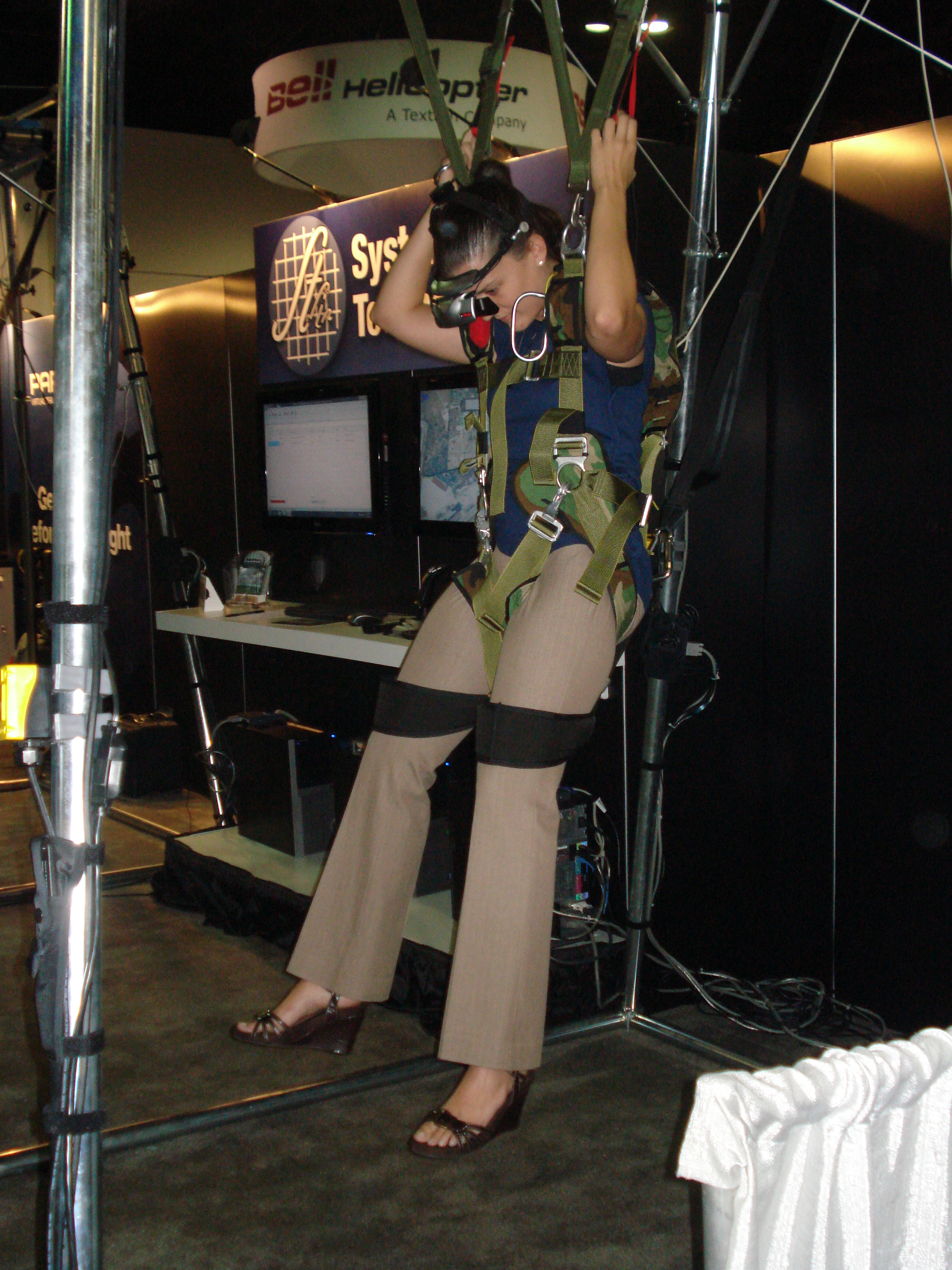
The trainee is strapped into her pack. She then slips on the goggles, which provide her with an aerial and ground view, as well as any peripheral details such as what her partner is doing.
Using the black leg straps the trainee is elevated and placed into a horizontal position in preparation for the free fall. At altitude, the free fall begins. When she reaches 5,500 feet, or any altitude stipulated, she deploys the canopy and verifies that there are no entangled suspension lines and the canopy if filled with air. The trainee then uses her brake lines to maneuver and control the fall.
Developers at Systems Technology, Inc have done an amazing job. Using PARASIM®, the trainer can simulate weather conditions, day or night, static or free fall as well as any conceivable emergency situation a trainee could encounter. Simulation, no matter how well implemented can never replace the actual event, but this is as close as you get given current technology. The only thing missing is the wind in your face.
The benefits are quite obvious: more frequent and flexible training, safer training environment and significant cost savings. Check it out!

 FOG HORN