
In Part 2 of my “Suppressors – Current State of Technology” I covered subsonic ammunition, its common application and the requirements it places on both the operator and platform. I mentioned that due to its low-speed and weight, subsonic ammunition requires a relatively fast twist of 1:10 for a 7.62×51 caliber. Suppressors also require a precise alignment between the bore’s centerline and the suppressors centerline. Meaning that the bore and suppressor must be completely concentric. A failure to achieve concentricity will significantly degrade performance and in extreme cases can cause injury from baffle strikes. This YouTube video of a baffle strike should drive home my point. Watch the suppressor as the individual fires the rifle.
It’s the mounting system, that ensures concentricity and securely holds the suppressor in place. It is critically important to the successful implementation of a suppressor.
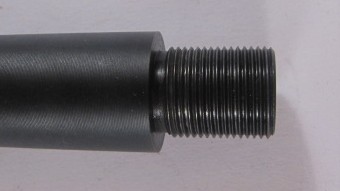
Threaded Barrel - Single Point Mount.
Broadly speaking, suppressor mounts fall in one of two categories, single point or two point mounts.
When we use a single point mount we screw (or quick attach) the suppressor directly to the muzzle or use a purpose-built mount – for quick attach/detach support.
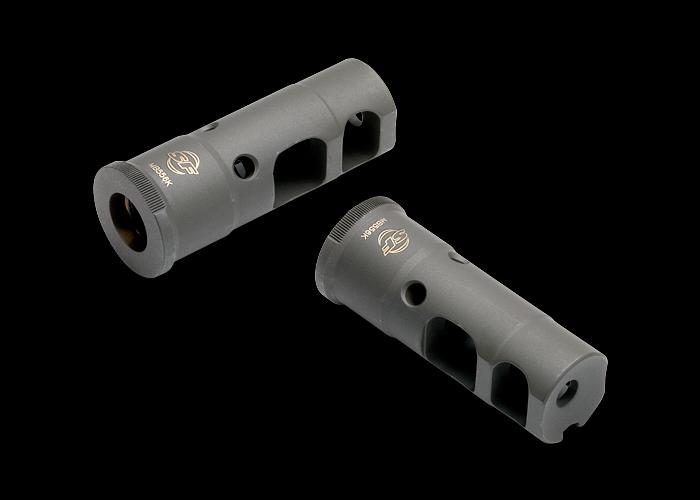
- Surefire’s MB556K serves both as a muzzle brake and a suppressor quick attach/detach mount.
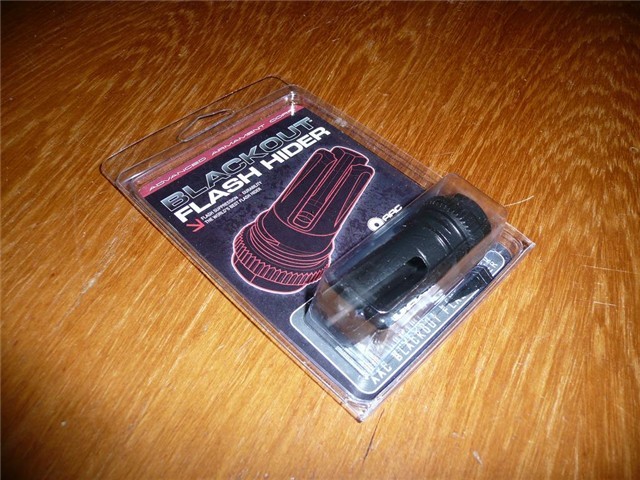
Made by Advanced Armament Company - Note the ACME thread pattern just forward of the notched spring mount. This particular mount functions as a flash hider and a suppressor quick attach/detach mount.

Two point mounts are considered to be self aligning.
A two point mount aligns to the barrel using muzzle threads and a bushing that’s fitted to the barrel such that the suppressor slips over the barrel.
The distinct advantages of the two-point mount is that it is self aligning, it provides a massive expansion chamber and it extends only a few inches past the weapon’s muzzle. If the weapon receives a hard smack at the muzzle, the suppressor is more likely to retain its alignment to the bore.
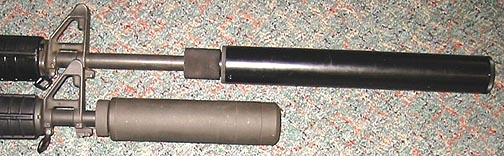
Single Point Mount (top) v. Two Point Mount (overall weapon length comparison)
Its disadvantage is that it will form condensation more readily, due to its larger expansion chamber, and can not be quickly removed or attached because it has to be screwed on to the muzzle and/or a secondary mounting collar.
One example of a two point system currently used by the U.S. Army is the Knight’s Armament Company M110 SASS. The system uses a thin suppressor that slips over the barrel and locks against the A2 bird-cage and to a collar downstream from the muzzle.

Suppressed M110
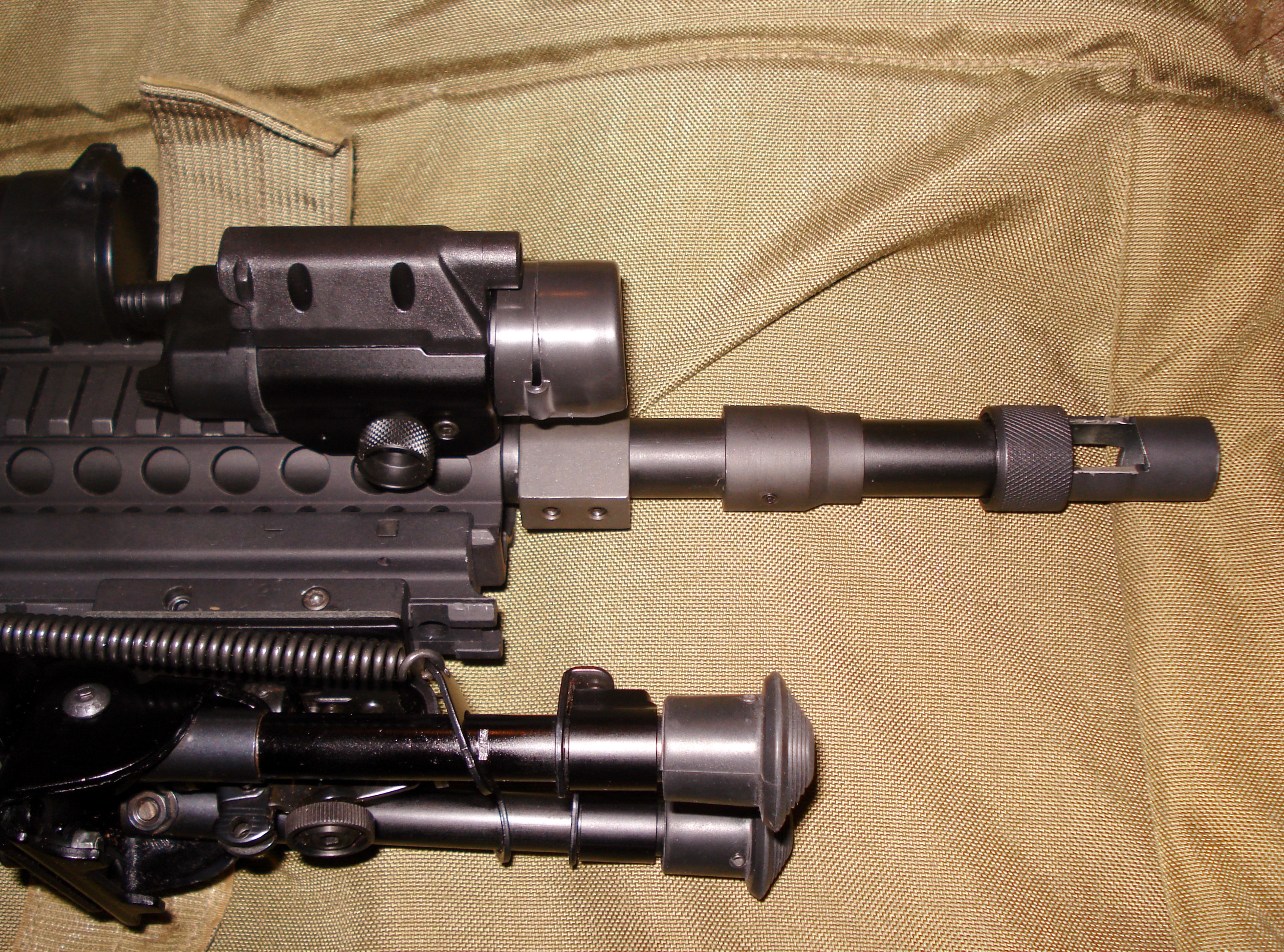
Illustration of two point mounting arrangement. Note the collar behind the muzzle. The suppressor slips over and threads on to the muzzle device while the collar or bushing supports the suppressor at the second point. This arrangement is self-aligning and makes concentricity achievable without matching suppressor and barrel thread patterns.
Your choice on the mount type is ultimately driven by operational requirements; however, whatever mounting arrangement you select it must secure the suppressor so that it is mechanically concentric with the rifle or pistol bore. My personal preference is the two point mount because of its self-aligning and its resistance to shocks or impacts. There are a number of excellent quick attach / detach mounts on the market; however, as part of your testing criteria be sure to expose the mount and suppressor to shock and confirm concentricity before you make your decision.
In Part 4 I’ll conclude the “background” segment with a discussion of the unique aspects of pistol caliber suppressor.

 FOG HORN
Pingback: Suppressors – Current State of Technology Part 4 | FOG HORN